
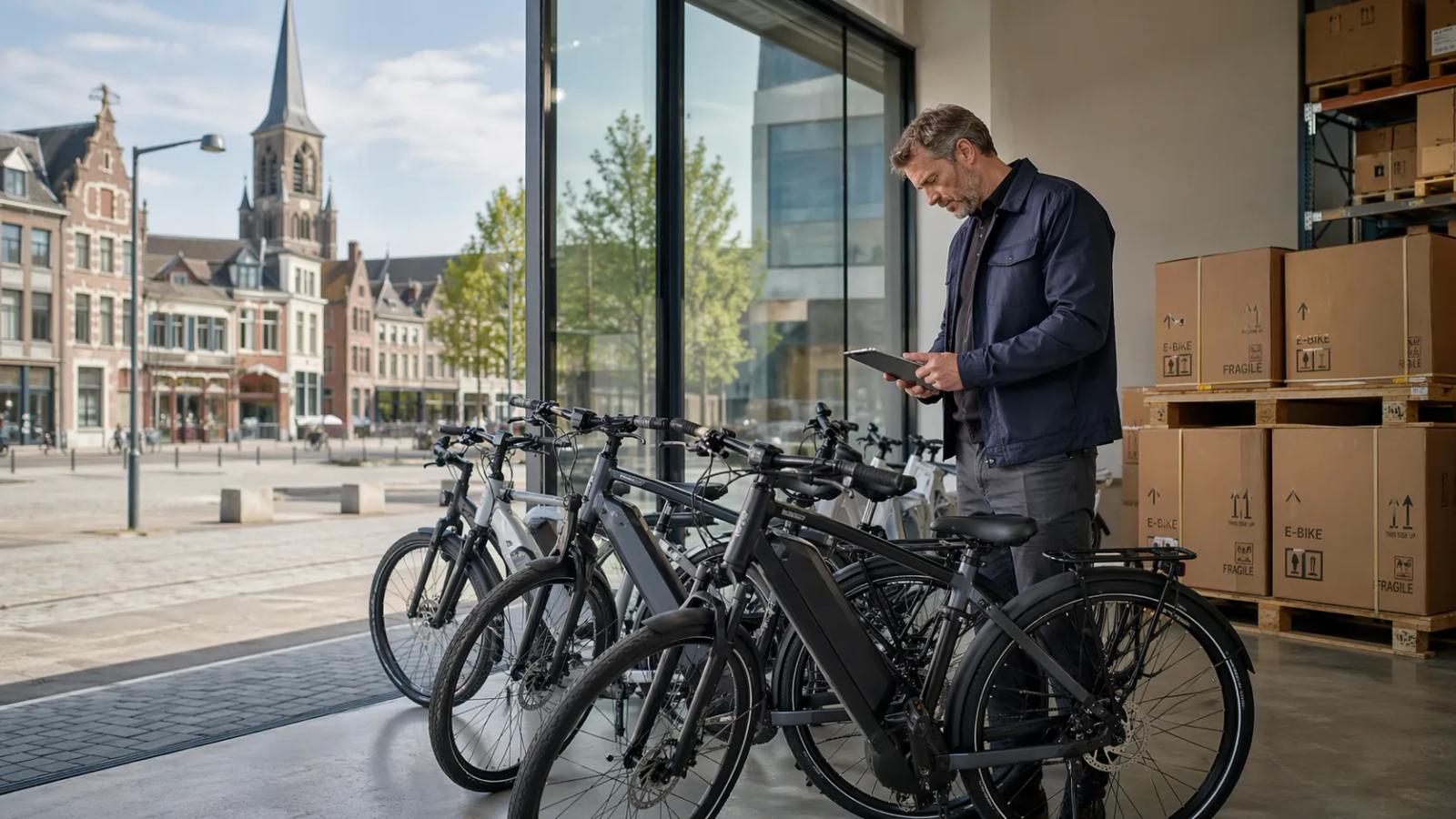
Europe E-Bike Market 2026: Anti-Dumping Strategy, Bonded Warehousing & B2B Sourcing Playbook
EU e-bike imports reached 223,000 units in Q2 2024. But the real story is in the price dynamics—and what that means for distributors.
EU e-bike imports reached 223,000 units in Q2 2024. But the real story is in the price dynamics—and what that means for distributors.
Navigating European E-Bike Importation: Anti-Dumping Duties, SKD/CKD Rules of Origin & EN 15194 Compliance
Factory Direct Sourcing & OEM/ODM Manufacturing with ClipClop
Commercial partners can inspect our manufacturing infrastructure on our OEM/ODM E-Bike Manufacturing Facility page, review standard configurations on our CS01 Fat Tire & CS04 Commercial Utility Platforms, or directly request volume FOB terms via our Commercial Quote Request Portal (MOQ 20).
European e-bike importation is strictly regulated under European Commission anti-dumping duties (AD643) and countervailing measures, imposing tariffs ranging from 18.8% to 79.3% on complete bicycle imports from specific territories. For distributors across Germany, France, the Netherlands, and Scandinavia, sustainable commercial margins require moving away from conventional finished-bike (CBU) imports toward compliant Semi-Knocked Down (SKD) and Completely Knocked Down (CKD) manufacturing frameworks.
ClipClop supports European brand owners and wholesale importers through tailored supply-chain models: tariff-optimized SKD container packing, complete CE and EN 15194:2017+A1:2023 technical dossier issuance, and bonded logistics staging. By delivering certified painted frame assemblies and matched powertrain kits, we enable European partners to achieve compliant localized final assembly while slashing import duty burdens and accelerating inventory turnaround.
| Import Framework | Applicable EU Duty | Assembly Requirement | Lead Time to Market | ClipClop Supply Model |
|---|---|---|---|---|
| SKD Component Kits | Optimized Parts Tariff (4.7%) | Localized Final Assembly in EU | 30–45 Days Container Delivery | Frame + Powertrain Matched Packs |
| Complete Bicycle (CBU) | Standard Duty + Anti-Dumping (up to 79.3%) | Zero (Ready to Ride) | 60–75 Days Shipping | High Tariff Exposure for EU Brands |
| Bonded Warehouse Stocking | Deferred Duty Upon Clearance | Turnkey Local Dispatch | 3–5 Days Dispatch in EU | European Buffer Inventory Program |
In Germany—Europe's largest single national market—e-bike sales totaled approximately 2 million units in 2025, a modest decline of 4.8% from 2024, according to ZIV (Die Fahrradindustrie) data. On the surface, demand did not collapse. But the financial picture tells a harder story: total German bicycle and e-bike sales revenue fell 7.7% year-on-year, driven by both lower unit volumes and a reduction in average selling price. The e-bike average selling price in Germany moved from €2,650 in 2024 to €2,550 in 2025. That €100 shift matters for buyers setting channel pricing expectations, because it suggests the pressure on manufacturer and distributor margins was not limited to the clearance phase—it persisted into what should have been a stabilization period.
The conclusion entering 2026 is straightforward but important: the market is not in a strong recovery. It is in a phase where volume has found a lower floor, and pricing remains under pressure despite the inventory correction narrative. Buyers who assume a clean return to pre-2023 pricing conditions are likely working with the wrong model.
What Q1 2026 Is Already Signaling
Q1 2026 is where the story becomes most relevant for current buyers, because the monthly company data released so far this year is more current than any headline import statistic. And the signal it sends is decidedly mixed.
Giant Group's official disclosures for 2025 provide one anchor point. The company's OEM business—serving other brands that resell under their own names—grew as a share of total revenue, rising from 26% to 33% in 2025. More importantly, Giant's management stated publicly that OEM customer inventory adjustments were approaching completion. That is a meaningful signal: the destocking that has suppressed order flow for more than a year may finally be working its way through the channel.
But the monthly revenue data for early 2026 complicates that picture. Giant's revenue in January 2026 declined 21.6% year-on-year; February declined 40.0%; March declined 17.0%. These are not the numbers of a market in healthy recovery. Even if inventory adjustment is technically complete, the demand side has not responded accordingly. Sell-through from dealers to end consumers appears to remain subdued, which means reordering has not accelerated to the degree that would signal a clean recovery.
Merida's data points in the same direction from a different angle. The company's full-year 2025 revenue declined 9.7% year-on-year, and Bike Europe reporting in March 2026 noted that early 2026 pressure at Merida reflected wider market conditions rather than company-specific problems. When two of the three largest e-bike manufacturers by volume are both reporting continued revenue contraction in early 2026, the honest reading is that the inventory cycle has moved past its worst phase, but demand has not yet re-engaged at the pace a true recovery would require.
One commercially significant detail from the Giant data is the rising OEM share itself. As own-brand sales remain under pressure, more of Giant's revenue is coming from serving other brands—that is, from the OEM channel that ClipClop's buyers are themselves operating in. This suggests OEM demand may be stabilizing from the supply side even as retail demand remains soft. For buyers evaluating whether to place orders now or wait, that distinction matters: the floor may be closer for OEM flow than for consumer-facing brand activity.
Background: What Q2 2024 Revealed During the Inventory Reset
Q2 2024 still matters because it marked a visible turning point in import behavior, but 2025 and early 2026 show that the turn was toward stabilization, not a clean return to pricing power.
In Q2 2024, EU e-bike imports reached 223,000 units, up from 125,000 in Q1—a sharp sequential rebound that looked, at the time, like the beginning of a recovery. Import value rose as well, but not proportionally: volume grew 78% quarter-over-quarter while value grew only 52%. That gap between volume and value was the first signal that the rebound was being driven in part by lower-priced shipments rather than by broad pricing strength. Taiwan-origin average unit prices fell from €1,625 in Q1 to €877 by June 2024, a decline of 46% in a single quarter—a pattern consistent with aggressive inventory clearing rather than sustainable pricing.
The subsequent data from 2025 and Q1 2026 validates that reading. EU full-year 2025 imports were still below 2023 levels. Giant's own-brand revenue remained under pressure even as it reported OEM stabilization. Merida's 2025 revenue fell. If Q2 2024 had truly signaled a new growth phase, those outcomes would not be consistent with the trajectory we are now observing. The more accurate reading—and the one that holds up against subsequent data—is that Q2 2024 was a restocking bounce in a correction that was still in progress, not a clean recovery (for more on EU sourcing context, see our 2026 Ghana e-bike sourcing guide).
Buyers who read Q2 2024 as a green light and ordered aggressively into that bounce would, in most cases, have found themselves holding elevated inventory at prices that were still adjusting downward through 2025. That is the specific risk this background is meant to illustrate—and to help buyers avoid repeating.
What Buyers Should Do in 2026
The practical question for 2026 is not whether the market has recovered—it has not—but how to make good sourcing decisions within a correction that may be closer to its end than its beginning. Three specific shifts in approach are supported by the data described above.
1. Do not mistake OEM stabilization for retail pricing recovery. Giant's management says OEM inventory adjustment is nearly complete, and the rising OEM revenue share at Giant confirms the OEM channel is reordering. But the monthly revenue declines show that end-demand has not followed suit. Buyers should treat these as two separate signals: the supply side is stabilizing, but the retail channel is not yet generating the pull that would justify aggressive volume increases.
2. Reassess landed cost assumptions against 2025 price reality, not 2024 peaks. German e-bike average selling prices fell from €2,650 to €2,550. If buyers are setting channel pricing or negotiating new OEM terms based on a 2023–2024 reference point, they are likely building in margins that the market will not support. EU full-year 2025 import volumes also confirm the market did not experience a meaningful demand-led price correction—it was volume stabilization under continued pricing pressure. Reorder decisions should be evaluated against current market conditions, not the expectation of a quick return to earlier pricing norms.
3. Break down procurement signals by channel, not just aggregate volume. Import volume, brand revenue, and dealer sell-through data can tell different stories at the same time. The most useful framework for 2026 is to track three indicators separately: OEM order flow (for supply-side timing), dealer inventory and markdown intensity (for channel health), and country-level retail pricing (for market-specific positioning). Acting on aggregated headline data without separating these layers is what leads to the ordering mistakes that followed Q2 2024.
Frequently Asked Questions
Q: What does Q1 2026 suggest about Europe's e-bike pricing environment?
The monthly company data from Giant and Merida, combined with German retail pricing trends, points to a market where pricing pressure has not fully resolved even as the inventory correction phase is technically complete. For buyers, this means pricing conditions are more favorable than they were at peak 2023–2024 levels, but not yet healthy enough to support the margin expansion that would accompany a genuine demand-led recovery. The practical implication is that buyers who can act on selective opportunities—particularly in the OEM channel where stabilization is most visible (see also our Cambodia e-bike export analysis for current supplier dynamics)—may find better entry points now than they will once demand actually re-engages.
Q: Has the inventory reset actually ended for OEM buyers?
The most current evidence is that the inventory reset is approaching completion on the supply side but has not yet translated into improved demand conditions at retail. Giant's management explicitly stated OEM customer inventory adjustment is nearly done, which is a meaningful signal for buyers sourcing through OEM arrangements. But the continued revenue declines in early 2026 mean buyers should not assume the channel is now healthy—they should evaluate reorder timing based on their own inventory positions and channel feedback, not on the narrative of a completed correction.
Q: Why can OEM stabilization coexist with weak own-brand performance?
OEM stabilization and own-brand weakness can coexist because they operate at different points in the supply chain and reflect different competitive dynamics. When Giant's OEM business grows as a share of total revenue, it means the company is generating more of its income from serving other brands than from its own retail brand. This can happen while own-brand revenue declines if the own-brand business faces more direct retail competition and pricing pressure. For buyers, this pattern is significant: it means OEM relationships may offer more stable demand signals than own-brand channels, even when both are under the same manufacturer's umbrella.
Q: Which indicators matter more than import volume in 2026?
Three indicators are more useful than aggregate import volume in 2026: monthly manufacturer revenue (Giant publishes this monthly and it is publicly available), dealer sell-through and inventory reports from brand-level disclosures, and country-level average selling price data where available. Import volume tells you how much entered the channel; these three indicators tell you whether the channel is actually moving that inventory through to end consumers.
Sources and Methodology
This article uses publicly available import and market reporting through Eurostat-based industry coverage, company financial disclosures, and national market data releases as of Q1 2026. Key sources include Bike Europe reporting on EU e-bike import totals for 2025; ZIV (Die Fahrradindustrie) market data for Germany 2025; Giant Group financial disclosures including 2025 annual results and 2026 monthly revenue data; and Merida industry coverage through Bike Europe, March 2026. All company-level figures are sourced from public disclosures or verified industry reporting. Where interpretations are made, they are clearly labeled as such.
ClipClop Manufacturing Standards & Build Quality
See our best-selling European commuter and urban cargo platforms: ClipClop C1 Step-Through Commuter and our ClipClop CS04 Long-Tail Cargo Bike, meeting all current European standards.
About the Author
the ClipClop Engineering Team is involved in international e-bike sourcing and B2B market communication at Guangzhou Clipclop Technology Co. Ltd. He writes about supplier evaluation, export-market demand, and product positioning for overseas buyers.
Commercial Procurement & Fleet Sourcing with ClipClop
Deploying electric bicycle fleets or distributing private-label e-bikes requires a trusted manufacturing partner capable of consistent container-level production, robot-welded frame alignment, and rigorous batch QC. From our 25,000 m² factory in Qingyuan, Guangdong, ClipClop provides end-to-end OEM/ODM electric bike manufacturing services with an accessible MOQ of just 20 units per SKU. Every container order includes dedicated spare parts allocation (2% free warranty backup components), full international compliance documentation (EN 15194, UL 2849, UN38.3), and 15-day sample dispatch.
Ready to evaluate engineering samples for the CS01 Fat Tire & CS04 Commercial Utility Platforms or review container FOB volume pricing? Visit our Commercial RFQ Portal to submit your technical specifications, or speak directly with our engineering sales team via our B2B contact desk.
More OEM field notes.
E-Bike Frame Sourcing for Brazil: Corrosion-Resistant 6061-T6 Aluminum for Tropical Fleets
Tropicalized Heavy-Duty E-Bikes for Brazil: Reinforced Frames & 2.4"+ Tires for Fleets

NYC Commercial Delivery E-Bikes: UL 2849 Compliance, Heavy Cargo & Fleet Specifications
Send your brief. We will field-note back.
Reply includes the feasibility view, sample cost, MOQ, and the next step for your project. We aim to respond within 48 hours.