


Hej, jeg er Leo Liang. Jeg arbejder med ClipClop-crewet i Guangzhou, og helt ærligt, min hjerne bor i off-road elcykler de fleste dage. Det er ikke bare “byg en cykel, send en cykel”. Det er mere som: hjælpe distributører, udlejere og brands med at undgå de dumme fejl, jeg allerede har set ske i virkeligheden.
En ting jeg gentager til partnere: én komponentvalg kan ødelægge hele din markedsindtræden. F.eks. kan du have et rent ramme, god lak, endda god emballage, og stadig miste penge fordi én del ikke passer til kunden eller de lokale regler. Og ja, motorvalget er den største kamp hver gang.
Også for EU-import (Polen kommer ofte op), er det ikke bare “hvilken motor er stærkere”. Det er om compliance, kørefølelse, garanti-rate, service-hovedpine og marginer. En spec-ark vil ikke advare dig om returneringer på grund af svak bakkekørsel, eller smerten ved en container, som told behandler som mopeder i stedet for cykler. Det er den slags overraskelse ingen ønsker.
Denne guide er i bund og grund hvad jeg fortæller B2B-klienter på opkald, når de vælger fra tusindvis af kilometer væk. Jeg springer consumer-hype snakken over og holder mig til hvad der rammer din forretning: juridisk risiko, landed cost, reel ydeevne og brand omdømme. Jeg vil stadig tale tech, men altid med “vil dette sælge og overleve?”-linsen.
Før Vi Taler Tech, Lad os Tale Compliance: Er Det en Elcykel eller et Motorkøretøj i Europa?
Hvis du kun husker én ting fra denne artikel, lad det være denne: bestem den juridiske kategori først, før du forelsker dig i en motor. I EU (og lande som Polen), er grænsen klar, og at krydse den ved en fejl kan forvandle dit “lager” til “usælgelige problemer”. Jeg har set købere sidde fast fordi de antog “det er en elcykel, så det er fint.”
For massemarktet, er du normalt ude efter EPAC (Elektrisk Power Assistet Cycle), knyttet til EN 15194. Det er rammeverket du skal indbake i sourcing, ikke tilføje senere som en lappet. Jeg siger altid til folk: behandl EPAC-regler som et produktkrav, ikke som papirarbejde.
De kerne-EPAC-regler er ret strenge: kontinuerligt nomineret effekt på eller under 250W, assist kun når du træder, og stop ved 25 km/t. Og throttle-situations betyder meget—ingen throttle-only tilstand der kører cyklen uden at træde. Hvis du følger disse regler, forbliver cyklen “cykel” juridisk: ingen registrering, ingen forsikringskrav, og cykelforadgang mange steder. Det er den gyldne vej.
Men så snart specs kryber op—500W, 750W, assist over 25 km/t, eller en throttle—forlader din cykel normalt EPAC-landet. Så er du ude efter L-kategori-regler (ofte diskuteret sammen med Forordning (EU) 168/2013), som er en anden verden: typegodkendelse, overensstemmelseskontrol og mange flere dokumenter. Det er her importører brænder, fordi forsyningskædeplanen ændrer sig helt.
Så du skal vælge en strategi forhånds. Importerer du EPAC-kompatible e-MTBs til offentlige veje og bred detaljhandel? Eller sourcer du højere-effekt “kun off-road” maskiner der skal markedsføres med meget klare “privat landbrug”-ansvarsfraskrivelser? Jeg har set bloggere sige “mærk det hårdt, vær ikke vagt”, og jeg er enig—skriv det, print det, gentag det, og få dine forhandlere til at gentage det også.
Hvorfor Foretrækker Premium E-MTBs Mid-Drive Motorer?
Når dine.
A mid-drive sits at the bottom bracket and pushes power through the crankset. That placement sounds simple, but it creates big performance differences off-road. You’ll hear people say “mid-drive climbs better,” and yeah, that’s true, but the reason matters for how you position the product.
First advantage: gearing. A mid-drive uses the drivetrain (chain, cassette, derailleur), so riders can shift to keep the motor in a good RPM range. On steep climbs, dropping into a lower gear multiplies torque at the rear wheel. That’s why a 250W mid-drive with, say, 85 Nm can often out-climb a 500W hub motor on rough terrain. It’s not magic—just smarter power use.
Second advantage: handling. A mid-drive keeps weight low and centered, so the bike feels more stable and less “pulled backward” by the rear wheel. On corners and descents, this is a big deal, not a tiny detail. I’ve heard some riding YouTubers say “center weight wins confidence,” and that matches what we see in customer feedback too.
And there’s also the wheel weight factor. With mid-drive, wheels stay lighter, which reduces unsprung mass. That helps suspension react faster over bumps, roots, and rocks, so traction improves. For premium customers, this “refined feel” is kind of non-negotiable. If your brand wants to play in the high-end segment, you basically need to understand this story and sell it clearly.
Are Hub Motors a Viable Choice for Off-Road Biking?
Mid-drive is king at the top, but hub motors are not some “bad choice.” I’d actually say hub motors are a smart business tool in the right segment. For many B2B use cases—rental fleets, entry-level buyers, and cost-sensitive markets—a good hub motor setup is reliable, simple, and easier on your service budget.
Hub motors sit in the wheel hub (usually rear for off-road). In this space you’ll mostly see geared hub motors, not direct-drive. Geared hubs use internal planetary gears, so they’re smaller and can still produce decent climbing torque versus direct-drive styles. They’re not perfect, but they’re practical.
The big win for business: lower mechanical complexity and less drivetrain wear. Because a hub motor doesn’t push power through the chain and cassette the same way mid-drive does, you often see less damage to chains, cassettes, and chainrings. For rental fleets, this matters a lot—less downtime, fewer repairs, fewer angry customers who “shifted wrong and snapped something.”
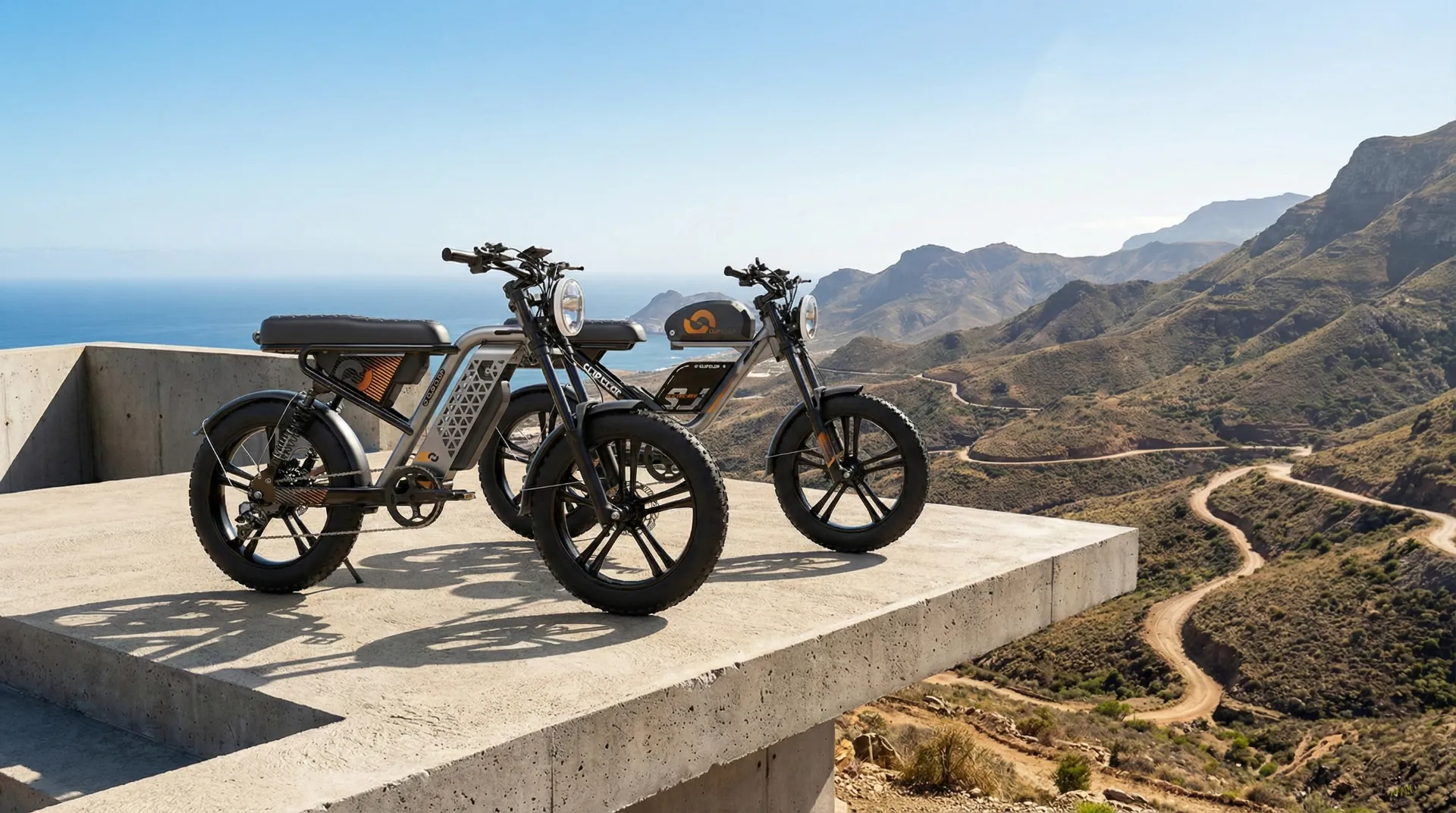
Cost is the other obvious factor. Hub systems are usually cheaper than mid-drive setups, which lets you hit a friendlier MSRP and widen your market. For example, our ClipClop C1 uses a 48V 500W hub motor with a durable Aluminium Alloy 6061 frame. It won’t feel like a high-end mid-drive e-MTB, but it gives a strong, fun boost on forest trails, farm tracks, and adventure touring—and it’s simpler to maintain. That’s a real value story.
What Truly Matters for Climbing: Unpacking Torque (Nm) vs. Power (W)?
In B2B sourcing, motor specs can turn into a weird number-flex contest. Suppliers throw big watts around like it’s the only truth. But if you care about off-road performance and customer satisfaction, you need to understand what the numbers actually mean on a hill, not just on a PDF.
Power (watts) is basically how fast the motor can do work over time. But here’s the thing I always push partners to ask: continuous rated power vs peak power. Continuous is what it can sustain without overheating, and in the EU EPAC world, continuous power is the legally regulated number. Peak power is just short bursts, like starting from a stop.
Some suppliers (not all, but enough) love advertising peak power because it looks impressive. A sourcing blogger I follow basically says: “force them to show continuous rating in writing,” and yeah—do that. Ask for test docs, ask for labeling details, and don’t accept vague answers like “it’s about 250W-ish.”
Torque (Nm) is the rotational force—the “push” you feel when starting and climbing. For e-MTBs, torque is often the better “feel” metric than watts. A higher torque motor (50 Nm, 80 Nm, 100+ Nm) will usually feel stronger uphill even if watts look similar. This is why torque sells e-MTBs in real riding situations.
And this is where mid-drive has a structural advantage again: it can multiply torque through the bike’s gears. So if you’re comparing systems, don’t just compare W. Ask for torque rating, and if possible ask for a torque curve chart. A well-integrated 250W motor producing 85 Nm can feel way better on technical climbs than a sloppy 500W hub producing 60 Nm. Numbers are not the whole story, but they point you in the right direction.
How Do Sensors and Controllers Define the Riding Experience?
A powerful motor can still feel terrible if the system delivers power like a light switch. Rider experience comes from the electronics: the sensor (detects pedaling) and the controller (the brain that decides how power comes out). If you’re building a brand, “feel” becomes your reviews, your return rate, and your long-term reputation.
The key sensor decision is torque sensor vs cadence sensor. Cadence sensors detect crank rotation and basically act like on/off—pedal turns, motor helps at a preset level. It’s cheap and dependable, but it can feel jerky, especially on technical terrain where riders want precise control. For leisure bikes, many customers accept it. For performance e-MTB marketing, it usually disappoints.
Torque sensors measure how hard the rider is pushing. So assistance becomes proportional: pedal harder, get more help. This feels natural, like the rider suddenly has stronger legs instead of a motor “kicking” randomly. If you’re selling to enthusiasts, torque sensing is one of the easiest ways to reduce “this bike feels weird” complaints.
Then the controller: higher-end controllers often use FOC (sine-wave) control, which makes power delivery smoother, quieter, and more efficient. Cheaper controllers are often square-wave and can feel rougher and louder. Also, controller tuning matters—max current settings affect acceleration and torque feel, and thermal protection matters on long climbs.
Heat is real on off-road climbs, especially with heavy riders, sand, mud, or slow technical routes. A good controller does thermal rollback—reduces power gradually to protect components. A bad one just cuts out, which feels awful and can be unsafe on steep terrain. When you talk to suppliers, ask exactly how they handle overheating. Don’t let them dodge that question.
Which Motor System Best Suits Your Target Customer and Terrain?
A healthy e-bike business usually isn’t about one “best” bike. It’s about matching the right motor system to the right buyer and riding environment. If you segment your line honestly, it gets easier to market, easier to support, and usually easier to profit.
For serious trail, enduro, and technical climbing riders, mid-drive is the real option. These buyers want balance, agility, and that smooth torque-sensor feeling. They pay more, but they demand more. In this segment, I’d focus on reputable mid-drive systems, torque ratings above 80 Nm, and frames designed around that central motor position—often 6061 or 7005 aluminum builds for toughness.
For budget-focused customers, rental fleets, and riders doing moderate terrain and forest service roads, geared hub motors make a lot of sense. They prioritize reliability and lower maintenance costs, and the drivetrain usually survives longer. A model like our ClipClop C1 fits here: 500W hub power, strong off-road fun, and less complexity. The marketing should be honest—sell durability and adventure, not “pro enduro weapon.”
For niche stuff like fat bikes on snow or sand, or hunting bikes, high-torque geared hub motors are often preferred because the direct push can work well in low-traction conditions. Mid-drives can sometimes stress drivetrains when traction is low and shifting isn’t perfect. But if you go 750W or 1000W, be super clear: these are typically non-EPAC, private-land machines, and your disclaimers need to be loud and consistent.
Your Essential B2B Sourcing Checklist: Questions to Ask Your E-Bike Supplier
When you’re vetting suppliers, don’t be shy—ask direct questions and ask for proof. For motor and controller: What’s continuous rated power vs peak power (in watts), and can you show labeling or test info? What’s maximum torque (Nm), and can you share a torque curve? Is the controller sine-wave (FOC) or square-wave, and what’s max current (A)? How does overheating protection work—rollback or hard cutoff?
On durability and service: What’s the IP rating for motor, controller, and connectors, and was it actually tested in wet/muddy conditions? What bearings and seals do you use inside the motor, and do you have specs or brand info? Are wiring harnesses and connectors standardized so my service team can replace parts fast? I’ve seen fleet operators say “standard parts save your life,” and they’re not wrong.
For EU compliance and documentation, be strict. If it’s EPAC, can you provide conformity documentation tied to EN 15194 (not just a casual “yes”)? Do the battery packs comply with relevant EU requirements, including the EU Battery Regulation documentation and markings? For non-EPAC high-power models, how do you keep them clearly distinct—controller settings, physical throttle presence, labeling, and sales paperwork? Vague answers here are a red flag.
Beyond the Spec Sheet: Navigating Import Duties and Hidden Costs
I’m not only on the engineering side at ClipClop—I care a lot about whether the business works after the container lands. Because a perfectly specced e-bike is useless if your landed cost makes you uncompetitive. For EU imports from China, two big things hit you early: trade policy costs and compliance risk costs.
First, the EU has imposed anti-dumping and countervailing duties on electric bicycles originating from China, and these can be serious on top of normal tariffs. So you need a freight forwarder or customs broker who actually knows this category and commodity code details. Don’t guess. Calculate landed cost properly, or your margins will vanish. A good manufacturer should understand the paperwork, but the financial responsibility is still on you.
Second, misclassification risk can destroy you. If you import bikes you believe are EPAC, but customs decides they don’t meet the 250W / 25 km/h requirements, the consequences can get ugly—impounded shipments, fines, and reclassification into L-category moped rules. Then you’re facing a new certification process you probably didn’t budget for. This is why I push partners to lock specs clearly and collect compliance documents early, not after payment.
At the end of the day, choosing the motor is the foundation of your product strategy. It shapes performance, defines rider feel, sets price point, and—most importantly—decides whether you can legally sell the bike the way you planned. Hub vs mid-drive isn’t about “better,” it’s about “right for your customer, your terrain, and your market rules.”
At ClipClop, we try to be more than a factory. I prefer thinking like a partner on the ground, helping you avoid sourcing traps and build a lineup that sells and survives. I’ve watched brands lose trust over tiny technical choices, so I take this stuff seriously, even if I talk about it casually.
If you want to talk through motor selection, EPAC-safe configurations, custom builds, or just how to structure a practical sourcing plan, message us. We do end-to-end manufacturing and export for electric off-road bicycles for distributors, wholesalers, and brand partners worldwide. Let’s build something solid—and legal—and actually profitable.
Frequently Asked Questions (FAQ)
1. Can I legally sell a 750W e-bike in Poland or the EU?
You cannot sell a 750W e-bike as a standard bicycle (EPAC). It would be classified as an L-Category vehicle, requiring type-approval, registration, and insurance, similar to a moped. You can import and sell them, but they must be marketed strictly for “off-road” or “private land use only,” and you must make the customer aware of the legal restrictions on public road use.
2. What is the real-world maintenance difference between hub and mid-drive motors?
Hub motors generally require less maintenance. The system is self-contained and does not put extra stress on the bike’s chain and cassette. This is a major advantage for rental fleets. Mid-drive motors, because they channel their power through the drivetrain, will accelerate the wear of chains, cassettes, and chainrings, requiring more frequent replacement of these components.
3. Why does a torque sensor feel so different from a cadence sensor?
A cadence sensor provides a fixed amount of power whenever you pedal, creating an artificial-feeling “push.” A torque sensor measures your effort and matches it proportionally. This synergy between rider and machine creates a natural, intuitive ride that feels like an amplification of your own strength, which is highly desirable for performance-oriented cycling.
4. How does wheel size (e.g., 27.5″ vs. 29″) affect motor performance?
A smaller wheel (27.5″) effectively acts like a lower gear, giving the motor a slight mechanical advantage for acceleration and climbing. A larger wheel (29″) will have a higher top speed for the same motor RPM and rolls over obstacles more easily. When choosing a motor, its performance will be influenced by the intended rammestørrelse og hjulspecifikationen for den endelige cykel.
5. Er en direkte drejnings-hjulmotor et godt valg til off-road elcykler?
Direkte drejnings-hjulmotorer er mindre almindelige på moderne el-MTBs. De er typisk tungere og har lavere startmoment sammenlignet med gearhusmotorer af tilsvarende størrelse. Deres hovedfordel er regenerativ bremsning (genopladning af batteriet på nedture), men denne fordel opvejes normalt af deres dårlige klatreperformance og højere vægt, hvilket gør gearhusmotorer til det overlegne valg for næsten alle off-road anvendelsesscenarier.
med en "dobbelt-rør" eller "forstærket nedre rør" for at kompensere for mangel på et øverste rør og forhindre "rammesving".
- EUR-Lex – 32013R0168 – Forordning (EU) nr. 168/2013 af Europa-Parlamentet og Rådet. (Officiel EU-lovdatabasen med detaljer om køretøjkategorier).
- CONEBI (Confederation of the European Bicycle Industry) – Leverer brancheindsigter og positioner om forordninger såsom EN 15194.
- Europæiske Kommission, Handel – Information om handelsforanstaltninger, herunder afgifter på elcykler fra Kina.



 English
  Spanish
  Portuguese
  Russian
  Arabic
  French
  Dutch
Dutch  German
  Danish
