

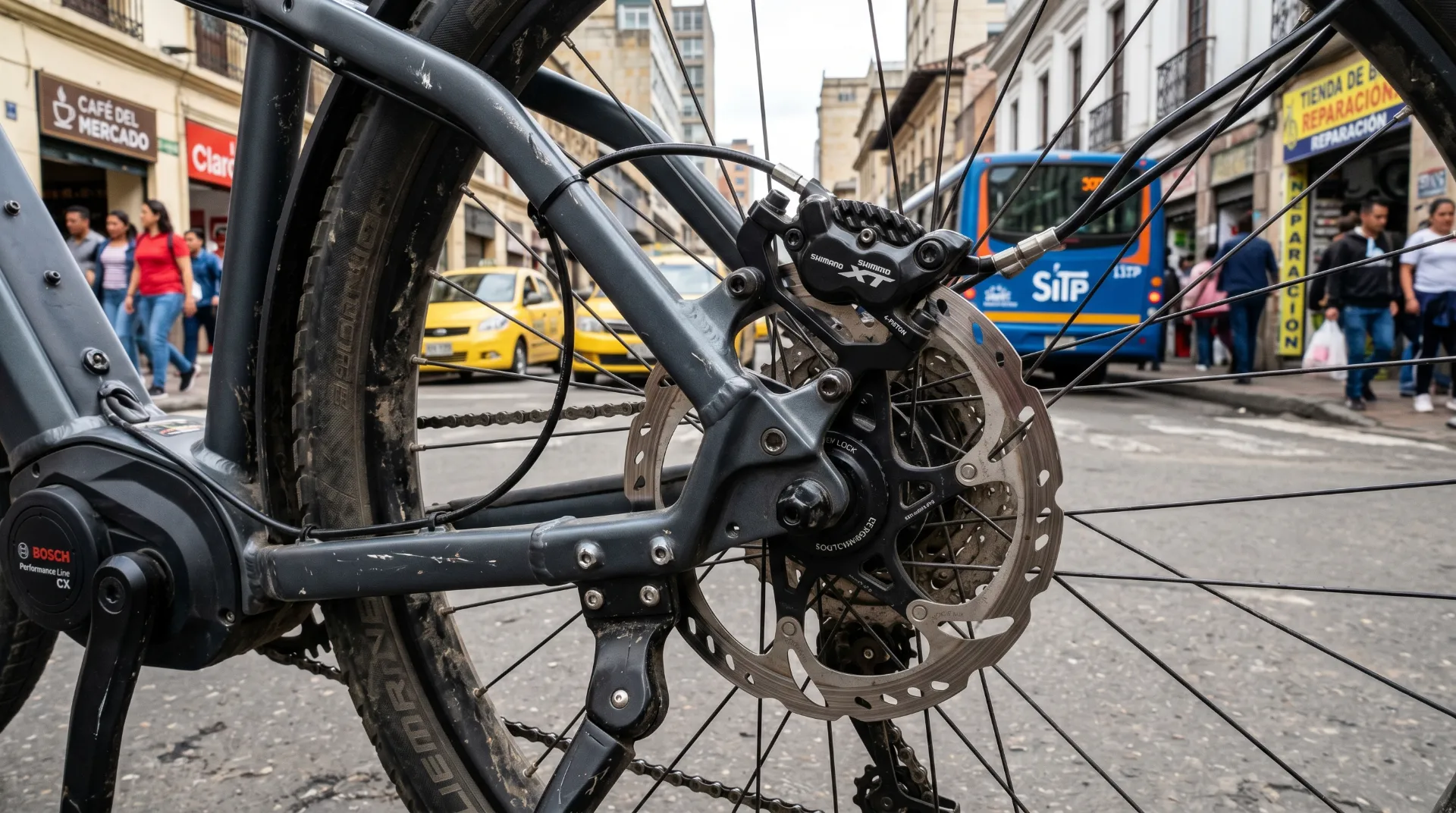
Look, I’ve been staring at brake calipers for way too long. Nine years at ClipClop Bike means I’ve spent thousands of hours talking with dealers who want the cheapest container possible, only to call back six months later when customers start complaining about braking performance.
I’m Leo Liang. I’m a sales specialist, not an engineer and definitely not a professional bike reviewer. My job is moving containers from Jiangmen to Cartagena and hearing what happens after those bikes hit Colombian roads.
What I’m still seeing in 2026 is surprising. Many Colombian distributors, especially smaller dealers in Cali and Barranquilla, continue treating mechanical disc brakes as “good enough.”
They aren’t.
Not for Colombia.
Not for steep urban descents.
Not for Medellín’s sudden downpours.
The $12 Decision That Became a Much Bigger Problem
Last year, a dealer in Bogotá—let’s call him Carlos—ordered 80 electric bikes. He wanted mechanical disc brakes to save approximately $12 per bike.
I explained that our L1 model comes standard with 180mm hydraulic disc brakes, dual-piston calipers, and metal-ceramic brake pads. To me, that isn’t a luxury upgrade. It’s a safety requirement for Colombian riding conditions.
He disagreed.
His argument was simple: his workshop could maintain mechanical brakes easily.
By July, during the rainy season, he was sending me WhatsApp voice messages explaining multiple customer complaints. Three riders experienced significant braking issues. One delivery rider in Suba entered an intersection after cable stretch reduced braking effectiveness on a wet road.
Nobody was seriously injured, but the bike was heavily damaged.
The dealer ended up replacing multiple brake systems under warranty. The warranty cost alone exceeded what he originally saved by choosing mechanical brakes. His online reviews also suffered, with customers specifically mentioning poor brake performance.
I’ve seen versions of this story repeatedly over the past few years.
Colombia Is Not Florida
A common mistake among distributors is copying specifications that work well in flat, dry regions.
A YouTube review from Miami may recommend a budget e-bike with mechanical brakes. That doesn’t mean the same setup works in Bogotá, Medellín, Pereira, or Manizales.
Colombia’s terrain creates different requirements.
Bogotá sits roughly 2,600 meters above sea level. Riders regularly encounter long descents, steep gradients, changing temperatures, and heavy rainfall.
Under those conditions, braking systems operate under far greater stress than they would on flat urban roads.
That’s where hydraulic systems consistently outperform cable-actuated mechanical systems.
Why We Standardized 180mm Hydraulic Brakes on the L1
The L1 uses:
- 180mm hydraulic disc brakes front and rear
- Dual-piston calipers
- Metal-ceramic brake pads
- Oversized rotors for improved heat management
Interestingly, this specification wasn’t originally developed in a conference room.
It came from dealer feedback.
One distributor in Pereira operates electric bikes for agricultural workers transporting coffee loads through mountain terrain. Their riders consistently overloaded smaller brake systems, causing rotor deformation and excessive wear.
After reviewing field data, we standardized 180mm rotors on all Latin American L1 units beginning in late 2024.
Real-world feedback often teaches more than online discussions.
The Difference Riders Feel Immediately
Mechanical brakes generally provide acceptable stopping performance in dry conditions.
The challenge is consistency.
Cable systems stretch.
Housing accumulates contamination.
Adjustment requirements increase over time.
Hydraulic systems maintain braking force more consistently because the fluid-based system automatically compensates for normal pad wear.
In wet weather, that consistency becomes especially valuable.
Riders descending steep roads don’t want uncertainty. They want predictable braking response every time they pull the lever.
Maintenance Costs Tell the Real Story
Many buyers focus exclusively on initial purchase price.
Fleet operators focus on total operating cost.
One delivery company in Cali operates approximately 45 electric bikes. Before switching to hydraulic-equipped L1 units, their mechanic spent substantial time adjusting cables, replacing housings, and correcting brake tension issues.
After the transition, maintenance intervals became significantly longer.
Instead of constant cable adjustments, the mechanic primarily monitors brake pad wear and performs routine inspections.
That’s where hydraulic systems often become less expensive over the long term despite higher upfront costs.
The One Legitimate Argument Against Hydraulics
To be fair, hydraulic brakes aren’t perfect.
If a rider crashes and damages a hydraulic hose, repairs require specialized parts and proper bleeding procedures.
Not every workshop in Colombia currently has that expertise.
I’ve visited stores where technicians have extensive experience with mechanical systems but very limited exposure to hydraulic maintenance.
That’s a real challenge.
However, it’s increasingly difficult to justify avoiding hydraulic technology because of training limitations. Modern hydraulic systems are widely documented, training resources are readily available, and most mechanics become comfortable servicing them after a relatively short learning period.
For bulk orders over 50 units, ClipClop now includes brake bleeding kits to help dealers support their service departments.
Why We Use Metal-Ceramic Brake Pads
Some customers prefer organic brake pads because they’re quieter.
That preference makes sense until you consider Colombia’s environment.
Wet roads, dust, mud, and constant stop-and-go riding accelerate brake pad wear dramatically.
Several dealers experimented with organic compounds to reduce noise complaints. Most eventually switched back.
The reason was simple: durability.
In our field observations, metal-ceramic pads regularly achieve approximately 3,500 kilometers under mixed Andean riding conditions.
Organic pads often require replacement far sooner.
Yes, metal-ceramic pads can be noisier.
They also tend to last substantially longer.
E-Bikes Are Heavier Than Most People Realize
The L1 weighs approximately 39kg.
Add a rider, cargo, delivery equipment, or groceries, and total system weight can easily exceed 120kg.
That mass must be controlled safely during descents.
Heat management becomes critical.
Larger 180mm rotors dissipate heat more effectively than smaller alternatives. When brakes repeatedly absorb energy on long downhill sections, rotor temperature rises quickly.
I’ve personally received photos from dealers showing heavily overheated mechanical brake rotors with visible discoloration caused by excessive heat.
Those situations are exactly why braking capacity matters.
Safety Is Becoming a Competitive Advantage
As Colombia’s e-bike market matures, regulators are paying closer attention to safety standards.
Distributors increasingly need to demonstrate that their products are designed for real transportation use rather than simply meeting the lowest possible price point.
Reliable braking systems support that conversation.
When accidents occur, questions inevitably follow.
Dealers must be prepared to explain why they selected a particular specification.
Hydraulic brakes provide a much stronger answer than “they were cheaper.”
The Price Difference Is Smaller Than Most People Think
Let’s look at the economics.
A hypothetical downgrade from hydraulic to mechanical brakes might reduce factory cost by approximately $25 per unit.
That’s the entire savings.
Spread across a 15,000-kilometer service life, the difference becomes almost insignificant.
Meanwhile, maintenance costs, warranty claims, customer complaints, and downtime can easily erase those savings.
From a dealer’s perspective, choosing better brakes often becomes the less expensive option over time.
The L1 Was Designed as a Complete System
The L1 combines:
- 750W motor output
- 1200W peak power
- 48V 15Ah battery
- 7-speed Shimano drivetrain
- Dual suspension
- 180mm hydraulic disc brakes
These components were selected to work together.
Braking performance isn’t an isolated specification. Motor behavior, controller tuning, weight distribution, and stopping power all influence the riding experience.
Changing one component affects the entire system.
My Factory-Floor Conclusion
I understand the skepticism.
I work for ClipClop Bike.
Of course I’m advocating for a product configuration we sell.
But I’m also the person receiving late-night messages from dealers when problems occur.
I’ve seen damaged bikes, worn brake systems, warranty claims, and frustrated customers.
Based on everything I’ve observed, hydraulic brakes are no longer a premium feature for Colombia in 2026.
They’re the baseline.
The hills are real.
The rain is real.
The weight of modern e-bikes is real.
And the consequences of inadequate braking systems are real too.
One distributor in Medellín told me something recently that perfectly summarized the market:
“The customer doesn’t buy the bike because of the motor. They buy it because they trust it won’t scare them on the way down.”
That’s what brakes really sell.
Trust.
And in Colombia, trust starts when the road points downhill.
— Leo Liang, Sales Specialist, ClipClop Bike



 English
  Spanish
  Portuguese
  Russian
  Arabic
  French
  Dutch
Dutch  German
  Danish
