

Okay. Full disclosure: I’m Leo Liang, export sales at ClipClop Bike in Guangzhou. We’ve been shipping containers to Mexico since 2021, maybe 2022—the years blur when Chen, our lead engineer, argues with me about stem angles at midnight. Every January my WhatsApp explodes from dealers in Guadalajara, Monterrey, Mexico City, Puebla, León. They want the L2 motor, the battery, the price. But half the complaints I fielded in 2025 weren’t about the motor wheezing. They were about the handlebars. How the bars made customers’ wrists feel after bouncing through cobblestones in Guadalajara or lane-splitting in Centro Histórico.
Handlebars sound boring. My competitor SAMEBIKE wrote this clean technical breakdown. It’s fine. Very textbook. But they’re not the ones getting voice notes at 11 PM from a Monterrey dealer because twenty buyers said the bars were too wide for traffic. So I’m doing this messier. More honest. Biased, probably. Because if you order fifty L2 units and your customers hate the bars, you don’t reorder. And then I don’t eat.
Flat Bars: The Unsung Hero
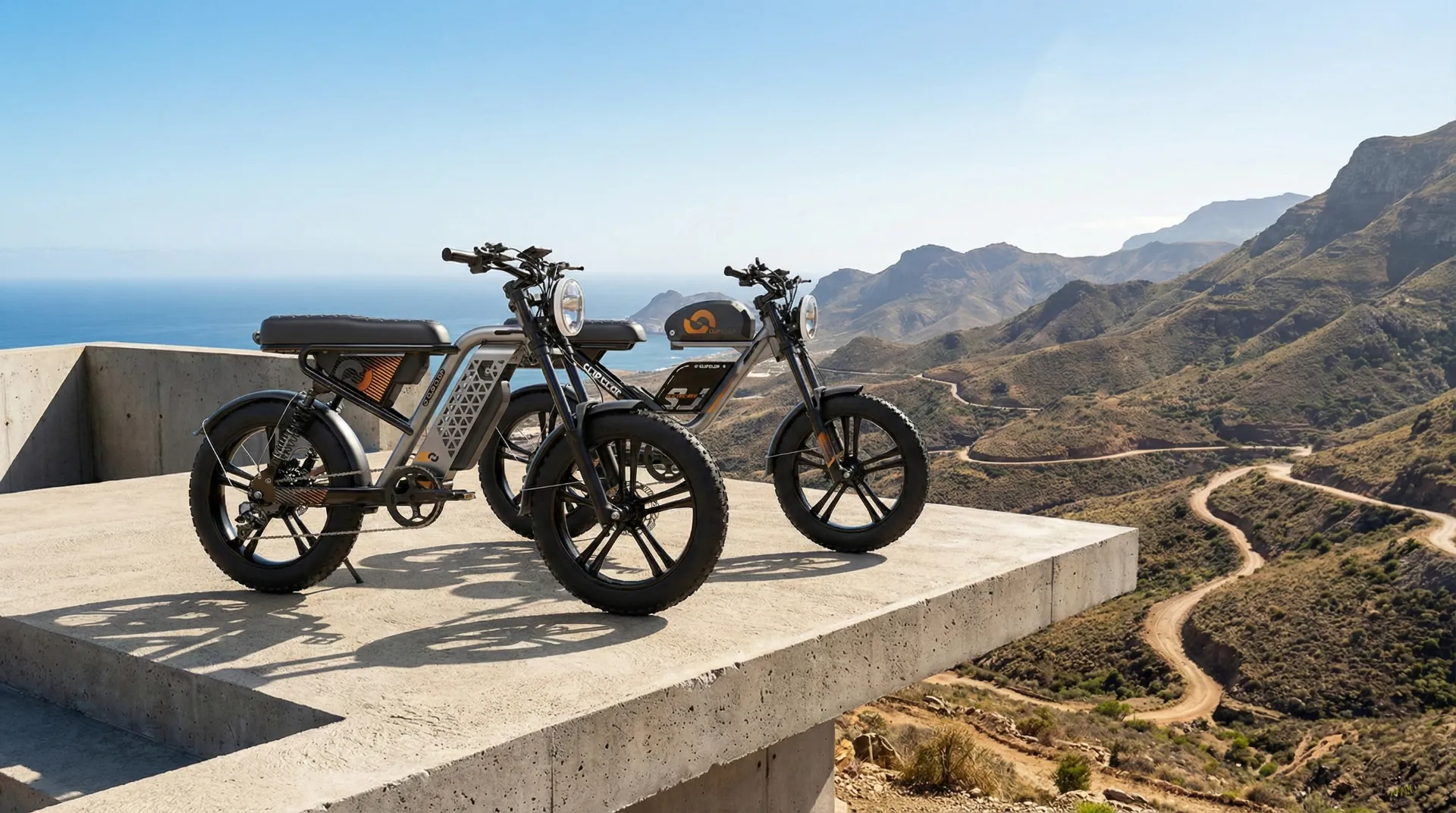
The L2 runs flat bars. Straight, simple, no drama. When we specced it for export in 2023, Chen pushed hard for flat bars with a slight backsweep. Not risers. Not some trendy integrated cockpit. Flat. Mexico City traffic is chaos. Beautiful, terrifying chaos. You’re lane-splitting between Tsurus, microbuses, delivery trucks that materialize out of thin air. Wide riser bars look comfy on paper, but in Centro Histórico at 8 AM? They catch side mirrors. They clip pedestrians. They turn your e-bike into a battering ram.
I had a dealer—let’s call him Ernesto, because that’s not his name—operating in Coyoacán. Ordered thirty units of a different brand with 780mm riser bars. Looked great in photos. Very aggressive. Three weeks later he calls me, voice tight: six customers returned bikes because the bars were “too wide for the streets.” His exact words: “Leo, my buyers love the motor, but they’re fighting the handlebar more than the traffic.” That stuck. The L2’s flat bar is 680mm. Narrow enough to slip through gaps, wide enough that you don’t feel like a tightrope walker.
But it’s not just width. The L2 packs a 48V 750W motor peaking at 1200W. When you hit the throttle in traffic, torque comes fast. You need direct steering input. Flat bars give that precision. Plus—and Chen loves lecturing me about this—the L2’s bars have a 9-degree backsweep. Your wrists aren’t locked in a pure MTB attack position. You’re upright enough to see traffic, angled enough that your shoulders don’t scream after forty minutes. With dual 15Ah batteries giving 80-100 km range, what’s the point of all that distance if your upper body gives up after 30 km?
There’s this blogger, @CiclismoUrbanoMX, who posted in March 2025 about how flat bars “kill your posture” on long rides. I commented—maybe too aggressively—that he was testing them on a non-electric hardtail in the Ajusco mountains. Different game. With a motor doing the heavy lifting, your upper body isn’t bracing against pedal torque the same way. Flat bars make more sense on e-bikes, not less. He didn’t reply. I’m still bitter.
Riser Bars: Love Them, Hate Them, Depends on the Zip Code
Riser bars? Complicated relationship. For mountain towns? Love. Oaxaca, Puebla, anywhere with elevation and surprise speed bumps that seem designed to launch you into orbit. The upright position saves your lower back. Your weight stays back when descending streets not engineered for 45 kg e-bikes with 4-inch tires.
But here’s where I get biased: I think Mexican commuters in flat cities overbuy riser bars because they look tough. Instagram bike reviewer @BiciElectricaMX posted this whole series last year about how riser bars “dominate the trail” and give you “commanding presence.” Sure. But your buyer in Zapopan? He’s commuting on Avenida Vallarta, paved, flat, windy as hell. The riser bar puts him in a slightly too-upright position that catches wind like a sail. I’ve told dealers this. Some listen. Some don’t. The ones who don’t usually call back three months later asking to swap to flat bars.
That said, not a total hater. In Toluca, anywhere above 2,500 meters, riser bars make sense. Altitude saps performance. Being upright helps breathing. One dealer in Querétaro—let’s call her Mariana—switched her L2 order to risers for mountain-town customers. Sales went up 15%. She was smug. I let her be smug. Context matters.
Drop Bars: I’m Just Going to Say It
Drop bars? Overrated for the Mexican e-bike market in 2026. There. I said it. The roadie crowd in Querétaro and fixed-gear guys in Condesa love them. Aerodynamics! Speed! But e-bikes already have a motor. You don’t need to hunch over to save watts. The motor does that. Most Mexican e-bike buyers are 35-55 years old. They want to get to work without arriving soaked in sweat, or ride to the mercado without their lower back filing a lawsuit.
Drop bars put too much weight on your hands. They force your neck into a crane position to see traffic. I had a client—let’s call her Rosa, northeast-based—who ordered drop-bar urban e-bikes alongside her L2s. Six months later? Half the drop-bar units sat in her warehouse collecting dust. “Too aggressive,” she told me over coffee. “My customers feel like they’re falling forward. One guy said it was like riding a bike trying to throw him over the front.” I steer Mexican dealers away from drops unless they know their market is actually roadie-adjacent. Which, in 2026, is maybe 5% of the market.
LaBiciInteligente, a blogger I follow, wrote something I keep pinned: “In Mexico, the bike doesn’t need to be fast. It needs to disappear under you.” Drop bars never disappear. They remind you they’re there via sore shoulders, numb fingers, and anxiety when a microbus cuts you off and you can’t reach the brakes because your hands are in the drops.
Cruiser Bars: The Beach Town Secret Weapon
Cruiser bars, though. Mexico has this massive leisure market that export manufacturers ignore because it’s not “performance.” Puerto Vallarta. Cancún. Mérida. Mazatlán. Places where people ride to the malecón at 6 AM before the heat hits 35 degrees. Cruiser bars—swept back, wide, super upright—make perfect sense there. Not for the L2, obviously. The L2 is dual-sport, built for streets that might turn to dirt. But if you’re selling coastal, add a cruiser-bar model alongside it.
One dealer in Veracruz—let’s call him Jorge—added ten cruiser-bar units to his L2 order in 2024. Skeptical. Thought they looked “old fashioned.” Sold out cruisers in three weeks. The L2s took two months. His customers were retirees and vacation-home owners. They didn’t need 750W for a flat coastal ride. They needed comfort. Humidity in Veracruz is brutal—salt air eats everything—so the simplicity of cruiser bars, fewer cables in the cockpit, holds up better. Jorge figured that out on his own. I pretended I knew it all along.
Butterfly, Bullhorn, Aero: The Quick Hits
Butterfly bars? I wish more Mexican dealers knew about them. Long-distance touring is growing here. Mexico City to Toluca. Guadalajara to Tequila. Butterfly bars give you a million hand positions. ElCiclistaPractico, a YouTuber I follow, ranted in late 2024 about how butterfly bars “saved his wrists” on a 200-km tour through the State of Mexico. They look weird though. Customers see them and go, “¿Qué es eso?” Inventory risk is real. But for the adventure niche in Guanajuato or San Cristóbal? Underrated.
Bullhorn bars? Fixed-gear guys in Condesa love them. Very hipster. But for the L2 with a 7-speed Shimano and a motor dumping 1200W peak torque? No. I tried it on a sample unit. Felt like holding a horse that decided to gallop. Steering gets twitchy. I nearly ate pavement in our factory lot. Chen laughed for three days. Never again.
Aero bars? No. Just no. Not for Mexican traffic where you grab brakes every twelve seconds because a taxi stopped in the bike lane. Not wasting your time.
The Real-World Mess Nobody Talks About
Handlebar type matters, but setup matters more. Dealers mess this up constantly. They unbox the bike and hand it to the customer exactly as it came from the factory. Fine, mostly. But not always.
A dealer in León—big guy, loud voice—ordered forty L2s for fleet rental near the centro. Called me three weeks later, stressed. “Leo, customers love the bike, battery lasts forever, motor climbs like a goat, but two complained about wrist pain. One said his fingers went numb after twenty minutes.” I asked about handlebar angle. Silence. Then: “My mechanic installed them straight. Zero backsweep. He thought it looked sportier.”
Well, there it was. The L2’s 9-degree backsweep isn’t decorative. It puts wrists in a neutral position. Straight bars lock wrists into extension, compress the carpal tunnel, ruin the ride. We walked him through loosening the stem faceplate, tilting the bars back five degrees, tightening to spec. Problem solved. He ordered another sixty units in Q3. Small adjustment. Huge difference. That’s the stuff SAMEBIKE’s article doesn’t tell you. The “my mechanic thought it looked cooler this way” problem.
Another case: a dealer in Puebla, let’s call her Sofía, ordered standard L2s but her customers were mostly women over fifty, shorter than average, riding upright. She panicked that the reach felt too long. We swapped to a 60mm stem instead of 80mm. Suddenly the bikes fit. She sold out in a month. The handlebar didn’t change. The relationship between handlebar and rider changed. Don’t just think about bar type. Think about bar position. Stem length. Angle. Height. It’s a system.
What I’m Seeing in 2026
Mexican buyers are getting pickier in a good way. They watch YouTube reviews. Compare specs on Reddit. But they’re also caring about ergonomics in ways they didn’t in 2022. I blame smartphones—everyone already has text-neck and thumb pain, so they notice immediately when a bike makes it worse.
I think adjustable stems will be the next quiet revolution. Not just different bar types, but stems that let riders fine-tune height without tools. We’re testing a quick-adjust stem for the L2 right now. Might launch in July. Might not. Chen thinks it’s unnecessary complexity. I think Mexican dealers will love it because it lets them sell one bike to multiple body types. We’ll see who’s right.
More women are buying e-bikes in Mexico in 2026 than ever. Commuters. Mothers. Students. They’re not always served by handlebars designed for average male proportions. @MujeresEnBiciMX posted a thread in February about how most e-bike bars assume a shoulder width that doesn’t match reality for many female riders. The L2’s 680mm bars are actually on the narrower side for the category—not intentional, but a happy accident. Three female dealers mentioned it unprompted: “Finally, a bar that doesn’t feel like I’m doing the butterfly stroke.” I’m taking credit even though it was Chen’s engineering constraint.
My Slightly Biased Bottom Line
That’s my messy, biased take on handlebars for Mexico in 2026. Don’t copy what works in California or Amsterdam. Mexico’s roads are different. Traffic psychology is different—more chaotic, more improvisational. Rider demographics are different. The climate is different. The L2’s flat-bar setup isn’t a cost-cutting measure. We chose it because it works here. Because I’ve seen what happens when dealers guess wrong.
Could we offer riser bars? Sure, for bulk orders over 100 units. We can mix containers. We can customize. ClipClop is built for B2B flexibility. But for 90% of Mexican dealers in urban or mixed terrain? Start with flat. Watch your customers. Listen to complaints. Adjust based on your actual market, not what looks cool on Instagram or what some YouTuber in Denver said about “commanding ride position.”
Your customers in Guadalajara don’t care about commanding presence. They care about getting to work without wrist pain. About slipping through traffic without clipping a taxi mirror. About feeling safe when they grab the hydraulic brake levers because some delivery guy cut them off.
The handlebar is where the bike meets the body. Where control happens. Where comfort lives or dies. Get it right, and the L2 disappears under your customer. Get it wrong, and they’ll blame the motor, blame the battery, blame the brand—when really, it was just a piece of aluminum pointing the wrong way.
I’m Leo. If you want to argue, or talk about a mixed container for your shop in Monterrey or Mazatlán, my contact is on the ClipClop site. I’ll probably respond at 1 AM Guangzhou time because that’s when I’m awake and Chen isn’t hovering over my shoulder telling me I’m wrong about stem angles.
Cheers. Ride safe. Check your handlebar angle before you sell a single unit. Trust me on this one.



 English
  Spanish
  Portuguese
  Russian
  Arabic
  French
  Dutch
Dutch  German
  Danish
