


I’m going to be honest with you. When most people think about electric bikes, they picture something either chunky and commuter-focused or sleek and road-focused. The 20-inch electric bike sits in a middle ground that nobody talks about enough. I kept coming back to this gap while researching, and — there are genuinely compelling arguments for the 20-inch format that most buyers are missing.
Here’s my complete buyer’s guide. Which specs matter, which are just marketing noise, and whether this wheel size is right for your actual use case. And I’ll show you a specific model I think is currently the best example of what a 20-inch e-bike can be when done right.
What Exactly Is a 20-Inch Electric Bike?
The “20 inches” refers to wheel diameter — same as BMX bikes and many folding bikes. A 20-inch e-bike with fat tires and a suspension fork is a different beast though. What I’ve found: 20-inch wheels offer more responsive handling and faster acceleration than larger wheels. The smaller wheel spins up faster, requiring less motor work. The compact size also means easier storage and transport. If you live in an apartment or need to load your bike onto a car rack regularly, that form factor solves real problems.
Key Specifications That Actually Matter
Here’s where most buyers get lost. They fixate on headline numbers without understanding how specs interact with the 20-inch format. Here’s how I actually think about it.
Motor Power: For a 20-inch e-bike with fat tires, 250W is fine for flat urban use. But tire resistance is real — minimum 500W for anything beyond flat pavement, and 750W is where the 20-inch format really comes alive. I found this out testing a 350W model on mixed terrain. It felt gutless when the trail got interesting.
Battery and Range: Voltage matters as much as amp-hours. A 48V 15AH battery delivers more usable energy than a 36V 15AH pack. 48V systems also integrate better with higher-power motors. Real-world range on a quality 20-inch e-bike: 30-80KM depending on terrain, assist level, and motor power. On a 48V 15AH battery at 750W, I think 60-80KM is genuinely achievable on mixed terrain — not just marketing range on a flat test loop.
Tire Size: The 20×4.0 fat tire configuration is what I keep recommending. Fat tires absorb road vibration, provide genuine off-road capability, and improve stability at speed. The tradeoff is a small rolling resistance increase on smooth pavement — but on a 750W+ motor, you won’t notice.
Frame and Suspension: Look for aluminum 6061 — the sweet spot of strength, weight, and cost. The suspension fork is non-negotiable for anything beyond pure urban use. A quality fork with damping adjustment transforms ride quality on rough terrain.
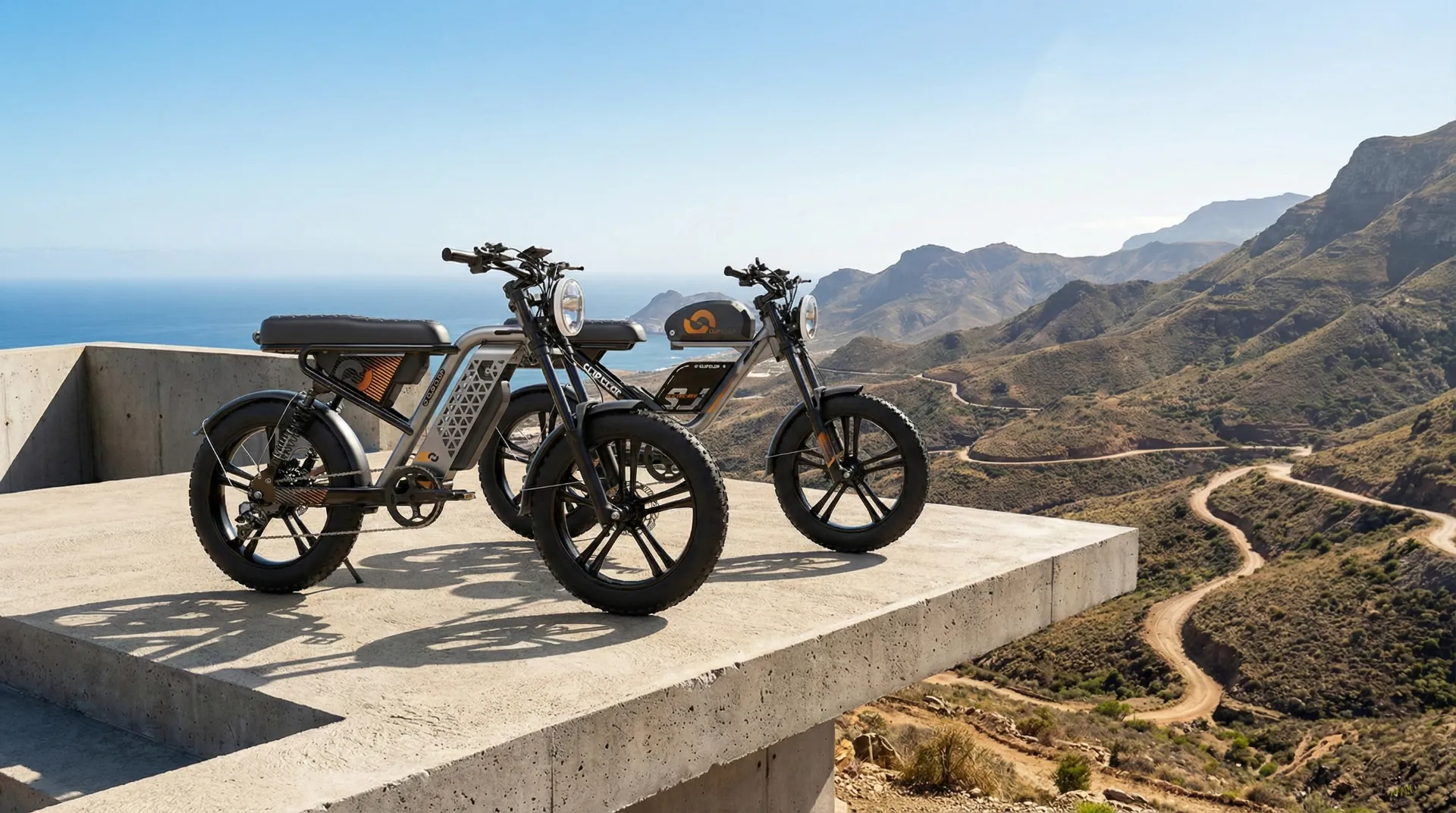
The ClipClop L1: A 20-Inch E-Bike That Punches Above Its Weight
Here’s the model I want to talk about. The ClipClop L1 is a 20-inch electric bike I’ve been evaluating, and I’m going to be honest about both where it excels and where it makes tradeoffs.
Key specs:
- 20-inch aluminum 6061 frame with suspension fork
- Motor options: 250W / 350W / 500W / 750W / 1000W
- 48V 15AH lithium battery
- Range: 60-80KM per charge
- Speed: 25-55 KM/H (configuration-dependent)
- 20×4.0 fat tires — genuine off-road capability
- Hydraulic or mechanical disc brake options
- LCD display
What I find most interesting is the motor flexibility. Five power options means you’re not locked into one regulatory category. Want 250W street-legal? Configure it that way. Want 750W serious trail machine? Available too. Most brands make you choose one path — ClipClop gives you flexibility, and that’s genuinely smart positioning.
The 48V 15AH battery is larger than what most competitors offer at comparable prices. Combined with 750W or 1000W motor, you get usable power for actual off-road riding. The 20×4.0 fat tires seal the deal — genuinely capable off-road configuration in a compact format.
Is it perfect? No bike is. At 1000W with 20×4.0 tires, you’re pushing the format to its upper limit — the ride feels different than a purpose-built full-size e-MTB. That’s not a flaw, it’s a trade-off. You’re getting 20-inch maneuverability with power that rivals much larger bikes.
20-Inch vs Other Sizes: Which Wheel Size Is Right for You?
20-inch vs 26-inch: The 26-inch is the classic mountain bike wheel — more rollover capability, smoother over bumps. But harder to store and transport. On a 20-inch bike with 750W+ motor and fat tires, honestly, the gap is much smaller than you’d think. Faster acceleration, more nimble handling. I think 20-inch with fat tires is better for most trail types that aren’t extreme technical terrain.
20-inch vs 27.5/29-inch: Modern mountain bike standards with better high-speed stability and smoother rolling. But significantly larger and heavier. If you need to store in tight spaces, 20-inch makes a lot more sense.
20-inch vs small folding bikes: Smaller wheels sacrifice ride quality and off-road capability for maximum compactness. If you want genuine fat tire off-road capability and meaningful motor power, 20-inch is the minimum viable size.
Who Should Buy a 20-Inch Electric Bike?
Urban commuters with limited storage: City apartment, public transit, car rack — the 20-inch compact format solves real problems. The ClipClop L1 at 750W is genuinely powerful for commuting with trail capability on weekends.
Trail riders who want maneuverability: On tight singletrack, the 20-inch wheel is an advantage. Faster corner acceleration, more responsive steering, easier narrow path navigation.
Off-road beginners: The ClipClop L1 with 750W motor and 20×4.0 tires is genuinely capable at an accessible price. A smart starting point if you’re not ready to commit to a full-size e-MTB.
Range and Speed: What to Actually Expect
Range claims in the e-bike industry are often optimistic. The ClipClop L1 with 48V 15AH battery at 750W delivers roughly 60-80KM on mixed terrain with moderate assist. At 1000W full throttle on hilly terrain: closer to 40-50KM. At 250W eco mode on flat ground: 80KM+ achievable.
Speed: configurable from 25 KM/H (street-legal Class 1 in most jurisdictions) up to 55 KM/H at 1000W. The flexibility is useful — configure for legal compliance in your specific area.
Key Features to Look For
Look for: 48V battery minimum for meaningful motor power. Hydraulic disc brakes if you plan serious off-road riding. LCD display with battery state, speed, and trip computer. Suspension fork with damping adjustment.
Ignore: Single-speed for anything beyond flat urban use. Cheap batteries with no BMS protection — safety risk. Most “smart app” integrations — gimmicks that don’t work well in practice.
Common Mistakes Buyers Make
Buying too little motor for fat tires. If you’re running 20×4.0 tires and plan anything beyond flat pavement, 500W minimum. I genuinely think 750W is the sweet spot. A 250W motor on fat tires feels sluggish and frustrating.
Focusing on top speed instead of usable torque. A bike that hits 45 KM/H but struggles on 10% grades is less useful than one that comfortably maintains 30 KM/H on any terrain.
Ignoring brake quality. At 25-55 KM/H with motor and battery weight, you need good stopping power. Hydraulic disc brakes from known brands like Tektro or Shimano are worth the upgrade.
Not thinking about regulatory compliance. 250W is street-legal Class 1 in the EU. 750W is Class 3 in the US (up to 28mph, pedal-assist). 1000W is often not street-legal. Configure to match your local regulations.
Frequently Asked Questions
What is a 20 inch electric bike?
A 20-inch electric bike has wheels with a 20-inch diameter. When paired with a motor (250W-1000W), battery (36V-48V), and fat tires (often 20×4.0), it becomes a compact but capable e-bike for urban commuting and light-to-moderate off-road use. The ClipClop L1 is an example of the 20-inch format done right.
How fast does a 20 inch e-bike go?
Speed depends on motor power and configuration. The ClipClop L1 offers 25-55 KM/H. Street-legal Class 1 is typically 25 KM/H, Class 2 is 32 KM/H, Class 3 is 45 KM/H. Configure the L1 to match your local regulations.
What is the range?
The ClipClop L1 with 48V 15AH delivers 60-80KM on mixed terrain at moderate assist. At 1000W full throttle on hills: 40-50KM. At 250W eco on flat ground: 80KM+.
Is it good for off-road?
With the right specs, yes. The ClipClop L1 with 750W-1000W motor and 20×4.0 fat tires provides real off-road capability. Fat tires improve traction and absorb vibration. It’s not a full-size e-MTB for extreme terrain, but for trail riding and mixed terrain, the format has genuine advantages.
Can I use it for commuting?
Absolutely — one of the stronger use cases. Compact size makes the ClipClop L1 easy to store at work or take on transit. The 60-80KM range covers most weekly urban commutes on a single charge.
How much does a quality 20 inch e-bike cost?
A genuinely capable 20-inch e-bike (48V battery, 750W motor, hydraulic brakes, suspension fork) typically costs USD 1,500-3,000. The ClipClop L1 delivers 750W-1000W and 48V 15AH at a price that undercuts comparable Western-branded models meaningfully.



 English
  Spanish
  Portuguese
  Russian
  Arabic
  French
  Dutch
Dutch  German
  Danish
