
Cargo E-Bikes vs Delivery Vans: Commercial Fleet Total Cost of Ownership (TCO) Analysis
Hello, I'm Leo Liang. For years, my work at ClipClop has been centered on a single mission: providing businesses with powerful, reliable electric mobility solutions.
Hello, I'm Leo Liang. For years, my work at ClipClop has been centered on a single mission: providing businesses with powerful, reliable electric mobility solutions.
Commercial last-mile delivery and corporate shared fleets place extreme demands on electric bicycle hardware, demanding heavy-duty payload ratings, swappable power systems, and low-maintenance drivetrains. For logistics operators, municipal delivery contractors, and fleet leasing companies, specifying commercial e-bikes requires calculating total cost of ownership (TCO), frame torsional rigidity under 150kg+ cargo loads, and IoT telematics integration. This commercial procurement guide provides actionable engineering criteria for scalable fleet operations.
Commercial partners can inspect our manufacturing infrastructure on our OEM/ODM E-Bike Manufacturing Facility page, review standard configurations on our CS01 Fat Tire & CS04 Commercial Utility Platforms, or directly request volume FOB terms via our Commercial Quote Request Portal (MOQ 20).
Why Is This B2B Mobility Comparison Happening Now?
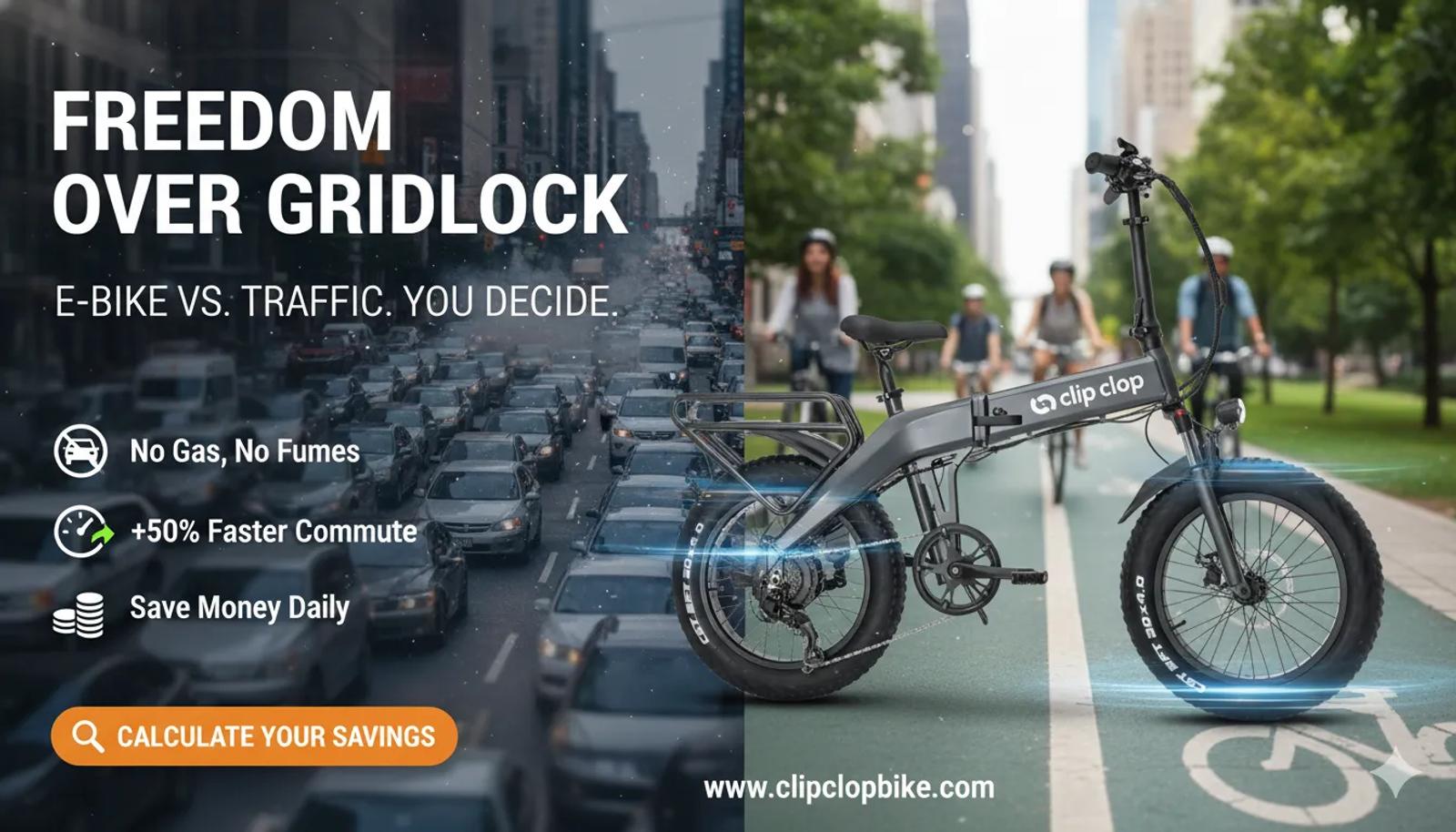
The landscape of urban and commercial logistics is evolving at an unprecedented pace. The 'old way' of simply using a fleet of vans is starting to encounter some very modern roadblocks. First, it is not just that urban congestion is no longer an irritation; it is a major drain on resources, with businesses paying dearly through wasted fuel and man-hours. A delivery van stuck in traffic is a non-performing asset. Second, the global drive toward sustainability has translated into LEZs and ULEZs expanding rapidly within most of the world's major cities. For business, this equates to daily charges, possible fines, and perhaps the biggest headache of all-the looming prospect of their current vehicle fleet becoming obsolete or noncompliant. This creates, naturally, a strong financial incentive for green transport alternatives.
At the same time, customer expectations have shifted. The need for faster, more accurate delivery windows in e-commerce and local services requires agility above all else. A van's historical advantage of cargo space is often rendered irrelevant by its inability to find parking or navigate narrow city streets, thus taking more time for 'last-hundred-feet' delivery. This is a critical pain point that e-bikes are uniquely positioned to solve. They represent a paradigm shift away from brute force logistics toward intelligent, nimble operations. This is not about taking every van off the road but bringing a smarter, more flexible tool into the mix of mobility. Companies in pioneering markets such as the Netherlands are already proving that a hybrid fleet-in which e-bikes take care of dense urban routes-can drastically improve overall efficiency and customer satisfaction. The conversation is happening now because the financial, regulatory, and operational pressures have aligned, forcing a necessary and, ultimately, profitable evolution.
Download the 2026 ClipClop Factory Catalog (PDF)
Full e-bike specs, motor & battery options, MOQ, and container loading details.
What is the Real Total Cost of Ownership (TCO)?
When we do a TCO comparison, it's critical to look beyond the initial sticker price. A commercial van might sound like a simple investment, but its real cost is a long tail of expenses accumulated over its lifetime. That includes the purchase price, taxes, insurance, depreciation (which could be as high as 20-30% in the first year alone), and, of course, fuel. For an e-bike, especially a robustly built commercial model, the initial outlay is significantly lower. But the real story unfolds over the following 3-5 years of operation. Let's break it down.
Insurance for a commercial vehicle is a major, ongoing expense. For an electric bike, it is dramatically lower and, in many areas, may not even be required for business use, although we always advise it. Next are parking permits, registration fees, and regular inspections-all expenses of traditional vehicles that just don't apply to e-bikes. Depreciation on an e-bike is also far less severe in absolute monetary terms. Although the percentage might be comparable, the loss in value from a $35,000 van far exceeds that of a $2,500 commercial e-bike.
Let's consider a tangible example like our ClipClop M20F. It's engineered for durability with a 20" Aluminium Alloy 6061 frame, designed to withstand the rigors of daily commercial use. The initial investment is a fraction of a new or even used van. When you factor in the near-elimination of fuel costs, minimal maintenance, and zero parking fees or emissions charges, the financial equation tips heavily in favor of the e-bike for many urban applications. This is where, according to the cost-benefit analysis, one van can be substituted by a small fleet of e-bikes that do more, achieve more, and drastically bring down the TCO per vehicle. It is about moving from a high-cost, low-utilization asset to a low-cost, high-utilization tool.
Can You Really Achieve Substantial Savings on Fuels and Maintenance?
Absolutely, this is where some of the most immediate and impactful electric bike benefits are felt on the balance sheet. Let's start with the most obvious: fuel cost savings. The cost to fully charge a 48V 14AH Samsung 35E lithium battery, which offers a real-world range of 40-65 kilometers, is mere cents in most markets. Compare that to the cost of gasoline or diesel required to cover the same distance in a van-especially in stop-and-go city traffic where fuel efficiency plummets. Over a month of daily use, this difference doesn't just add up; it compounds into thousands of dollars in annual savings per vehicle. For a business running a fleet of five, ten, or fifty vehicles, these savings can be transformative, directly impacting profitability.
Then there's the maintenance cost. A traditional internal combustion engine is a complex system of hundreds of moving parts requiring regular oil changes, filter replacements, transmission servicing, and coolant flushes. These are not just costs in parts and labor but also in vehicle downtime. Every hour a van spends in the workshop is an hour it's not generating revenue. An electric bike has, in comparison, a radically simpler powertrain. The core component, a high-quality hub motor like the 48V 500W hub motor (Peak 1200W) in our M20F, is sealed and requires virtually no maintenance. The primary wear-and-tear items are the same as a conventional bicycle: brake pads, tires, and the chain. These are inexpensive parts that can be replaced quickly by any competent mechanic, or even a trained member of your own staff, minimizing downtime. The electronic components, like the controller and display, are modular and designed for easy replacement. This simplicity doesn't just save money; it maximizes uptime and operational readiness-a critical factor for any B2B operation.
E-Bike Fleet vs. Traditional Vehicle Fleet: A Head-to-Head B2B Comparison
| Feature / Aspect | Commercial E-Bike Fleet (e.g., ClipClop M20F) | Traditional Vehicle Fleet (Cars/Vans) |
| FINANCIALS | ||
| Initial Purchase Cost | Low per unit, enabling larger fleet deployment. | High per unit, significant capital investment. |
| Total Cost of Ownership (TCO) | Significantly Lower over the asset's lifecycle. | Significantly Higher due to numerous recurring costs. |
| Fuel / Energy Costs | Minimal. Cents per full charge for 40-65 km range. | High and volatile. A major operational expenditure. |
| Maintenance Costs | Low. Primarily simple consumables (tires, brake pads). | High. Complex engine, transmission, and exhaust systems. |
| Insurance & Taxes | Minimal to none, depending on local regulations. | A major, mandatory, and recurring annual expense. |
| Payback Period / ROI | Rapid. Often achievable in under 6-12 months. | Long-term. Asset depreciates heavily year over year. |
| OPERATIONS & EFFICIENCY | ||
| Urban Agility & Speed | High. Bypasses traffic using bike lanes and shortcuts. | Low. Often stuck in urban gridlock, reducing productivity. |
| Parking | Easy, fast, and typically free. Can be parked anywhere. | Difficult, time-consuming, and costly (permits, fines). |
| Regulatory Access | Unrestricted access to LEZ / ULEZ zones. | Restricted or subject to heavy daily charges. |
| Vehicle Downtime | Minimal. Quick repairs and modular component swaps. | Significant. Service appointments lead to lost revenue hours. |
| SUSTAINABILITY | ||
| Operational Emissions | Zero at the point of use. Silent operation. | High (CO2, NOx, Particulates). Contributes to air/noise pollution. |
| Lifecycle Emissions | Low. Smaller manufacturing and disposal footprint. | High. Resource-intensive from manufacturing to end-of-life. |
| Brand Image | Positive. Demonstrates commitment to green transport & CSR. | Neutral to negative, depending on fleet age and type. |
How do ebikes improve day-to-day operational efficiency?
While the financial savings are compelling, the improvements in operational efficiency can be even more valuable. In congested urban centers, the average speed of traffic can be excruciatingly slow. An e-bike, however, often can utilize dedicated bike lanes and alternative routes, avoiding gridlock altogether. That means more deliveries per hour, more service calls completed, and faster response times. Being able to maintain a consistent, predictable travel time regardless of traffic conditions is a huge competitive advantage.
Another operational bottleneck is parking, which gets eliminated with e-bikes. A delivery driver may well spend a great deal of their time circling blocks in search of a parking spot, generally far from the actual drop-off point. This "last hundred feet" problem adds minutes to every single stop. An e-bike can be parked directly at the entrance of a building, on the sidewalk, or brought inside, reducing stop time from minutes to seconds. Particularly adept at this is our M20F model, with its compact 20" frame and foldable design, going through tight spaces and being stored securely indoors.
Even more important, outfitting your team with e-bikes translates to a healthier, more active workforce. While it doesn't sound very intuitive, studies have demonstrated time and again that even with electric assistance, riders get important physical exercise. It can equal a reduction in stress, and sick days, too. It is also one of those benefits that are much more difficult to quantify but perhaps a very real benefit in terms of productivity and employee retention. At its root, though, operational efficiency is about minimizing wasted time and maximizing output. By overcoming the core urban challenges of traffic and parking, e-bikes empower businesses to operate with an agility that traditional vehicles simply cannot match. It is a direct enhancement to the bottom line, achieved via smarter, not just harder, work.
What's the True Environmental Impact Beyond the Tailpipe?
It's easy to point to a van's exhaust and an e-bike's lack thereof and declare the e-bike the winner. But for a credible B2B mobility comparison, we have to consider the complete lifecycle emissions: the environmental cost of raw material extraction, manufacturing, transportation, operational energy use, and end-of-life recycling or disposal. While it is true that manufacturing an e-bike-particularly its lithium-ion battery-does have a carbon footprint, this pales in comparison to the impact of producing a car or van. A traditional vehicle requires enormous quantities of steel, aluminum, plastic, and complex electronics, and its manufacturing process is far more energy-and resource-intensive.
During the operational phase, this gap exponentially widens. The energy consumption of an e-bike per kilometer is a fraction of even the most efficient electric car, let alone every gasoline or diesel van. The electricity used for charging, even if generated from a mixed grid, results in significantly lower emissions than burning fossil fuels. As energy grids worldwide become greener, the footprint of an e-bike fleet will only continue to decrease over time.
Finally, consider the end-of-life stage: while battery recycling is a critical and evolving field, the total mass of material to be disposed of, or recycled, from an e-bike is minuscule when compared with a one- or two-ton vehicle. An e-bike also contributes much less to non-exhaust emissions-particulate matter from tire and brake wear-simply due to its much lower weight. When you do a proper cradle-to-grave analysis, the e-bike emerges as decisively the superior option for green transport. For businesses focused on CSR and reducing their carbon footprint, adopting an e-bike fleet is one of the most impactful and financially sound decisions they can make.
How quickly can my business expect a return on investment?
Any new asset acquisition should be supported by a calculation of the payback period, and in this case, that calculation is remarkably favorable for an e-bike fleet. The ROI is driven by the rapid accumulation of savings on fuel, maintenance, insurance, taxes, and parking. Let's conduct a very simplified cost-benefit analysis. Assume that a business decides to take an inner-city van, with considerable daily costs for fuel, possible emission zone charges, and high insurance premiums, out of commission and replace it with a commercial-grade e-bike.
Assume a daily operational cost saving of $20, which is very conservative for fuel alone, let alone parking, etc. In an average work year of 250 days, that's a yearly saving of $5,000. Add to that the lower annual cost of insurance and the absence of road tax-another
1,000−1,000-1,000−
2,000 in savings. Thus, yearly, the e-bike is creating approximately
6,000−6,000−6,000−
7,000 in direct cost avoidance compared to the van it replaced. If the initial purchase price of a high-quality commercial e-bike is, for example, $2,500, the payback period is less than six months. From that point forward, the e-bike is not just a tool but a profit-generating asset, actively contributing to the company's bottom line.
This calculation doesn't even take into consideration the "soft" returns: improved efficiency allowing increased numbers of deliveries or service calls, or the value of the marketing signal that your company is committed to sustainability. For businesses in food delivery services, last-mile logistics providers, or major corporate campuses that need to move personnel efficiently, the ROI is even faster and more profound. For these businesses, the initial investment is no longer a "cost" but rather a strategic move toward unlocking immediate and sustained financial benefits. The question for many fleet managers today is no longer "Can we afford to switch?" but rather "Can we afford not to?"
Can E-bikes be a suitable solution for all types of business?
But benefits notwithstanding, it is equally important to match machine to mission. E-bikes aren't a universal replacement for every truck and van, but they are a superior solution for a surprisingly broad range of commercial applications. The key is identifying the roles within your operation for which agility, low cost, and urban access are more critical than sheer cargo volume. They're a game-changer for last-mile delivery-especially for parcels, documents, and food. In facility management and corporate campuses, they enable maintenance staff and security personnel to travel around large areas with speed and silence, no emissions. For event management and tourism, rental fleets of e-bikes offer an additional revenue stream and an efficient way to manage logistics in crowded venues.
The suitability of an e-bike for a particular task depends largely on its specification. You cannot compromise one bit on build quality for demanding commercial use. A consumer-grade e-bike will not withstand the rigors of all-day, every-day use. That is why B2B procurement needs to focus on the key components: the motor should have enough power for hills and loads-a model with a 48V 500W hub motor with the ability to deliver a peak of 1200W is an excellent benchmark for commercial-grade performance; the frame should be robust, hence materials like Aluminium Alloy 6061 are considered the industry standard for strength-to-weight ratio; the battery system should be based on high-quality cells, such as Samsung 35E, to ensure reliability and longevity and consistent range. Specialization is practiced in markets like the Netherlands, where a whole ecosystem of cargo bikes, delivery bikes, and commercial e-bikes has been created for specific business use cases, proving how scalable and versatile this model truly is.
What Should I Look for When Procuring a Commercial E-Bike Fleet?
The transition to an e-bike fleet is a strategic investment, and success depends on making the right match between partner and product. Your procurement should go beyond the basic specifications into detail that ensures long-term reliability and a low total cost of ownership. First, scrutinize the core powertrain components. As mentioned earlier, the rating of the motor power is critical, with a nominal 500W as a strong baseline to take on varied terrain and commercial loads. Equally important will be the battery. Look for detailed specifications about the cells in use-brand names such as Samsung or Panasonic signal higher quality and safety-and also ensure that the BMS is robust. The range advertised should be looked upon skeptically; ask for real-world estimates based on your specific use case, such as payload and terrain.
The structural integrity of the bike is a non-negotiable asset. An Aluminium Alloy 6061 frame offers an excellent blend of durability and corrosion resistance that will be required from this wheeled carrier, which will most definitely be exposed to elements. Look at the quality of the welds and the specifications of other components, such as the fork, brakes, and tires. Hydraulic disc brakes are preferred for stopping power. Consider applicable terrain and application scenarios for your business: do you need fat tires for varied surfaces or slicker tires for city speed?
Finally, and perhaps most importantly, evaluate the supplier: Are they a manufacturer with deep industry experience, or are they just a reseller? Can they provide comprehensive after-sales support, including readily available spare parts and technical guidance? Do they offer customization or OEM/ODM services to tailor the bikes to your specific branding and operational needs? A good B2B partner is not just about being a vendor; they are a consultant who truly understands your challenges and is able to provide a complete solution-from initial configuration to long-term fleet maintenance. Choosing the right supplier is as important as choosing the right bike.
As you can well imagine, the case for integrating electric bikes into your commercial fleet is thus not just compelling but underpinned by a powerful combination of financial savings, operational advantages, and environmental responsibility. The shift is already happening, and those businesses that adapt now will secure an extraordinary competitive edge.
For any questions on how to choose the right electric off-road bike, configure a fleet, or explore a custom solution, don't hesitate to contact us. We specialize in the manufacturing and export of electric off-road bikes, while providing end-to-end services-from technical support down to complete vehicle solutions-for distributors, wholesalers, and brand partners around the world. Let's create a more efficient and profitable future for your business together.
Frequently Asked Questions (FAQ)
Q1: What is the realistic cargo capacity of a commercial e-bike?
While a standard e-bike like our M20F can be outfitted with robust racks to carry significant loads (typically 25-50 kg), specialized e-cargo bikes are designed to carry much more. These models, featuring larger frames and cargo boxes, can often handle payloads of 100-250 kg, making them a direct competitor to small vans for many urban delivery tasks.
Q2: How does adverse weather like rain or snow affect the performance and maintenance of an e-bike fleet?
Commercial-grade e-bikes are built to be water-resistant, with sealed motors, batteries, and controllers. They can be operated safely in the rain. Performance in snow can be enhanced by using studded or wider, low-pressure tires. Maintenance is key: after riding in wet or salty conditions, a simple routine of wiping down the frame and lubricating the chain will prevent corrosion and ensure longevity, which is far less intensive than dealing with rust on a traditional vehicle.
Q3: Do my employees need a special license or training to operate a commercial e-bike?
In most countries, including the majority of Europe and the United States, e-bikes that are speed-limited (typically to 25 km/h in the EU or 20 mph in the U.S.) do not require a driver's license, registration, or insurance. However, we strongly recommend providing your staff with a safety training course covering traffic laws, defensive riding techniques, and proper use of the e-bike's electric system.
Q4: How long does an e-bike battery last, and what is the replacement cost?
A high-quality lithium-ion battery, like the Samsung 35E cells we use, is typically rated for 800-1,000 full charge cycles before its capacity degrades significantly (usually to about 80% of its original capacity). For a daily-use commercial bike, this translates to roughly 3-5 years of reliable service. The replacement cost varies by capacity and brand but is a predictable expense that should be factored into the long-term TCO.
Q5: Can e-bikes handle hilly terrain in my city?
Absolutely. This is where motor power is critical. A motor with a high peak power output, like the 1200W peak from our 500W nominal motor, provides the necessary torque to ascend steep inclines, even when carrying a load. When evaluating an e-bike for hilly environments, pay close attention to the motor's torque rating (measured in Newton-meters, Nm) and its peak power, not just its nominal wattage.
References:
- European Cyclists' Federation (ECF). "The benefits of cycling: For the economy, the environment, and you." ecf.com
- Deloitte. "The future of the automotive value chain: 2025 and beyond." deloitte.com
ClipClop Manufacturing Standards & Build Quality
Looking for production-grade e-bike manufacturing? Explore our ClipClop CS04 Commercial Cargo Bike, engineered with factory-direct OEM customization from 10 units.
- U.S. Department of Energy, Office of Energy Efficiency & Renewable Energy. "Alternative Fuels Data Center: Electric Bikes (E-Bikes)." afdc.energy.gov
Commercial Procurement & Fleet Sourcing with ClipClop
Deploying electric bicycle fleets or distributing private-label e-bikes requires a trusted manufacturing partner capable of consistent container-level production, robot-welded frame alignment, and rigorous batch QC. From our 25,000 m² factory in Qingyuan, Guangdong, ClipClop provides end-to-end OEM/ODM electric bike manufacturing services with an accessible MOQ of just 20 units per SKU. Every container order includes dedicated spare parts allocation (2% free warranty backup components), full international compliance documentation (EN 15194, UL 2849, UN38.3), and 15-day sample dispatch.
Ready to evaluate engineering samples for the CS01 Fat Tire & CS04 Commercial Utility Platforms or review container FOB volume pricing? Visit our Commercial RFQ Portal to submit your technical specifications, or speak directly with our engineering sales team via our B2B contact desk.
Download the 2026 ClipClop Factory Catalog (PDF)
Full e-bike specs, motor & battery options, MOQ, and container loading details.
More OEM field notes.
Off-Road & All-Terrain E-Bike Sourcing: Fat Tire & Trail Platforms for Wholesalers
Global E-Bike Market Segmentation 2026: Commuter, Cargo & eMTB Product Strategy for Importers
Urban Commuter E-Bike Sourcing: High-Volume City Bike Platforms for European Distributors
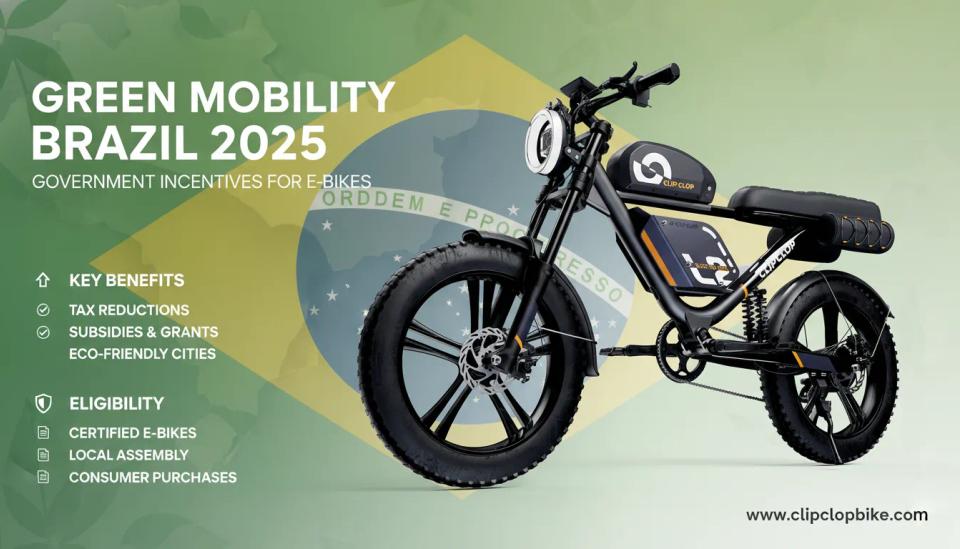
Importing E-Bikes to Brazil 2026: IPI Tax Reductions, Inmetro Rules & Manaus Assembly (SKD)
Send your brief. We will field-note back.
Reply includes the feasibility view, sample cost, MOQ, and the next step for your project. We aim to respond within 48 hours.