

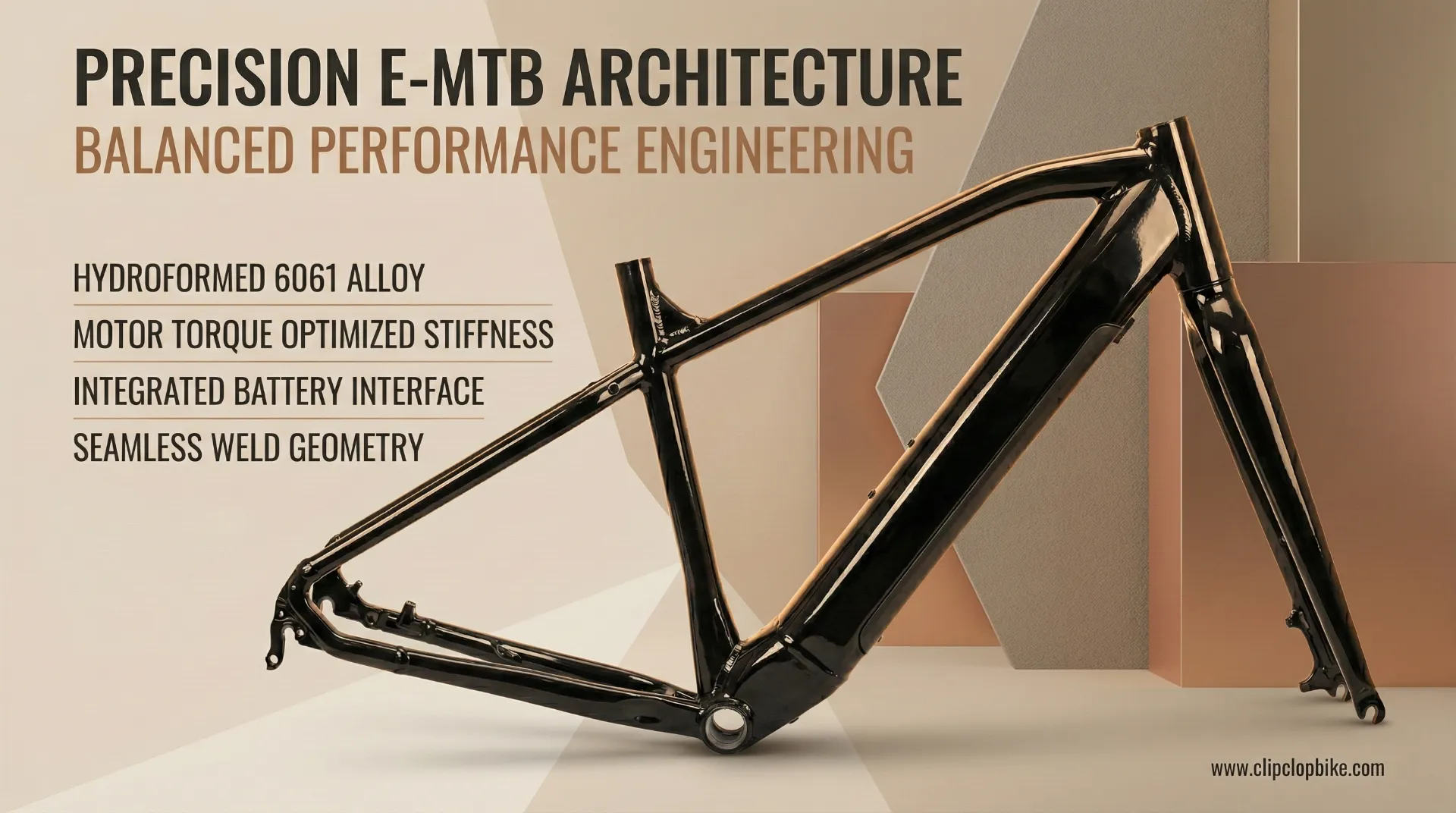
The e-bike market is moving fast, and buyers feel it in every spec sheet. Distributors want frames that are tough, light, sharp-handling, and still affordable at scale. Physics won’t let all four rise together—Strength, Stiffness, Weight, and Cost constantly tug against each other. At ClipClop, we treat tube wall thickness and geometry as the main “control knobs” for landing on a smart, sellable balance.
Wall thickness isn’t simply “more metal = more safety.” On a 6061 aluminum frame, welding creates a Heat Affected Zone (HAZ) where the alloy temporarily softens. If you ignore that, the strongest material grade on paper can become the weakest point on the road. The fix is targeted thickness: add material where stress concentrates—head tube, bottom bracket, motor mount, and the ends of stays—instead of making every tube uniformly heavy.
The ClipClop L1 platform was built around use cases, not slogans. A 250W commuter and a 1000W high-torque build may share the same outline, but internally the frame has to “behave” differently. Battery packaging matters too: a 48V 15Ah pack needs clearance and mounting points that don’t carve away the downtube’s backbone. Done right, the bike feels calm at city speeds and still stable when you push toward 55 km/h.
For sourcing managers, the hardest question is what’s “enough” without paying for “too much.” Go overly thick and you add system weight, trimming real-world range (often 60–80 km) and raising shipping costs. Go too thin and fatigue life becomes the silent killer—small flex turns into cracks, warranty claims, and reputation damage. The goal isn’t perfection; it’s predictable performance over years of use. And yes, riders notice.
Why strength decides fleet lifespan
Strength is the ability to avoid permanent deformation or sudden failure under high loads. High-torque motors punish the bottom bracket area, chainstay junctions, and dropouts. Thicker walls—or better, thicker walls only at those hotspots—help prevent snapped stays and ovalized mounts during steep climbs, heavy cargo use, or repeated hard braking.
A common pitfall is obsessing over raw tensile numbers and forgetting that welds rewrite the story. 6061-T6 looks great on a datasheet, but the HAZ near welds is softer until proper post-weld heat treatment restores it. That’s why butted tubing matters: thicker tube ends provide stronger joints and more weld area, while thinner mid-sections save weight where stresses are lower.
If you want to validate strength instead of trusting brochures, ask for fatigue data. Tests under standards such as ISO 4210 simulate years of vibration and impacts. Passing high-cycle fatigue targets doesn’t guarantee immortality, but it’s a strong signal the frame was engineered as a structure, not just a shape. For rental fleets, this paperwork is often the cheapest insurance you can buy.
Battery integration adds another twist. A large battery opening creates an “open section,” reducing stiffness and concentrating stress around edges. The practical fix is a mix of local wall thickening, ports with smooth radii, and internal sleeves or gussets around the bay. It’s a small, calculated weight penalty that pays back in fewer cracks and fewer emergency replacements.
How stiffness changes handling and safety
Strength keeps the bike from breaking; stiffness keeps it from feeling nervous. A frame that flexes wastes motor input, can trigger speed wobble, and makes hard braking feel vague. Torsional stiffness matters most: if the main triangle twists, shifting suffers, rotors rub, and the rider loses confidence—especially at speed.
Stiffness can rise quickly without a huge weight penalty if you combine thickness with smart tube shapes. Large-diameter, hydroformed tubes increase rigidity geometrically, so you get a big jump in control for a modest increase in material. That “sculpted” look on good aluminum frames is often structural, not cosmetic.
There is a comfort ceiling, though. An ultra-rigid frame can transmit bumps, so the system needs balance: use the chassis for steering precision and the suspension for comfort. In practice, that reduces rider fatigue and lowers the odds of mistakes when the surface gets rough.
The hidden costs of chasing the lowest weight
“Lightweight” sells, but it can hide risky shortcuts. If a supplier thins wall thickness too far to hit a marketing number, the frame may pass a quick static test yet fail later from fatigue. Building light and strong usually demands tighter weld control, more complex forming, and stricter heat treatment—none of which is truly cheap. When a “featherweight” frame is priced like a budget frame, the missing cost is often hiding in process quality.
It’s also worth remembering where the mass really lives. On most e-bikes, the motor and battery dominate system weight. Saving a few hundred grams on the frame can help, but not if it compromises the downtube that protects a high-capacity pack. A slightly heavier, properly reinforced frame often wins long term because it stays aligned, quiet, and serviceable.
How thickness influences manufacturing cost
Tube thickness affects more than raw material spend. Very thin walls are harder to weld without burn-through, raising rejection rates and making pricing unstable. Slightly thicker joint areas can improve yield and reduce rework, which often matters more than the aluminum price per kilo. Hydroforming adds upfront tooling cost, but it can reduce the need for extra gussets and manual reinforcements, simplifying assembly and improving consistency.
Heat treatment is the quiet make-or-break step for 6061. After welding, frames need the correct solution treatment and aging to regain T6-level strength. Some factories shorten cycles to save time and electricity, and the result is a frame that’s meaningfully weaker than it should be. Strong QA here isn’t glamorous, but it’s one of the best ways to avoid expensive field failures.
What changes when you spec for a 1000W motor
Going from 250W to 1000W isn’t a small upgrade—it changes the load case. Dropouts and torque interfaces become critical because the axle wants to rotate under heavy current and traction. Frames meant for high power typically use thicker dropout plates, torque-arm strategies, and extra reinforcement where the rear triangle meets the main frame.
High speed also raises impact loads. Hitting a pothole at 55 km/h is a different event than hitting it at 25. Reinforced head tube and downtube junctions, plus controlled wall thickness around welds, help manage those spikes without adding unnecessary mass everywhere. That targeted approach is what separates a serious platform from a generic “one-size-fits-all” frame.
Why 6061 is still the standard
6061 earns its spot because it’s a practical middle ground: strong enough after heat treatment, highly weldable, widely available, and friendly to hydroforming and butting. It also supports predictable supply chains and recycling as sustainability expectations rise. At ClipClop, our team—including leo liang—obsesses over repeatable welding and heat-treat control, because consistency is what turns a good material into a reliable product.
How B2B buyers can verify quality before ordering
Before committing to a container load, ask for evidence that matches real failure modes: fatigue test reports, stiffness or deflection data, and heat-treatment documentation. Then inspect welds—clean, even beads with no undercutting are a good sign of process control. Finally, look at battery ports and cable routing: reinforced openings with smooth transitions reduce stress risers and keep electronics secure. If a supplier can’t show you these basics, you’re not buying confidence—you’re buying a gamble.
FAQ: Common Questions About E-Bike Frame Engineering
Q1: Is a heavier frame always stronger? Not necessarily. Strength depends on the material quality (6061-T6), the Wall thickness in high-stress areas, and the quality of the welds. An efficiently designed “butted” frame can be stronger and lighter than a cheap, heavy, straight-gauge frame.
Q2: Why is frame stiffness important for high-speed e-bikes (55KM/H)? At high speeds, lateral forces increase. A “flexy” frame can cause dangerous oscillations (speed wobble). High torsional stiffness ensures the bike tracks straight and remains stable under heavy braking with Hydraulic disc brakes.
Q3: Can I customize the frame for a larger battery? Yes. At ClipClop, we specialize in OEM/ODM solutions. However, increasing the battery size usually requires a Frame optimization strategy to ensure the larger downtube doesn’t compromise the Structural integrity or weight balance.
Q4: What is the benefit of 20*4.0 fat tires on an aluminum frame? Fat tires provide natural “pneumatic suspension,” which reduces the impact loads on the Aluminum alloy frame. This can actually extend the Fatigue life of the frame by absorbing high-frequency vibrations before they reach the metal.
Q5: How do you balance cost and quality for large-scale B2B orders? We use a Performance-to-cost ratio framework. By standardizing on 6061 alloy and using automated Hydroforming, we keep production costs low while maintaining the High-performance specs required for international markets.



 English
  Spanish
  Portuguese
  Russian
  Arabic
  French
  Dutch
Dutch  German
  Danish
