
E-Bike Frame Material Selection Guide: 6061 Aluminum vs Steel vs Carbon for B2B Importers
Choosing the frame for an e-bike fleet isn’t some nerdy engineering side quest, at least not to me. From my experience, it’s a straight-up business decision that hits profits, warranty headaches, and
Choosing the frame for an e-bike fleet isn’t some nerdy engineering side quest, at least not to me. From my experience, it’s a straight-up business decision that hits profits, warranty headaches, and
Choosing the frame for an e-bike fleet isn’t some nerdy engineering side quest, at least not to me. From my experience, it’s a straight-up business decision that hits profits, warranty headaches, and how much people trust your brand. As a distributor or retailer, I always remind myself: I’m not just buying bikes, I’m buying the backbone my customers literally rely on every single day.
Commercial partners can inspect our manufacturing infrastructure on our OEM/ODM E-Bike Manufacturing Facility page, review standard configurations on our CS01 Fat Tire & CS04 Commercial Utility Platforms, or directly request volume FOB terms via our Commercial Quote Request Portal (MOQ 20).
In the fast-growing electric mobility world, especially in tough regions like Mexico and South America, the frame really carries everything. I’ve seen bikes get destroyed on cobblestone streets or overloaded by delivery riders who just keep pushing. Whether you’re selling to couriers or weekend trail lovers, the frame material—Aluminum Alloy, Steel, or Carbon Fiber—ends up shaping how long that bike actually survives.
In this guide, I’m not staying on the surface. I want to dig into things like fatigue limits, tensile strength, real manufacturing costs, and even supply chain stress. I’ve learned the hard way that skipping these details gets expensive later. By the end, you should have a clear, practical way to pick the right e-bike frame material for your specific market and customers.
Why Does Frame Material Choice Define Your Business Success?
For B2B buyers like me, the frame eats up a big chunk of the BOM, and it quietly controls import costs. When I calculate total landed cost, the frame affects more than the factory quote. It changes shipping weight, HS codes, and sometimes triggers ugly anti-dumping duties. Ignore this stuff, and margins disappear faster than expected.
I’ve also noticed how frame material connects directly to after-sales pain. If the frame is too brittle for local roads, failures happen, recalls follow, and reputation tanks. On the flip side, going too heavy kills battery efficiency on modern 48V systems. Then customers complain about range, and suddenly your “durable bike” feels like a bad purchase.
In markets like Mexico, searches for “durable e-bike” or “e-bike for delivery” keep growing. Riders there treat e-bikes like work tools, not toys. Speed bumps, potholes, steep climbs—it’s daily abuse. So yeah, yield strength and corrosion resistance aren’t optional details. From what I’ve seen, they’re survival-level requirements for inventory that actually sells.
Download the 2026 ClipClop Factory Catalog (PDF)
Full e-bike specs, motor & battery options, MOQ, and container loading details.
How Do Global Trends and Local Reality Influence Material Selection?
When I scroll through Google Trends, Reddit threads, or X posts, the gap between desire and reality is obvious. People search for “lightweight” and “cheap,” but then ride like they want “tough” and “fixable.” Bloggers often say the same thing: don’t trust keywords alone, watch how bikes are actually used on the street.
For B2B buyers targeting Latin America, I’ve seen a clear shift toward utility-first thinking. The question is no longer “how fast?” but “will this crack under 150kg?” That’s where the aluminum vs steel e-bike frame debate gets serious. Real-world load matters more than marketing promises.
Delivery riders online often complain about rear dropout failures on cheap alloy frames, especially with hub motors. At the same time, high-end riders argue about carbon stiffness on trails. My takeaway is simple: filter the noise. Match stiffness and elasticity to terrain. A rigid frame on rough roads without suspension just creates fatigue and structural stress.
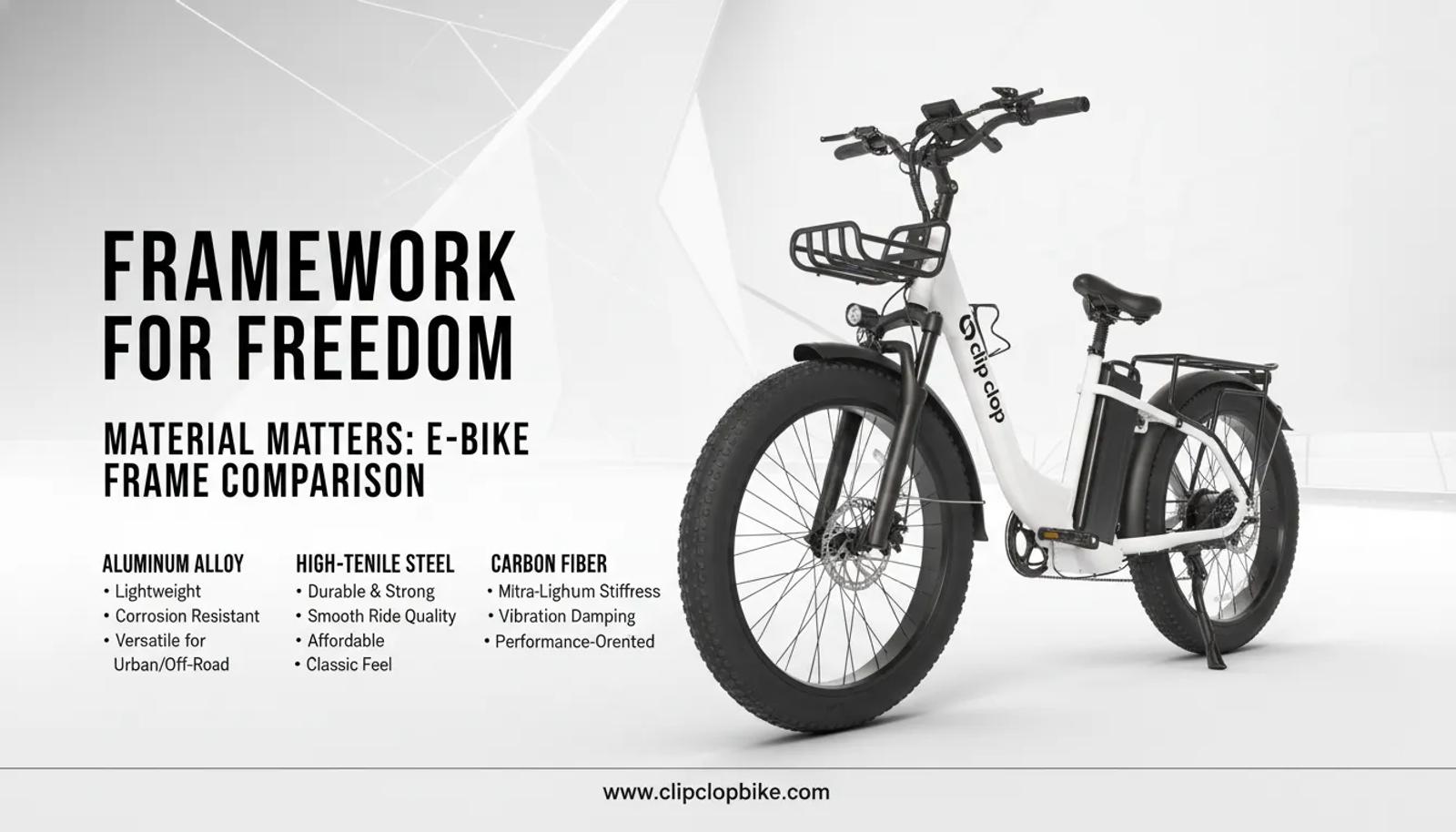
Aluminum Alloy: The Industry Standard for a Reason
Aluminum Alloy, especially 6061 and 7005, dominates the mid-to-high-end e-bike space for good reasons. It sits in that comfortable middle ground between weight, cost, and performance. At ClipClop, I’ve seen how a 6061 frame lets us run a 48V 750W motor and a 48V 15Ah battery without making the bike feel like a tank.
What I like most about aluminum is its strength-to-weight ratio. It’s about one-third the density of steel, which matters a lot for e-bikes. Every kilo saved on the frame can go into battery or motor instead. Plus, aluminum naturally resists corrosion, which bloggers always remind me is crucial for coastal or humid cities.
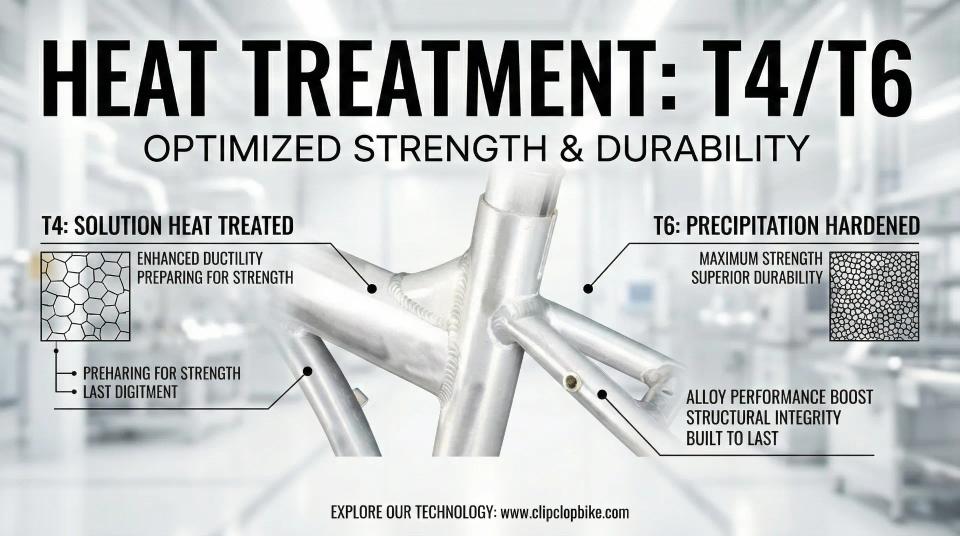
That said, manufacturing aluminum isn’t forgiving. It needs clean TIG welding and proper T6 heat treatment. I’ve seen factories skip this to save money, and the weld zones turn brittle. So I always ask suppliers directly: do you do full solution heat treatment and artificial aging, or not? That question saves trouble later.
Application-wise, aluminum works best for urban commuting, off-road e-MTBs, and folding bikes. It gives that modern look and lighter feel people expect, especially city riders who carry bikes upstairs or onto public transport.
Steel: The Unstoppable Workhorse for Heavy Duty
Even though aluminum dominates consumer bikes, steel still wins when abuse is guaranteed. From my experience comparing aluminum vs steel e-bike frames for fleets, steel often comes out ahead on total cost of ownership. It’s not flashy, but it survives things other frames don’t.
Steel’s fatigue limit is a big deal. Unlike aluminum, steel can handle endless stress cycles if they stay below a certain level. It bends before breaking, which gives riders warning. Aluminum usually doesn’t warn you—it just snaps once cracks spread. For delivery riders, that difference matters a lot.
In Mexico, where riders overload bikes on rough roads daily, steel absorbs vibration better and rides smoother. And if it cracks, local welders can often fix it. Aluminum needs special welding gear and heat treatment, so field repair is basically impossible. That repairability keeps steel relevant.
Application-wise, steel shines for cargo e-bikes, delivery fleets, and budget entry-level models where durability matters more than weight or looks.
Carbon Fiber: The Pinnacle of Performance and Price
Carbon fiber frames sit at the top of the food chain in terms of performance. What fascinates me is that carbon isn’t isotropic like metal. Engineers can tune stiffness by changing fiber direction. That means stiff for pedaling power, but still comfortable vertically, which bloggers love to point out in reviews.
Carbon is incredibly light, and that changes how a bike feels. Handling improves, range stretches, and the design freedom allows wild, aerodynamic shapes. That premium look sells well to certain buyers who want status as much as speed or tech.
But for most B2B buyers, carbon is risky. Manufacturing costs are high, molds are expensive, and impacts are dangerous. A small crash that dents steel could cause invisible carbon damage. For rental fleets or big distributors, that hidden risk and liability usually kill the carbon dream fast.
Application-wise, carbon belongs to high-end e-MTBs, road e-bikes, and luxury lifestyle brands targeting wealthy, informed customers.
Technical Showdown: Analyzing the Physical Properties
When I make decisions, I still look at numbers. Density shows carbon is lightest, aluminum sits in the middle, and steel is heavy. That explains why aluminum feels like such a compromise material—it’s much lighter than steel, but way cheaper than carbon.
Tensile strength tells another story. Carbon and steel are both strong, but steel needs more material to reach that strength. Aluminum is weaker, so designers compensate with thicker, oversized tubes. Bloggers often mention this when talking about chunky aluminum frame designs.
Stiffness matters too. Steel is naturally stiff, aluminum less so, and carbon can be tuned anywhere in between. Corrosion resistance is where steel suffers most, especially in humid or coastal regions. Without coatings and care, rust becomes a real enemy fast.
For something like the ClipClop Model C3, 6061 aluminum keeps weight under 35.5kg while supporting 150kg loads. Steel would cut range, carbon would explode costs. That balance is why aluminum keeps winning.
Strategic Sourcing: Which Material Fits Your Business Model?
Your business model should always drive material choice. If you’re a DTC brand focused on commuting and lifestyle, aluminum makes sense. It looks premium, ships efficiently, and fits apartment living. From what I’ve seen, it delivers strong perceived value without crazy costs.
If you supply delivery fleets like UberEats or Rappi, uptime matters more than looks. Steel or reinforced aluminum works better here. Steel survives crashes and overloads. If you insist on aluminum, reinforce dropouts and head tubes to handle 750W motor torque properly.
If you’re a boutique performance shop, carbon belongs on your floor. Your customers want tech and status. They understand maintenance and accept the risks because they’re buying feel, weight savings, and handling advantages.
Common Sourcing Mistakes to Avoid
Over the years exporting from Guangzhou, I’ve watched buyers repeat the same mistakes. One big one is assuming “alloy” automatically means quality. Cheap recycled aluminum is not the same as virgin 6061-T6. Always ask for material certificates, even if it feels awkward.
Another mistake is ignoring welding quality. The joint matters as much as the tube. Robotic welding is usually more consistent for volume. Smooth or flat weld finishes often signal higher care. Bloggers constantly warn about ugly welds hiding weak spots.
Dropout design is another silent killer. Hub motors put massive torque on rear dropouts. Standard bicycle dropouts fail fast. Always confirm torque arms or reinforced designs are included, or failures are almost guaranteed.
Conclusion: Partnering with the Right Manufacturer
There’s no single “best” frame material. There’s only the right one for your customer and use case. Aluminum stays versatile and dominant, steel remains the tough veteran, and carbon plays the specialist role at the top end.
At ClipClop, we don’t just weld tubes together. We design around real-world use. Whether it’s a lightweight commuter like the Model C3 or a heavy-duty delivery solution, we understand materials, manufacturing, and supply chains deeply.
If you’re ready to upgrade your inventory with reliable, high-performance e-bikes, reach out. We’re experienced in electric off-road bike manufacturing and export, and we’re ready to support dealers, wholesalers, and brand partners with real, practical solutions.
FAQ: Common Questions About E-bike Frames
Q1: Which frame material is best for a 1000W electric bike?
For high-power e-bikes (1000W+), Chromoly Steel or reinforced 6061 Aluminum are recommended. The high torque requires a frame with high structural integrity, particularly at the motor mounting points. Carbon fiber can be used but must be specifically engineered for e-bike loads.
Q2: Can aluminum e-bike frames rust?
Aluminum does not rust like steel (red iron oxide). However, it can corrode (white powder oxidation) if exposed to salt and moisture for long periods without protection. Quality frames use powder coating or anodizing to prevent this.
Q3: Is a steel frame too heavy for an electric bike?
Not necessarily. While steel is heavier, the electric motor assists the rider, masking the weight penalty. For flat terrain and cargo use, the weight difference is negligible compared to the durability benefits. However, for lifting the bike upstairs, steel will be noticeably heavier.
Q4: How do I check the quality of an aluminum frame from a supplier?
Check the welds. They should be uniform, capable of a "stack of dimes" look (or smoothly sanded for high-end). Ask for the heat treatment capability of the factory (T4/T6 process) and check if the frame undergoes fatigue testing (e.g., ISO 4210 standards).
Q5: What is hydroforming in e-bike frames?
Hydroforming is a process where high-pressure hydraulic fluid is used to shape aluminum tubes into complex curves and shapes. This allows manufacturers to create frames that are stronger in high-stress areas and lighter in low-stress areas, optimizing the strength-to-weight ratio.
References:
- Sheldon Brown - Frame Materials for the Touring Cyclist. Retrieved from https://www.sheldonbrown.com/frame-materials.html
- MatWeb - Material Property Data (Aluminum 6061-T6). Retrieved from http://www.matweb.com
ClipClop Manufacturing Standards & Build Quality
Looking for production-grade e-bike manufacturing? Explore our ClipClop L1 Hydroformed 6061 Chassis and our ClipClop CS04 Reinforced Cargo Chassis, engineered with factory-direct OEM customization from 10 units.
- Cycling Industry News - Market Trends in E-Mobility Materials. Retrieved from https://cyclingindustry.news
Commercial Procurement & Fleet Sourcing with ClipClop
Deploying electric bicycle fleets or distributing private-label e-bikes requires a trusted manufacturing partner capable of consistent container-level production, robot-welded frame alignment, and rigorous batch QC. From our 25,000 m² factory in Qingyuan, Guangdong, ClipClop provides end-to-end OEM/ODM electric bike manufacturing services with an accessible MOQ of just 20 units per SKU. Every container order includes dedicated spare parts allocation (2% free warranty backup components), full international compliance documentation (EN 15194, UL 2849, UN38.3), and 15-day sample dispatch.
Ready to evaluate engineering samples for the CS01 Fat Tire & CS04 Commercial Utility Platforms or review container FOB volume pricing? Visit our Commercial RFQ Portal to submit your technical specifications, or speak directly with our engineering sales team via our B2B contact desk.
Download the 2026 ClipClop Factory Catalog (PDF)
Full e-bike specs, motor & battery options, MOQ, and container loading details.
More OEM field notes.
Mid-Drive Motors for Heavy Cargo & Mountain E-Bikes: Torque Multiplication & Gradients
The Real Story on E-Bike Frame Alloys: What Dealers Should Actually Know About 6061, 6063, and 7005
Hub Motors for Urban Delivery & Commercial Fleets: Reliability, TCO & Zero-Maintenance Design
T4 Solution Heat Treatment vs. T6 Artificial Aging: Yield Strength, Webster Hardness & ISO 4210 Fatigue Life
Send your brief. We will field-note back.
Reply includes the feasibility view, sample cost, MOQ, and the next step for your project. We aim to respond within 48 hours.