

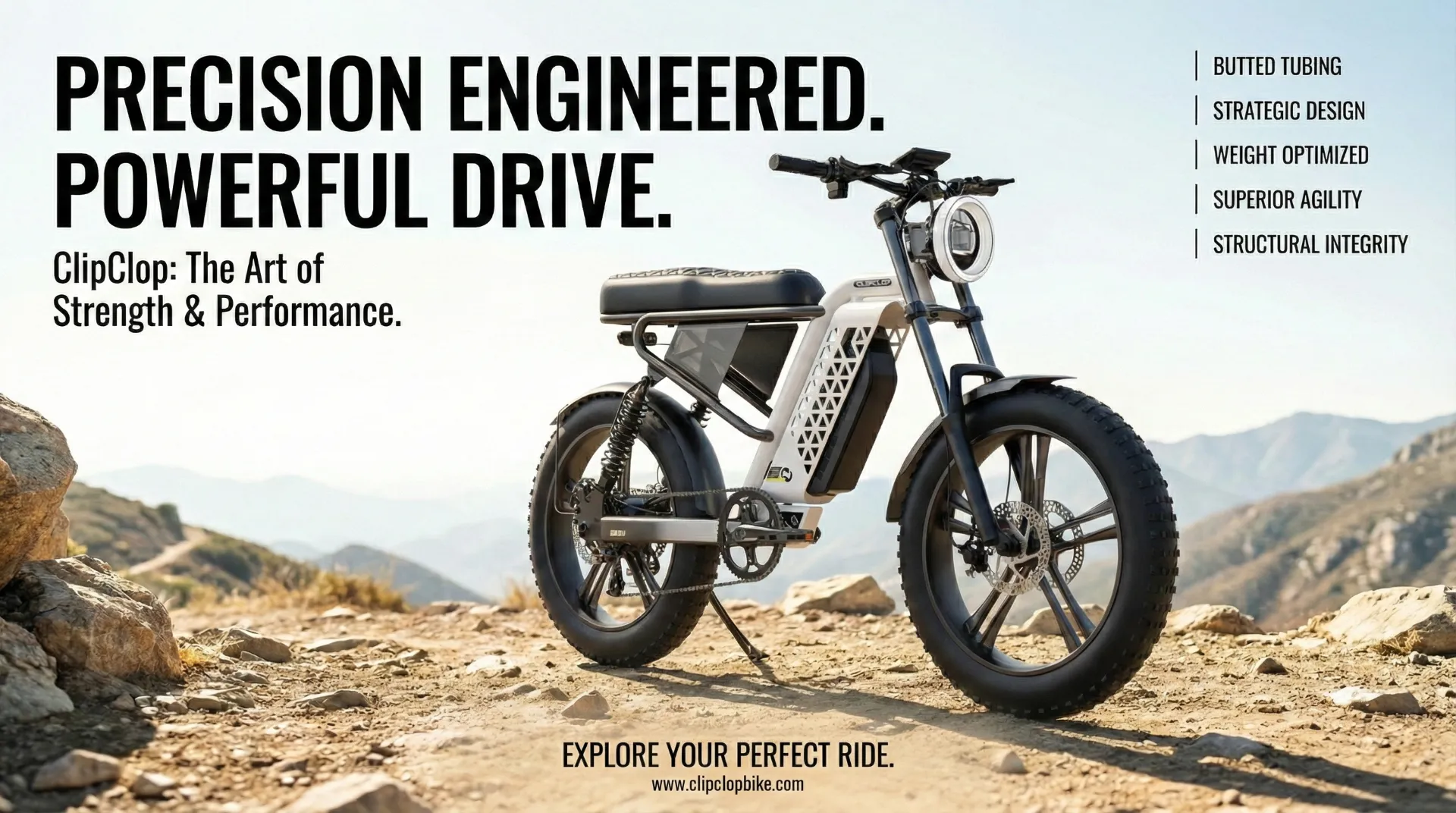
E-bikes are a contradiction: we add a battery and a high-torque motor, then expect the bike to feel nimble anyway. If you manage products or distribute globally, you’ve probably felt that tension in every spec meeting.
Tube wall thickness is one of the quiet levers that moves everything—handling, range, shipping cost, and warranty risk. That’s where Electric Bike Butting Technology becomes a real strategy decision, not just a technical detail.
I’m Leo Liang from ClipClop, and I’ve seen brands “save” on frames, then pay later through heavier freight, more fatigue complaints, and lower review scores. A smart butting profile is a simple way to avoid that cycle in the first place.
What “butted tubing” actually means (and what it’s not)
“Butting” means a tube is thicker near the ends (where it’s welded) and thinner in the middle (where stress is usually lower). A plain-gauge tube stays the same thickness end-to-end. Plain gauge is easy to build, but it often leaves dead weight in low-stress areas.
The logic is stress distribution. Head tube junctions, bottom bracket zones, and suspension interfaces see big loads—especially on 750W–1000W bikes. The center of most tubes is comparatively calm. So we keep material where the work happens, and remove it where it doesn’t.
Why Use Double Butted Tubing for most e-bike lineups
If you’re deciding Why Use Double Butted Tubing, here’s the practical answer: it’s the best balance of cost and performance for most commuter, trekking, and off-road e-bikes.
Single-butted tubes reinforce one end. Double-butted tubes reinforce both ends and thin the center. Triple-butted tubes can shave a bit more, but on many e-bikes the battery weight dominates, so the extra spend doesn’t always show up in the ride.
In day-to-day selling, double-butted 6061 aluminum is the “sweet spot” because it improves strength at the welds (where many failures start) while trimming meaningful weight from the frame. That translates into Butted Tubing E-bike Performance riders notice: better acceleration, easier lifting, and cleaner cornering.
Quick comparison table for procurement teams
| Tube type | Typical wall profile | Weight impact | Cost impact | Best fit | What to verify (B2B) |
|---|---|---|---|---|---|
| Plain gauge | Same thickness end-to-end | Baseline | $ | Entry models, price-first fleets | Alloy grade, weld QC, fatigue test reports |
| Single butted | Thick at one end, thinner elsewhere | Small savings | $$ | Budget commuters, moderate torque | Which end is thickened, thickness map |
| Double butted | Thick at both ends, thinner mid-section | 10–15% frame tube savings (common) | $$–$$$ | Most mid/high models, off-road | Butting map, ISO/EN test data, heat-treatment process |
| Triple butted | 3+ thickness zones | Max savings (incremental) | $$$$ | High-end “weight-focused” builds | Supplier consistency, tolerances, scrap rate |
Numbers vary by design, but the pattern is stable: double butting usually delivers the best ROI in a catalog that needs both margin and credibility.
Strength where it counts: joints, torque, and the real failure points
The fear I hear most is: “If the tube is thinner, isn’t it weaker?” If we were thinning the weld areas, yes. But with double butting, we do the opposite.
Welding creates a heat-affected zone that temporarily reduces local strength. By keeping more material at the joint, you give the weld a stronger platform. That’s why a well-designed double-butted frame can be more durable than a plain-gauge frame at the same weight.
On high-torque builds, the bottom bracket and head tube face the worst mix of loads: rider weight, motor torque, hard braking, and trail impacts. A good butting profile protects those zones without turning the whole frame into a heavy, overbuilt chassis.
Ride feel and vibration: the part riders remember
Stiffness isn’t the only goal. Comfort is money—especially if you sell to rental operators, commuters, or older riders who care more about stability than speed.
A butted tube can introduce a tiny amount of controlled compliance in the mid-section. That micro-flex helps reduce high-frequency road buzz, which matters when an e-bike cruises at 45–55 km/h. Tires and suspension do most of the comfort work, but the frame still shapes the feel.
Customers don’t always know why a bike feels premium. They just know it does, and that first test ride can make the sale.
Aluminum alloy frame optimization: don’t skip the invisible steps
Butting only works if the material and processes are right. For aluminum frames, that usually means a known alloy (often 6061 or 7005) plus disciplined heat treatment. T6 is common for 6061 when handled correctly.
After welding, properties change. If heat-treatment control is sloppy, the benefits of butting shrink, and you get inconsistent results from batch to batch. So treat “double butted” as a starting point—not the finish line. The finish line is repeatable metallurgy and repeatable QC.
B2B E-bike Sourcing Guide: questions that protect your brand
If you’re building a checklist, these questions are worth asking before you commit to volume.
Ask for a butting map (a wall-thickness profile drawing). If the supplier can’t share it, assume you’re paying for a label, not a technology.
Request test documentation aligned with your target market (ISO/EN fatigue and impact), and ask how often they run destructive tests. Then ask about traceability: tube batch numbers, heat-treatment logs, and incoming inspection of raw material.
These details aren’t glamorous, but they’re exactly what keeps you out of recall territory.
Cost-benefit: when the premium pays back
A double-butted frame usually costs more because processing and tolerances are tighter. But the business upside stacks quickly: lower perceived weight, better range efficiency at the same battery size, and a spec line that signals “premium” without changing the motor or electronics.
One overlooked win: lighter bikes are easier to live with—loading car racks, carrying upstairs, maneuvering in small apartments. Those daily moments turn into reviews, and reviews turn into repeat orders.
That’s Aluminum Alloy Frame Optimization with a bottom-line effect.
Range, shipping, and the “spec sheet math”
Even small weight savings create a cascade. If butting removes 1–2 kg from a fat-tire frame, the same 48V 15Ah battery has an easier job, so real-world range (often 60–80 km depending on assist level) becomes more achievable. Riders call it “better efficiency,” but what they really feel is quicker pickup and less effort when the motor is off.
On the B2B side, lighter units are simpler to handle in warehouses and at retail. A few hundred grams per bike won’t change sea freight volume, but it can reduce inland trucking costs, speed up unloading, and lower damage rates when cartons are moved repeatedly. Those are boring savings—until you scale to a container load.
Closing thoughts
If your brand is value-first, a well-executed plain-gauge or single-butted design can work. But if you want a product that feels confident and modern, double butting is usually the minimum you should consider.
At ClipClop, we use this approach on performance-oriented builds like our L1 Series because it delivers joint strength without dragging extra mass through every kilometer. If you’re comparing OEM options, don’t stop at “aluminum frame.” Ask for the profile, the process, and the proof.
If you want to talk through frame specs or positioning for retail partners, reach out—Leo Liang.
FAQ & Extended Reading
Q1: Is double butted tubing significantly more expensive for bulk orders? While the unit cost is higher, the reduction in weight can lead to savings in logistics and a much higher retail conversion rate, often resulting in a better overall ROI for the distributor.
Q2: Can I use double butted tubing for 1000W high-speed e-bikes? Yes, provided the frame is engineered with reinforced “Butt” sections at the head tube and motor mounts. It is actually safer than plain gauge because it manages stresses more effectively.
Q3: Does butting affect the welding quality of aluminum frames? Actually, it improves it. Because the walls are thicker at the weld sites, the welder (or robotic arm) has more material to work with, resulting in a deeper, stronger weld.
Q4: What is the difference between 6061 and 7005 alloy butting? 6061 is more common and easier to work with, offering great corrosion resistance. 7005 is stronger but harder to butt and weld. For most e-bike applications, double-butted 6061 is the optimal choice.
Q5: How can I verify if a sample frame is actually butted? The “Ting Test” involves tapping the tube with a metal object; the sound will change pitch as the wall thickness changes. For a professional verification, an ultrasonic thickness gauge is used.
References:



 English
  Spanish
  Portuguese
  Russian
  Arabic
  French
  Dutch
Dutch  German
  Danish
