
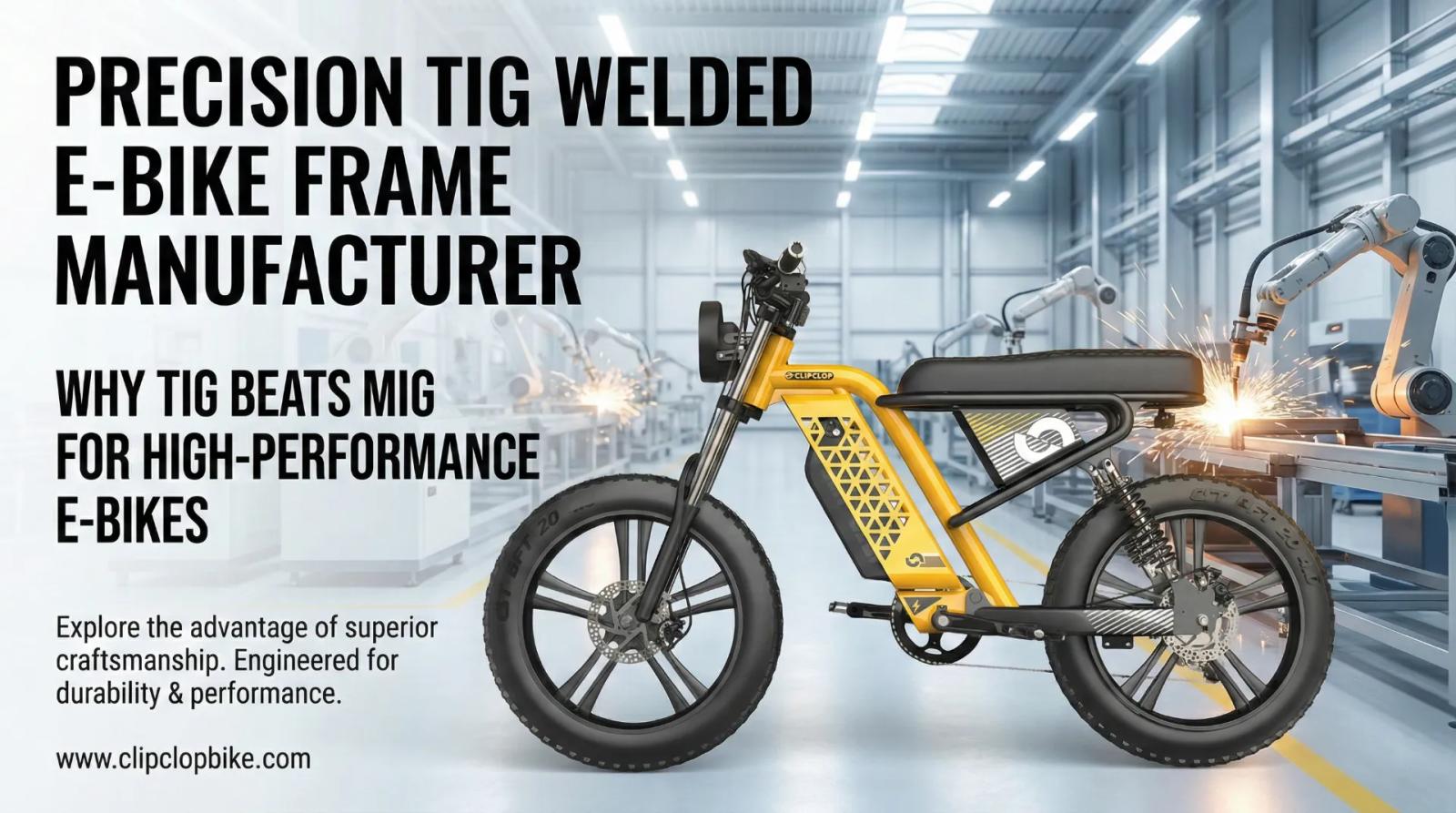
Precision TIG Welded E-Bike Frames: Factory Quality Standards vs Robotic MIG Welding
Hello, I’m Leo Liang . I’ve spent years in the B2B electric off-road bike world at ClipClop, and I’ve learned one thing the hard way: your motor spec gets the spotlight, but your frame pays the
Hello, I’m Leo Liang . I’ve spent years in the B2B electric off-road bike world at ClipClop, and I’ve learned one thing the hard way: your motor spec gets the spotlight, but your frame pays the
The structural chassis of an electric bicycle bears the combined dynamic stresses of motor torque, battery payload, and continuous commercial duty cycles. For OEM buyers, commercial fleet operators, and distributors, specifying e-bike frame manufacturing requires rigorous evaluation of hydroformed 6061-T6 and 7005 aluminum alloy chemistry, automated robot welding penetration, and post-weld T4/T6 artificial aging heat treatments to satisfy ISO 4210 and EN 15194 fatigue standards. This technical analysis outlines factory-floor quality benchmarks for high-volume frame production.
Factory Direct Sourcing & OEM/ODM Manufacturing with ClipClop
Commercial partners can inspect our manufacturing infrastructure on our OEM/ODM E-Bike Manufacturing Facility page, review standard configurations on our CS01 Fat Tire & CS04 Commercial Utility Platforms, or directly request volume FOB terms via our Commercial Quote Request Portal (MOQ 20).
During factory audits, there’s one question that pops up like an uninvited cousin at a BBQ: “Why TIG? Why not MIG?” And honestly? If you care about high-end aluminum frames, TIG is the boring answer that saves you from exciting disasters later.
This article breaks down the real reasons premium factories lean on TIG—heat control, fatigue strength, inspection, aesthetics, and why robotic TIG is quietly becoming the standard for serious distributors.
Why the bicycle industry keeps picking TIG over MIG
At the simplest level, TIG (Tungsten Inert Gas) lets you control heat and filler separately. MIG (Metal Inert Gas) typically feeds wire continuously, which is great for speed, but not great when you’re dealing with thin aluminum tubing and joints that can’t afford sloppy heat spread.
Aluminum bicycle frames—especially 6061-T6—are sensitive to heat. When you weld, you create a heat-affected zone (HAZ) around the joint. That zone is where the alloy’s properties can get softened if the heat input is too high or too wide. TIG’s focused arc helps keep the HAZ smaller and more predictable, which means more of the surrounding tube keeps its strength.
MIG is faster and cheaper, sure. But on thin-wall aluminum, speed can turn into “oops.” Too much heat too quickly can mean a taller bead, more distortion, and a bigger HAZ—basically a wider area of “this used to be strong.”
And yes, TIG also wins on looks. The famous “stack of dimes” ripple isn’t just aesthetics—it’s often a sign of stable heat control and a clean process. Customers notice it instantly, and in premium markets, that visual cue sells.
TIG vs MIG for aluminum e-bike frames (quick B2B comparison)
| Topic | TIG (Tungsten Inert Gas) | MIG (Metal Inert Gas) |
|---|---|---|
| Heat control on thin 6061 tubes | Excellent, precise, adjustable | Good on thicker parts, risky on thin sections |
| Heat-affected zone (HAZ) size | Typically smaller and tighter | Often larger due to higher deposition/heat |
| Weld appearance | Clean “stack of dimes,” minimal spatter | Thicker bead, more spatter, more cleanup |
| Inspection during production | Easier to spot issues early | Messier beads can hide defects |
| Distortion risk | Lower with proper sequencing | Higher, especially on complex frame geometry |
| Factory cost per unit | Higher labor/equipment time | Lower, faster throughput |
| Best fit | Premium aluminum frames, high stress points | Steel frames, heavy structures, cost-driven builds |
If you’re buying for a budget commuter bike, MIG can be acceptable (especially on steel). But for a high-torque, high-speed aluminum off-road platform? TIG is the “pay now, save later” option.
How aluminum TIG welding improves frame fatigue strength
Here’s the uncomfortable truth: aluminum doesn’t forgive forever. Unlike steel, many aluminum alloys don’t have a clean “fatigue limit” where stress cycles stop mattering. Every bump, vibration, landing, and curb hop adds up—especially on an off-road e-bike with big tires and a torquey motor.
A high-quality TIG joint helps in three practical ways:
First, TIG can achieve strong penetration with controlled heat, which helps create a uniform, dense weld structure. The fewer internal voids and inconsistencies you have, the less chance micro-cracks get a free ticket to start growing.
Second, TIG can reduce sharp transitions at the weld toe (where the weld meets base metal). Those sharp edges become stress risers—aka “crack starter kits.” A smoother bead profile spreads stress more gently across the joint.
Third, because TIG is more controlled, it usually means less distortion across the frame. Distortion doesn’t just look bad—it affects alignment, handling, brake rotor rub, and assembly fit. If a frame comes in slightly twisted, your “simple build” becomes a workshop mystery novel.
For our MODEL L1 style builds, the head tube region, motor mount areas, and rear dropout zones take repeated loads. TIG is simply better suited to protecting those areas from early fatigue failures.
Managing the heat-affected zone (the silent killer)
If there’s one topic distributors should care about—even if you hate metallurgical jargon—it’s the HAZ. The HAZ is the area that didn’t melt, but got hot enough to change structure. With 6061-T6, too much heat can partially undo the T6 condition near the weld, creating a softer zone that bends or cracks sooner.
A premium TIG welded e-bike frame manufacturer will have process discipline here: pulse settings, travel speed control, shielding gas stability, and heat management techniques (fixtures, sequencing, sometimes heat sinks). The goal is not “make it stick.” The goal is “make it stick without cooking the tube.”
During audits, you can often see clues. A very wide discoloration band around welds can indicate excessive heat spread. A clean, consistent band usually means better thermal control. (Not perfect proof, but a good early signal—like hearing a weird noise in your car before it becomes a big bill.)
Some factories also use post-weld heat treatment approaches to restore mechanical properties. The exact method depends on design, alloy, and production constraints, but the key message is simple: good factories treat welding as a system, not a single step.
Why robotic TIG welding is becoming the “boring” future (and that’s good)
Distributors love one word: consistency. If you order 500 frames, you want the first and the 500th to behave like siblings, not distant cousins raised in different countries.
Robotic TIG helps with that. Humans get tired, moods change, tiny hand movements vary. Robots don’t get sleepy after lunch. They repeat arc length, travel speed, and path accuracy with maddening consistency—exactly what you want for thin-wall aluminum joints.
The best setups also log parameters per weld, which improves traceability. If a problem is found, you can isolate the batch, the fixture, the program, and the weld station. That’s not just “factory nerd stuff”—it’s what keeps a small defect from turning into a distributor-wide headache.
Robotics isn’t magic; bad programming still makes bad welds. But when a factory invests in robotic TIG and the right QC culture, your risk profile drops fast.
Standardizing quality: NDT checks and ISO-style discipline
If you’re buying premium aluminum frames, you should care about verification, not vibes. Good factories use NDT (non-destructive testing) methods depending on the risk level and customer requirements:
Dye penetrant testing is common and practical for detecting surface cracks or porosity openings. For more critical joints or higher assurance, factories may use X-ray or ultrasonic methods to check internal integrity. Not every batch needs the most expensive test, but a serious supplier should have a clear plan for when and why testing happens.
On top of that, many professional frame programs align with recognized bicycle safety and fatigue test frameworks (for example, ISO-style bicycle frame testing protocols used in the industry). The specifics vary by market and product category, but the concept is the same: repeated stress cycles, controlled loads, measurable pass/fail criteria.
When someone offers you a “very cheap” frame with no testing story, that’s not a deal. That’s a surprise subscription you didn’t sign up for.
Practical B2B sourcing tips for TIG welded frames (from the ClipClop Engineering Team)
If you’re comparing quotes, don’t just compare the number at the bottom. Ask questions that reveal process maturity:
Request details on the welding specification: joint design, targeted penetration approach, bead profile standards, and how they control HAZ on thin sections. If the supplier answers in vague poetry, that’s a sign.
Ask what they do about alignment control: fixtures, welding sequence, post-weld checks, and tolerances. A straight frame saves you assembly time and reduces dealer complaints about handling and brake setup.
Check if they can support a consistent production method (manual TIG with strong QC, or robotic TIG with real traceability). Either can work, but “we just do it like this” is not a process.
And finally, match the welding process to the bike’s job. For a 750W off-road platform pushing 20×4.0 tires over rough terrain, the frame is under real stress. In that scenario, TIG is less of a luxury and more of a sensible insurance policy—like wearing a helmet. Not flashy, but you’ll be glad you did when things go sideways.
Closing
At ClipClop, we treat frame welding like the foundation of the entire product. Motors and batteries are important, but the frame is what keeps your customer safe—and keeps your brand out of painful after-sales drama. If you’re sourcing high-performance aluminum e-bikes, choosing the right TIG welded e-bike frame manufacturer is one of the most strategic decisions you’ll make.
Call to Action: If you have questions about electric off-road bike selection, configuration, or customization, feel free to reach out. We support dealers, wholesalers, and brand partners with one-stop services—from technical support to complete vehicle solutions. Let’s build something durable (and keep your warranty team calm).
FAQ & Extended Reading
Q1: Why is TIG welding more expensive than MIG for e-bike frames? A1: TIG welding is a slower process that requires a higher level of skill or advanced robotic TIG welding bicycle frame production equipment. It uses more expensive shielding gases (like pure Argon) and requires meticulous preparation of the 6061 aluminum alloy surfaces to prevent porosity. However, the reduction in frame failures and the superior bicycle frame weld bead smooth finish justify the investment for premium B2B products.
Q2: Can I use MIG welding for an aluminum e-bike frame? A2: While possible, it is not recommended for high-performance frames. MIG on aluminum often results in a larger heat-affected zone (HAZ) and higher risk of lack of fusion. For a bike that travels at 55KM/H like the MODEL L1, the TIG welded frame fatigue strength is essential for safety.
Q3: How do you inspect the quality of a TIG weld? A3: We use a combination of visual inspection for undercut and weld bead uniformity, and NDT inspection for bicycle frame welds such as dye penetrant testing. For high-end OEM projects, X-ray inspection can be used to ensure there are no internal defects in the bicycle frame welded joints.
Q4: What is the benefit of 6061-T6 aluminum over other alloys? A4: 6061-T6 aluminum offers the best balance of strength, weldability, and corrosion resistance. It responds excellently to 6061-T6 aluminum e-bike frame TIG welding, especially when followed by proper post-weld heat treatment to restore its T6 hardness.
Q5: Does ClipClop offer custom frame designs for B2B clients? A5: Yes, as a custom TIG welded bike frame OEM, we can modify the 20" aluminum alloy frame to fit specific battery sizes, motor mounts, or branding requirements, while maintaining our strict e-bike frame welding process specification.
References:
ClipClop Manufacturing Standards & Build Quality
Looking for production-grade e-bike manufacturing? Explore our ClipClop L1 All-Terrain Fat Bike and our ClipClop CS03 Performance Fat Bike, engineered with factory-direct OEM customization from 10 units.
- European Committee for Standardization - EN 15194
- AWS D1.2/D1.2M:2014 Structural Welding Code - Aluminum
Commercial Procurement & Fleet Sourcing with ClipClop
Deploying electric bicycle fleets or distributing private-label e-bikes requires a trusted manufacturing partner capable of consistent container-level production, robot-welded frame alignment, and rigorous batch QC. From our 25,000 m² factory in Qingyuan, Guangdong, ClipClop provides end-to-end OEM/ODM electric bike manufacturing services with an accessible MOQ of just 20 units per SKU. Every container order includes dedicated spare parts allocation (2% free warranty backup components), full international compliance documentation (EN 15194, UL 2849, UN38.3), and 15-day sample dispatch.
Ready to evaluate engineering samples for the CS01 Fat Tire & CS04 Commercial Utility Platforms or review container FOB volume pricing? Visit our Commercial RFQ Portal to submit your technical specifications, or speak directly with our engineering sales team via our B2B contact desk.
More OEM field notes.
Commercial E-Bike Hydraulic Brakes: Heat Dissipation, 4-Piston Calipers & Mountain Fleets
How We Verify B2B Buyers: A Case Study in Preventing Procurement Fraud & Impersonation
E-Bike Frame Sourcing for Brazil: Corrosion-Resistant 6061-T6 Aluminum for Tropical Fleets
Send your brief. We will field-note back.
Reply includes the feasibility view, sample cost, MOQ, and the next step for your project. We aim to respond within 48 hours.