
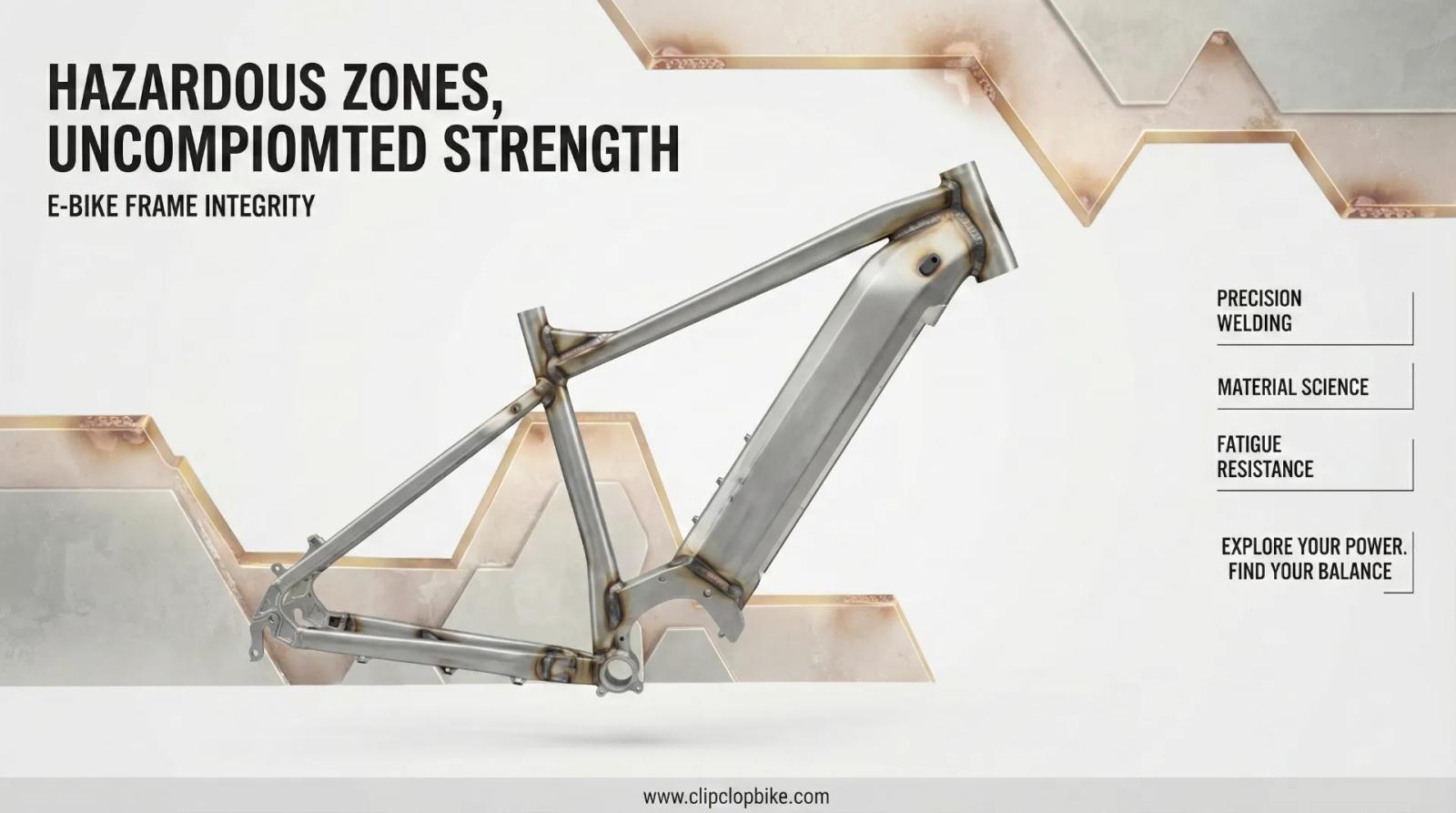
Heat-Affected Zone (HAZ) in E-Bike Frames: T6 Heat Treatment & Weld Quality Control
In B2B e-bike manufacturing, frame strength is the product. You can have a clean-looking weld and still ship a weak frame if you don’t understand the Heat Affected Zone (HAZ) —the band of base…
In B2B e-bike manufacturing, frame strength is the product. You can have a clean-looking weld and still ship a weak frame if you don’t understand the Heat Affected Zone (HAZ) —the band of base…
In B2B e-bike manufacturing, frame strength is the product. You can have a clean-looking weld and still ship a weak frame if you don’t understand the Heat Affected Zone (HAZ)—the band of base metal next to the weld that didn’t melt, but did get hot enough to change its microstructure. In aluminum frames, that change can quietly reduce local strength and fatigue life, turning a “beautiful” bead into a warranty problem later.
Factory Direct Sourcing & OEM/ODM Manufacturing with ClipClop
Commercial partners can inspect our manufacturing infrastructure on our OEM/ODM E-Bike Manufacturing Facility page, review standard configurations on our CS01 Fat Tire & CS04 Commercial Utility Platforms, or directly request volume FOB terms via our Commercial Quote Request Portal (MOQ 20).
I’ve seen this up close as the ClipClop Engineering Team: many “mystery cracks” near headtubes or bottom brackets are not mysteries at all. They’re predictable outcomes of thermal damage, stress concentration, and inconsistent recovery after welding. If you’re building off-road frames that face high torque and repeated impacts, HAZ control is not optional—it’s the difference between reputation and recall.
What the HAZ really does to aluminum frame strength
Aluminum alloys used in frames (especially 6061-T6) get much of their strength from heat treatment. Welding applies localized heat that partially or fully destroys that hardened condition around the joint. The weld metal may solidify strong enough, but the area right beside it can become a “soft zone” that deforms sooner and accumulates fatigue damage faster.
For 6061 frames, the HAZ can drop to a fraction of the original yield strength if you stop at welding and do nothing else. That’s why some frames fail even when the bead looks consistent—because the weak point isn’t always the bead; it’s the band beside it where the alloy got over-aged or annealed.
The practical takeaway for buyers is simple: if a supplier can’t explain how they manage HAZ width, HAZ hardness, and post-weld recovery, they’re guessing. And guessing is expensive.
Material choice sets the “difficulty level” of HAZ control
6061 is popular because it balances strength, corrosion resistance, and availability. But it’s precipitation-hardened, so welding locally disrupts the T6 temper. In contrast, some 7005 alloys can regain some strength through natural aging, which sounds attractive, but consistency and fatigue performance still depend on process discipline and design margin.
Tube thickness also matters. Thin sections heat quickly, enlarging the HAZ and raising distortion risk. Better frame programs use butted or variable-wall tubes so joints have more material where heat and stress concentrate, without making the whole frame heavy.
Below is a simple comparison that purchasing teams can use when reviewing suppliers:
| Factor | 6061 (typical frame choice) | 7005 (often marketed for “recovery”) | What to verify with supplier |
|---|---|---|---|
| Strength source | Requires proper heat treatment (e.g., T6) | Can regain some strength naturally | Exact alloy spec, certs, and temper |
| HAZ sensitivity | High—T6 can be “undone” by welding | Still sensitive, but behavior differs | Weld procedure + recovery method |
| Best path to consistency | Post-weld heat treatment + controlled welding | Tight parameters + validation testing | Hardness map, fatigue data, QC docs |
| Common failure if mishandled | Soft zone near joints, early fatigue cracks | Cracking/porosity if parameters drift | NDT results + rejection criteria |
Welding technique: shrinking the HAZ without sacrificing penetration
You can’t eliminate the HAZ with fusion welding, but you can control its width and stability. In high-quality aluminum frame work, heat input discipline is everything.
TIG welding remains the standard for premium builds because it gives fine control. Pulse TIG can help by limiting peak heat and allowing brief cooling cycles. In volume production, robotic welding can be a major advantage because travel speed and arc time stay consistent from frame #1 to frame #500—critical for distributors who hate “spec drift.”
Three practical levers matter most:
- Travel speed: Too slow widens the HAZ and encourages grain growth; too fast risks lack of fusion.
- Heat sinking / fixturing: Copper or heavy metal fixtures can draw heat away and reduce thermal spread.
- Surface cleanliness: Contamination forces extra heat to “burn through” oxides and oils, enlarging the HAZ and raising defect probability.
Even small improvements here can translate into big fatigue gains, especially in high-stress regions like the headtube cluster and bottom bracket area.
Post-weld heat treatment: the real strength recovery step
If you’re using 6061, post-weld heat treatment is the most direct way to restore mechanical properties across the joint region. Welding often leaves the area near the weld in a softened condition; a correct solution heat treatment + quench + artificial aging cycle rebuilds the precipitation structure that gives “T6-like” hardness and strength.
This step is also where alignment is handled properly. After quench, frames can be temporarily softer, which is a practical window for straightening before final aging locks in stiffness. Skipping or shortening the cycle may save time, but it usually leaves uneven hardness around joints—exactly what fatigue cracks love.
If a factory claims “T6 strength” but can’t show heat-treatment records (oven profiles, batch traceability, hardness checks), treat that as a red flag—not a paperwork issue.
Design strategy: don’t fight physics, design around it
Strong frames aren’t only about welding skill. Good engineering assumes the HAZ exists and keeps peak stresses away from the most vulnerable bands.
Common strategies used in robust off-road frames include:
- Move welds away from peak stress zones using gussets or redesigned load paths.
- Use joint geometry that avoids sharp transitions (smooth fillets, controlled bead toe).
- Butted tubing near joints so even if strength drops locally, the section still carries load safely.
- Reduce weld count by using single CNC-machined parts instead of multiple small brackets, avoiding overlapping HAZ regions.
This is why two frames with the same alloy and similar weld appearance can perform wildly differently in real-world riding.
Quality control: how serious suppliers “see” the HAZ
Visual inspection alone doesn’t tell you what the HAZ looks like internally. High-reliability programs add verification steps that confirm both defect absence and strength recovery.
Typical controls that matter in B2B supply include:
- Dye penetrant testing for surface cracks, especially near stress hot spots.
- Hardness testing adjacent to the weld to confirm recovery (a quick way to spot under-treated batches).
- Macro-etch checks in R&D (sacrificial samples) to measure penetration, HAZ width, and internal quality.
- Traceability reports that tie each batch to welding parameters, operators/robot programs, and heat-treatment cycles.
If your supplier can show you hardness distributions and consistent NDT acceptance criteria, that’s usually a better signal than glossy marketing claims.
Common distributor pain points—and how HAZ mastery solves them
Most distributors who switch suppliers do it for the same reason: unexpected cracking and warranty churn. The pattern is usually early failures near weld clusters after a few months of real riding—not lab-perfect conditions.
HAZ-focused process control reduces:
- Early fatigue cracks in high-stress joints
- Batch-to-batch inconsistency caused by parameter drift
- Costly “field repairs” that rarely restore original fatigue life
- Reputation damage from visible structural failures
When ClipClop talks about metallurgy, it’s not to sound academic—it’s to make sure the product behaves the same in a showroom, in a rental fleet, and on a rocky trail a year later.
What’s next: joining methods that reduce HAZ risk
The industry is moving toward joining processes that reduce or reshape thermal damage. One of the most promising is Friction Stir Welding (FSW), a solid-state method that avoids melting and can dramatically change the traditional HAZ story. It’s not a universal solution, but it’s a direction many serious manufacturers are exploring.
We’re also seeing more simulation-driven development—digital “weld modeling” to predict distortion, thermal gradients, and likely weak zones before production. This pushes quality upstream: fewer surprises, better repeatability, and more efficient iterations.
Sustainability is becoming a real constraint too. More efficient ovens and smarter heat-treatment scheduling can cut energy use while still protecting strength recovery—something European and North American buyers increasingly ask about.
Closing note from the ClipClop Engineering Team
As the ClipClop Engineering Team, my view is blunt: a weld is not just a seam, it’s a metallurgical event. If you treat HAZ as a side effect, you’ll ship frames that look great and age poorly. If you treat it as a core engineering variable—material, welding parameters, heat treatment, design, and QC working together—you get frames that survive real torque, real vibration, and real riders.
If you’re sourcing off-road frames and want fewer after-sales headaches, ask your factory one simple question: “Show me your HAZ control plan—weld parameters, heat treatment records, hardness results, and NDT criteria.” The answer will tell you almost everything you need to know.
FAQ & Extended Reading
Q: Why is the Heat Affected Zone (HAZ) more critical for aluminum than steel? A: Aluminum relies heavily on its heat-treated microstructure for strength. Welding heat disrupts this structure much faster and more extensively than in steel, making welding heat affected zone control a top priority for electric bicycle frame manufacturing.
Q: Can I skip post-weld heat treatment if the weld looks strong? A: Absolutely not. A "good-looking" weld on 6061 aluminum without post-weld heat treatment aluminum will only have a fraction of its required strength, leading to a high reduce HAZ cracking risk under the stress of a 48V 15AH lithium battery and off-road riding.
Q: How do fat tires (20*4.0) affect frame stress? A: 20*4.0 tires provide grip but also allow riders to tackle much rougher terrain, which puts significantly higher fatigue loads on the frame joints. This makes the fatigue strength after welding in the heat affected zone (HAZ) even more critical.
Q: What is the benefit of robotic welding for a B2B buyer? A: Robotic welding e-bike frames ensures that every single unit has the exact same heat input, which means the heat affected zone (HAZ) is consistent across your entire inventory, reducing the chance of "lemon" frames.
Q: Does motor power (e.g., 750W vs 250W) impact frame design? A: Yes. Higher power motors like the 750W motor option on the MODEL L1 apply more torque to the rear dropouts. This requires reinforced high strength aluminum e-bike frames and superior welding quality control for e-bikes to handle the increased mechanical stress.
References:
ClipClop Manufacturing Standards & Build Quality
Looking for production-grade e-bike manufacturing? Explore our ClipClop L1 Pro Dual-Battery Frame, engineered with factory-direct OEM customization from 10 units.
- TWI Global - Understanding the Heat Affected Zone
- ISO 19828:2017 - Welding for Aerospace and High-Performance Applications
Commercial Procurement & Fleet Sourcing with ClipClop
Deploying electric bicycle fleets or distributing private-label e-bikes requires a trusted manufacturing partner capable of consistent container-level production, robot-welded frame alignment, and rigorous batch QC. From our 25,000 m² factory in Qingyuan, Guangdong, ClipClop provides end-to-end OEM/ODM electric bike manufacturing services with an accessible MOQ of just 20 units per SKU. Every container order includes dedicated spare parts allocation (2% free warranty backup components), full international compliance documentation (EN 15194, UL 2849, UN38.3), and 15-day sample dispatch.
Ready to evaluate engineering samples for the CS01 Fat Tire & CS04 Commercial Utility Platforms or review container FOB volume pricing? Visit our Commercial RFQ Portal to submit your technical specifications, or speak directly with our engineering sales team via our B2B contact desk.
More OEM field notes.
Commercial E-Bike Hydraulic Brakes: Heat Dissipation, 4-Piston Calipers & Mountain Fleets

How We Verify B2B Buyers: A Case Study in Preventing Procurement Fraud & Impersonation
E-Bike Frame Sourcing for Brazil: Corrosion-Resistant 6061-T6 Aluminum for Tropical Fleets
Send your brief. We will field-note back.
Reply includes the feasibility view, sample cost, MOQ, and the next step for your project. We aim to respond within 48 hours.