
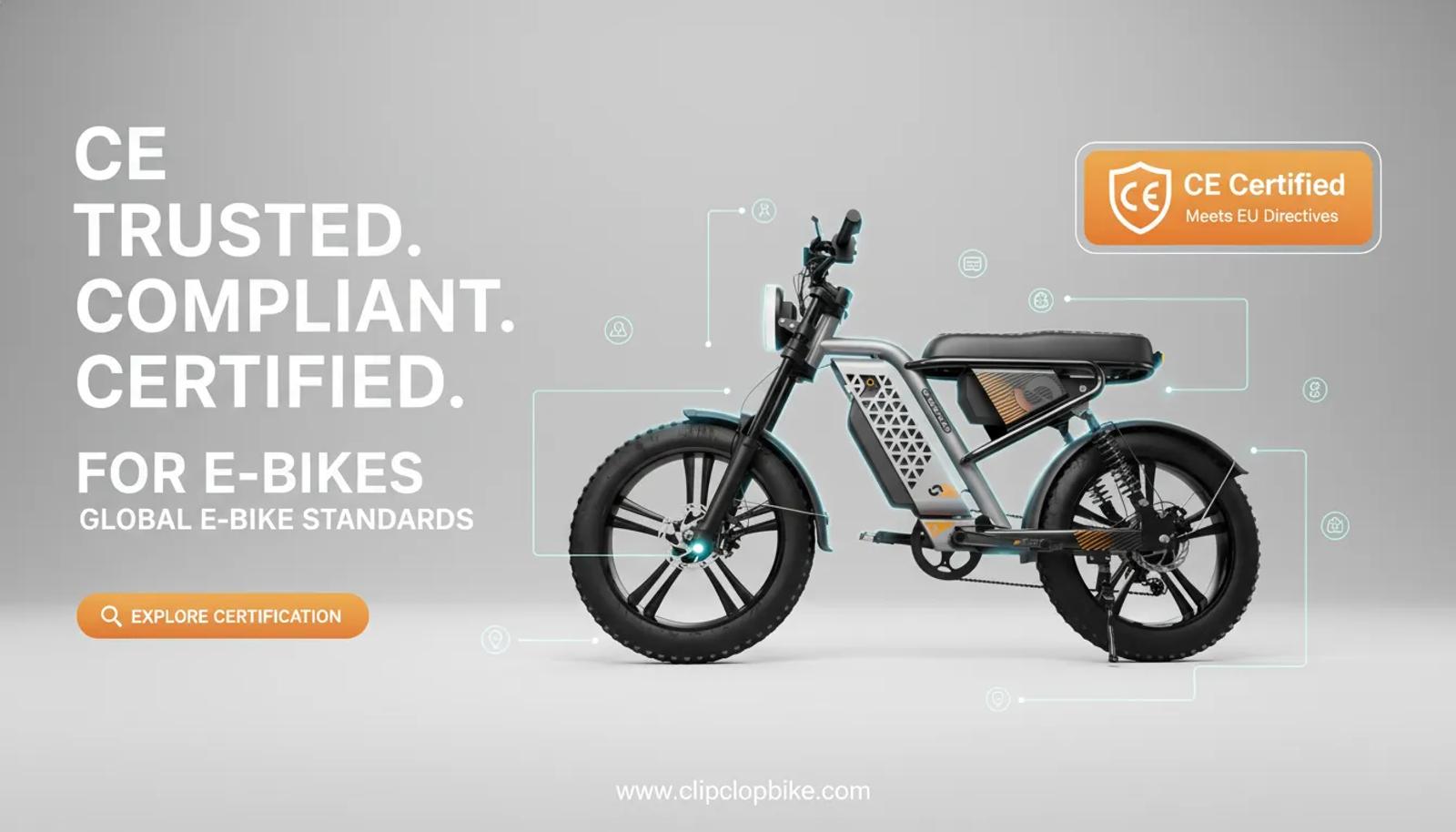
Navigating Electric Bike CE Certification: A B2B Importer’s Guide to EU Standards
Hello everyone, this is Leo Liang. Nice to connect with you again via the ClipClop blog. For those I haven't met, I'm part of the dedicated team at ClipClop, an electric off-road bike company based
Hello everyone, this is Leo Liang. Nice to connect with you again via the ClipClop blog. For those I haven't met, I'm part of the dedicated team at ClipClop, an electric off-road bike company based
Navigating international trade regulations, customs tariffs, and technical compliance standards is fundamental to scaling an electric bicycle distribution or retail business. For global importers, volume distributors, and prospective dealership partners, evaluating factory manufacturing contracts requires verifying test documentation (EN 15194, UL 2849, CE), structuring secure container payment milestones (T/T and L/C), and establishing protected sales territories. This commercial guide details the strategic framework required for profitable B2B e-bike procurement.
Commercial partners can inspect our manufacturing infrastructure on our OEM/ODM E-Bike Manufacturing Facility page, review standard configurations on our CS01 Fat Tire & CS04 Commercial Utility Platforms, or directly request volume FOB terms via our Commercial Quote Request Portal (MOQ 20).
Today, I want to tackle a subject that is absolutely critical, yet it's often shrouded in complexity for many of our international partners: the CE certification on electric bikes. For any business looking to import e-bikes into the European Union, understanding these regulations isn't just an advantage-it's a necessity. You might be asking, "What exactly is this 'CE' mark? Why is it so crucial for my business? And how can I be sure the bikes I'm sourcing are truly compliant?" These are precisely the questions we're going to demystify. This isn't about ticking a box on a form; this is about guaranteeing safety, ensuring product quality, and building a brand that your customers can trust. At ClipClop, we don't see these standards as hurdles but as the very foundation of an exceptional, reliable, and safe electric off-road bike. In this guide, I'll walk you through the core concepts of CE certification, break down the key technical standards involved, and explain how this impacts everything from motor performance to battery safety. My goal is to equip you with the knowledge and confidence you need to make informed procurement decisions and succeed in the competitive European market.
What is the CE Marking and why is it non-negotiable?
For any B2B buyer, importer, or distributor targeting the European Economic Area, the CE marking is your product's passport. It is a mandatory conformity mark that signifies a product has been assessed by the manufacturer and deemed to meet all EU safety, health, and environmental protection requirements.12 Think of it less as a quality seal and more as a declaration of B2B compliance; it confirms that the e-bike is legally fit for sale across all 30 EEA member countries. This single mark allows for the free movement of goods, eliminating the need to meet the specific national regulations of each country.
The critical point for businesses to understand is the consequence of non-compliance. Attempting to import electric bikes without a valid electric bike CE mark can lead to severe penalties. Shipments can be seized by customs, products can be recalled from the market, and significant fines can be imposed.12 For a distributor or a brand, the reputational damage can be even more costly than the financial loss. Your customers, whether they are rental companies or end-consumers, place their trust in the safety and legality of your products. The CE mark is the fundamental assurance of that trust. The process is one of self-certification, where the manufacturer, like us at ClipClop, bears the full responsibility for ensuring every aspect of the e-bike adheres to the relevant European standards. This involves a rigorous process of risk assessment, conformity testing, compiling extensive technical documentation, and finally, issuing a formal Declaration of Conformity (DoC).1 It's a comprehensive commitment to safety and regulatory adherence that underpins the entire supply chain.
Download the 2026 ClipClop Factory Catalog (PDF)
Full e-bike specs, motor & battery options, MOQ, and container loading details.
Deconstructing the Key EU Directives for E-Bikes
To achieve CE marking for e-bikes, a manufacturer must demonstrate compliance with several key EU directives. These directives form the legal framework that governs product safety and performance. While they might seem complex, they logically address every aspect of an e-bike's design and function. The most significant is the Machinery Directive 2006/42/EC. Since an e-bike incorporates a motor and a drive system, it is legally classified as "machinery." This directive sets out the essential health and safety requirements (EHSRs) to prevent accidents and ensure user safety. Complying with this directive is the primary step toward CE certification.
Next is the Electromagnetic Compatibility Directive 2014/30/EU. Every e-bike is an electrical system with components like a motor controller and a Battery Management System (BMS). The EMC Directive ensures that the electromagnetic emissions from these components do not interfere with other electronic devices like radios, phones, or medical devices, and the e-bike itself is not susceptible to interference from external sources. Another important piece is the Low Voltage Directive, LVD 2014/35/EU, generally applicable to the external charger of an e-bike to ensure it meets the safety standard for electrical equipment within a specific voltage limit. In addition, with the increase in smart technology, the Radio Equipment Directive 2014/53/EU will also apply if an e-bike has wireless features like Bluetooth for use with a companion app.1 Finally, there are directives like RoHS that limit the use of certain hazardous materials in electrical and electronic components, thus contributing both to environmental protection and user safety. Besides all that, navigating this web of regulations is a core responsibility we have as manufacturers: every bike that leaves our production is a holistically compliant system.
The Cornerstone of Compliance: Understanding the EN 15194 Standard
While the directives provide the broad legal framework, the technical "how-to" for e-bike compliance is detailed in a harmonized European standard: EN 15194. This standard is specifically for "Electronically Power Assisted Cycles"EPACs. Adhering to the EN 15194 standard provides a "presumption of conformity" with the Machinery Directive, making it the most direct path to certification.2 For our B2B clients, understanding the core requirements of this standard is crucial to ensure you import a legal and safe product for the EU market.
The standard puts clear, testable criteria in place: two of the most basic are that the motor assistance can only kick in when the cyclist is pedaling and must progressively reduce and cut off completely at 25 km/h or 15.5 mph. The maximum continuous rated power of the motor shall not exceed 250 watts. You may look at the specifications for our ClipClop Model L1, which has a 48V 750W brushless motor and boasts a top speed of 51 km/h, and maybe wonder how this fits into a 250W/25 km/h specification. This represents a very critical distinction of the global market. Our products are configured to meet regional regulations. In the EU market, our EPACs will be made fully compliant to the 250W and 25 km/h limits, but for other markets or off-road-specific applications with variable regulatory demands, we continue to offer other power options. This is critical for our international partners who need adaptability. The EN 15194 standard covers a whole gamut of other safety-critical issues, including, but not limited to, braking performance, frame strength, electrical system safety, and lighting requirements; with this standard, it is assured that the whole vehicle is roadworthy and reliable.
How Motor Power and Speed Limitations Influence Various Riding Scenarios
As we've determined, the EU standard for EPACs is very specific: a 250W continuous rated power and a 25 km/h power-assist speed limit. The aim of this regulation is to permit e-bikes to be classified legally as bicycles, thereby allowing them to make use of the same infrastructure, such as bike lanes, without type approval, registration, or a driver's license. This is unlike the more powerful "Speed Pedelecs." For B2B clients serving urban commuters, rental fleets in tourist areas, or leisure riders, this specification is perfectly positioned: it provides meaningful assist for tackling hills and headwinds, extending a rider's range and making cycling more accessible to a broader demographic. A bike compliant with these rules is ideal for navigating city streets and paved bike paths, where high speeds are neither necessary nor safe.
However, for the electric off-road bicycle market that ClipClop specializes in, these limitations can be a point of discussion. For riders tackling steep mountain trails, rugged forest paths, or challenging inclines, a higher motor output and torque are often desired for a better experience. This is where different product configurations become crucial. While our EU-market models adhere strictly to the 250W limit, models intended for private land use or for markets with different regulations, like the US, can be equipped with more powerful systems, such as our 48V 750W brushless motor that delivers 70Nm of torque. This higher power level is designed for conquering aggressive terrain where the extra boost makes a significant difference. As a B2B partner, it is essential to understand the legal framework of your target market and select the appropriate motor power grade to meet both customer expectations and regulatory requirements. Our role at ClipClop is to provide that expert guidance and deliver a product correctly configured for its intended application scenario.
| Feature / Parameter | EU Market (EN 15194 Compliant EPAC) | Off-Road / Non-EU Markets (e.g., ClipClop Model L1) |
|---|---|---|
| Motor Power (Max. Continuous) | 250W | 750W (or higher, based on regional laws) |
| Motor Assist Speed Limit | Cuts off at 25 km/h (15.5 mph) | Up to 51 km/h (or as per local laws) |
| Primary Use Case | Urban commuting, leisure cycling, paved bike paths | Aggressive mountain trails, steep inclines, private land |
| Legal Classification | Bicycle (no license, registration, or insurance required) | Varies by region (e.g., Off-Road Vehicle, S-Pedelec, Class 2/3 E-Bike) |
| Mandatory Compliance | CE Marking, conforming to EN 15194 Standard | Varies (e.g., US CPSC standards, regional specific regulations) |
| Key B2B Buyer Consideration | Ensures unrestricted market access across all EEA countries. | Caters to customers seeking higher performance for specific application scenarios. |
Frame, Battery, and Component Safety: A Deeper Dive into Technical Requirements
A CE-compliant e-bike is far more than just a compliant motor. The EN 15194 standard requires rigorous testing of the whole vehicle system for mechanical integrity and electrical safety. It is extremely important that the frame-the bike's backbone-undergoes extensive fatigue testing.4 This is particularly crucial in the case of electric off-road bikes intended for use on challenging terrains like hilly trails and uneven forest paths. We make use of 6061 Aluminum Alloy, which is well recognized for an outstanding strength-to-weight ratio and robustness, in our frames. These frames are required to resist thousands of stress cycles without failure, simulating years of hard use. The standard borrows much from ISO 4210 on bicycle mechanical safety but with even more stringent requirements due to the additional weight and strain from the electric drive system.
The battery and electrical system are another area of high focus. Our ClipClop Model L1 has a high-capacity 48V 15AH lithium battery. For CE compliance, these batteries and their chargers need to go through rigorous safety tests. Each battery is protected at its core by its BMS: an intelligent circuit board that helps to protect against overcharging, over-discharging, short circuits, and overheating—the causes of critical fire hazards. Batteries also need to be tested for safety based on standards such as EN 50604-1 for thermal runaway and other safety risks. And in fact, every single component, from the hydraulic disc brakes through to the Shimano 7-speed derailleur and even down to the 20"*4.0 fat tires, needs to be appropriate for the bike's intended use and contribute to the general safety of the bike. It is an all-encompassing approach that ensures every part of the bike-not just the motor-meets the high bar of safety in European standards.
Conformity Assessment Process: From Technical File to Declaration
Achieving CE marking for e-bikes is a structured process known as the conformity assessment. This is the manufacturer's internal procedure to ensure and declare that their product meets all applicable EU directives.2 It’s a pain point for many brands who are new to the EU market, as the documentation requirements are meticulous. The first step is to identify all relevant directives (Machinery, EMC, etc.) and the harmonized standards, chiefly EN 15194, that apply to the product. Following this, the manufacturer must perform a comprehensive risk assessment to identify all potential hazards associated with the e-bike and ensure they have been mitigated in the design and construction.
The cornerstone of this process is the creation of a Technical Documentation file, often called a Technical File. This is a comprehensive dossier containing all evidence that the e-bike is compliant. It includes design and manufacturing drawings, a bill of materials, circuit diagrams, a list of applied standards, and, crucially, all test reports from both internal and third-party laboratories. For example, this file would contain the reports verifying the frame’s fatigue strength, the battery’s electrical safety, and the motor’s compliance with the 250W power limit. Once the Technical File is complete and the manufacturer is confident the product meets all requirements, they issue and sign a Declaration of Conformity (DoC). This is a legally binding document that formally declares compliance. The CE mark can then be affixed to the e-bike frame.4 This meticulous process ensures traceability and accountability, giving B2B partners confidence in the product's legal and safety standing.
How to Verify Compliance as a B2B Buyer
Ensuring that the e-bikes you are sourcing are truly CE compliant will be a primary concern for any dealer, distributor, or OEM partner. The fact that there is a CE marking on the product is the first potential indicator, but due diligence will be required to avoid the risks associated with non-compliant goods. The first and most significant step is to request the Declaration of Conformity (DoC) from your manufacturer.1 It should be signed by a company representative and clearly list the product in question (model, serial number range), the directives with which it complies, and the standards - such as EN 15194 - applied. A reputable manufacturer will not demur from providing this.
Beyond the DoC, you can request summaries of key test reports from the Technical Documentation. While the full file is proprietary, a manufacturer should be able to provide evidence of compliance for critical components, such as battery safety tests or EMC reports. Examine the bike itself and its user manual. The e-bike frame should be permanently marked with the manufacturer's name, the CE mark, and often a reference to the EN 15194 standard. The manual should also contain compliance information and detailed safety instructions in the language of the target country. A major pain point for B2B buyers is the uncertainty of sourcing from overseas. Partnering with an experienced and transparent manufacturer like ClipClop, who understands the nuances of EU compliance and can provide clear, verifiable documentation, is your best strategy. This proactive approach to verification protects your business, ensures market access, and builds a foundation of trust with your end customers.
Partnering for Success: How ClipClop Ensures B2B Compliance
Navigating the landscape of European standards can be a daunting task, and this is where a strong partnership becomes invaluable. At ClipClop, we don't just manufacture electric off-road bikes; we provide comprehensive B2B compliance solutions. We recognize that our clients' success hinges on their ability to confidently and legally sell products in their target markets. Our process is built on a foundation of transparency and expertise. From the initial product consultation, we work with you to understand your market's specific requirements, whether it's for the EU, North America, or another region. For our European partners, this means ensuring every e-bike is built from the ground up to meet the EN 15194 standard.
We manage the entire conformity assessment process in-house, from rigorous component testing to the final Declaration of Conformity. Our engineering team maintains an exhaustive Technical Documentation file for each model, ready for inspection by market surveillance authorities. When you partner with us, you gain more than a supplier; you gain a compliance expert. We provide all necessary documentation-including the DoC-and offer guidance on labeling and user manual requirements. We can configure our bikes to different motor power levels and frame size specifications in order to meet a wide range of market needs, all while making sure the exact configuration you order is fully compliant. This takes away the guesswork and risk involved with international sourcing. Our commitment is to deliver a market-ready product that lets you focus on what you do best: build your brand and take care of your customers.
Call to Action:
We specialize in navigating the technical and regulatory complexities of the e-bike market. Whether you have questions on the selection of electric off-road bikes, configuration options, or custom requirements for your market, we invite you to contact us. As expert manufacturers and exporters in the electric bicycle industry, ClipClop provides a one-stop service for dealers, wholesalers, and brand partners alike-from in-depth technical support to complete vehicle solutions. Let's build a successful partnership together.
Frequently Asked Questions (FAQ)
Q1: What is the main difference between an e-bike that is CE certified and one that isn't?
The primary difference is legality and safety assurance. A CE certified e-bike has been verified by the manufacturer to meet all essential EU health, safety, and environmental protection requirements, making it legal to sell within the European Economic Area. An uncertified bike has no such guarantee, poses significant safety risks, and cannot be legally placed on the EU market. For a B2B buyer, sourcing non-certified bikes can lead to seized shipments, fines, and liability issues.
Q2: Can a 750W e-bike like the ClipClop Model L1 be sold in the EU?
Not as a standard EPAC (Electrically Power Assisted Cycle). Under the EN 15194 standard, e-bikes are limited to a 250W motor and a 25 km/h speed assist limit to be classified as bicycles. A 750W e-bike would fall into a different category, likely a moped or L1e-A "powered cycle," which requires type approval, insurance, and a license plate. At ClipClop, we manufacture specific EU-compliant versions of our models that adhere strictly to the 250W limit for the EPAC market.
Q3: What is a Declaration of Conformity (DoC) and why do I need it?
The Declaration of Conformity (DoC) is a formal, legally binding document signed by the manufacturer stating that the product complies with all applicable EU directives. As an importer or distributor, you must have this document to prove the legality of your products to market surveillance authorities. It is a critical part of the technical documentation and your primary evidence of EU compliance.
Q4: Does the CE mark apply to individual components or the entire e-bike?
The CE mark on the e-bike itself applies to the entire finished product. The manufacturer is responsible for ensuring that the complete vehicle, as an integrated system, complies with the Machinery Directive and other relevant regulations. However, many individual components, such as the battery charger (Low Voltage Directive) and any wireless modules (Radio Equipment Directive), must also carry their own CE marking to demonstrate their individual compliance.
Q5: We are an OEM partner. How does ClipClop handle CE certification for custom-designed e-bikes?
For our OEM partners, we integrate the conformity assessment process directly into the product development cycle. We work with you to ensure the custom design, material selection (like aluminum alloy types), and component choices meet all European standards from the outset. We then manage the required testing, compile the complete Technical File, and issue the final Declaration of Conformity for the unique model, ensuring your branded product is fully compliant and ready for the EU market.
References:
- European Commission. (n.d.). Machinery Directive. Retrieved from 1
- CEN-CENELEC. (2017). EN 15194:2017 - Cycles - Electrically power assisted cycles - EPAC Bicycles. Retrieved from 2
ClipClop Manufacturing Standards & Build Quality
Explore our fully certified European pedelec models: ClipClop C1 Step-Through Commuter and our ClipClop CS04 Long-Tail Cargo Platform, ready for rapid European distribution.
- TÜV SÜD. (n.d.). E-Bikes and Pedelecs Testing and Certification. Retrieved from 3
Commercial Procurement & Fleet Sourcing with ClipClop
Deploying electric bicycle fleets or distributing private-label e-bikes requires a trusted manufacturing partner capable of consistent container-level production, robot-welded frame alignment, and rigorous batch QC. From our 25,000 m² factory in Qingyuan, Guangdong, ClipClop provides end-to-end OEM/ODM electric bike manufacturing services with an accessible MOQ of just 20 units per SKU. Every container order includes dedicated spare parts allocation (2% free warranty backup components), full international compliance documentation (EN 15194, UL 2849, UN38.3), and 15-day sample dispatch.
Ready to evaluate engineering samples for the CS01 Fat Tire & CS04 Commercial Utility Platforms or review container FOB volume pricing? Visit our Commercial RFQ Portal to submit your technical specifications, or speak directly with our engineering sales team via our B2B contact desk.
Download the 2026 ClipClop Factory Catalog (PDF)
Full e-bike specs, motor & battery options, MOQ, and container loading details.
More OEM field notes.
B2B E-Bike Warranty & Replacement Parts Policy: Factory SLA for Importers & Fleets
Navigating the Maze of E-Bike Safety: Your In-Depth B2B Guide to UL Certification & International Compliance
Electric Bike OEM & Wholesale FAQ: MOQs, Lead Times, Certifications & Payment Terms
B2B Payment Terms for E-Bike Container Orders: T/T, L/C, Escrow & Production Milestones
Send your brief. We will field-note back.
Reply includes the feasibility view, sample cost, MOQ, and the next step for your project. We aim to respond within 48 hours.