
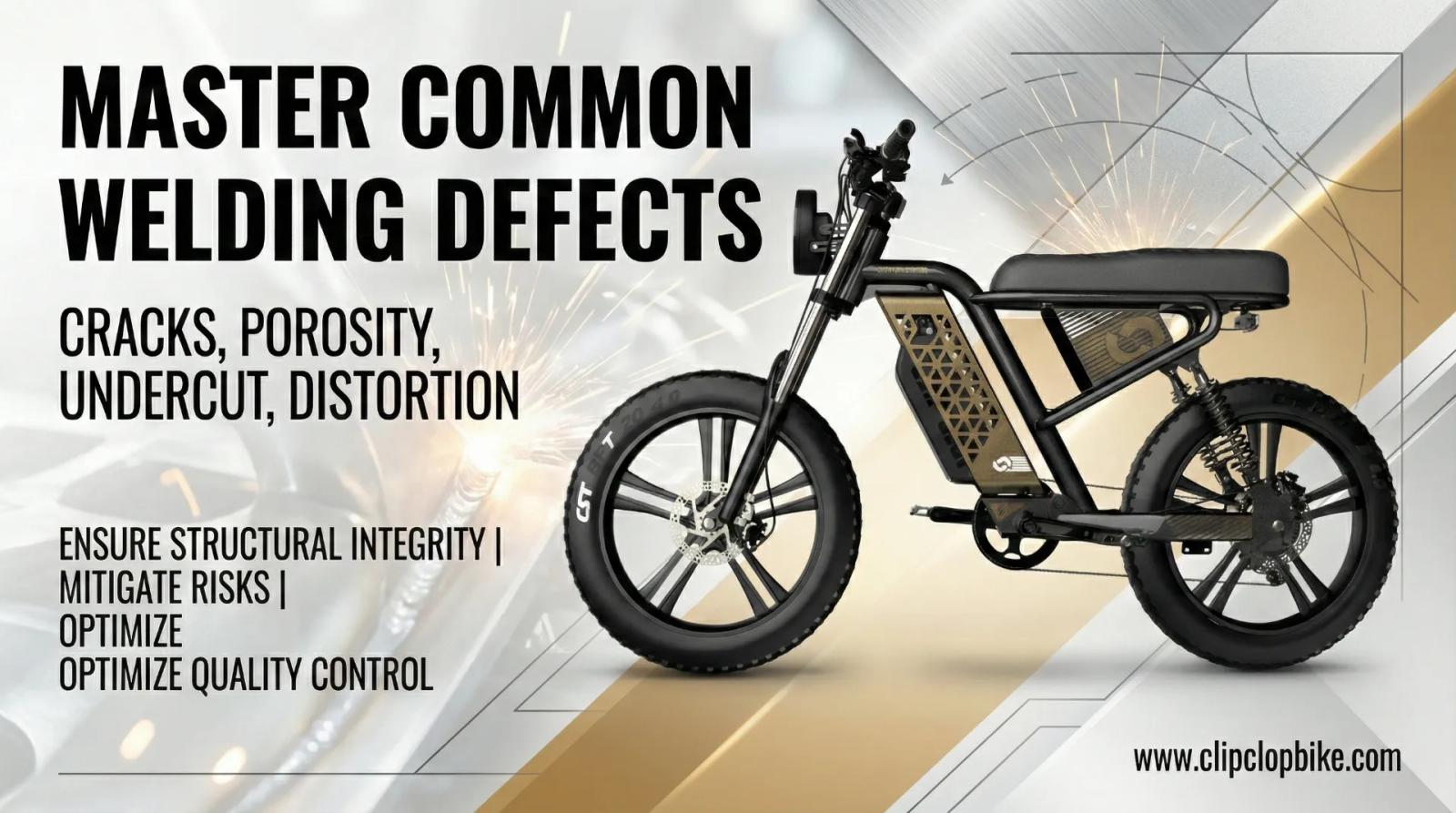
Master Common E-Bike Frame Welding Defects: Porosity, Undercuts, Hot Cracking & Factory AQL Inspection
Why welding defects matter for fleet safety and brand risk E-bikes load frames differently than non-electric bikes: more weight, more sustained torque, and more vibration over longer duty cycles.
Why welding defects matter for fleet safety and brand risk E-bikes load frames differently than non-electric bikes: more weight, more sustained torque, and more vibration over longer duty cycles.
E-Bike Frame Weld Integrity: Rejection Thresholds, Dye-Penetrant NDT & ISO 5817 Level B Standards
Factory Direct Sourcing & OEM/ODM Manufacturing with ClipClop
Commercial partners can inspect our manufacturing infrastructure on our OEM/ODM E-Bike Manufacturing Facility page, review standard configurations on our CS01 Fat Tire & CS04 Commercial Utility Platforms, or directly request volume FOB terms via our Commercial Quote Request Portal (MOQ 20).
In high-torque electric bicycles, weld seams are subjected to localized stresses 2.5 times greater than standard mechanical bicycles due to motor torque spikes and battery inertia. Welding defects such as internal porosity, root undercut, cold laps, and hot solidification cracking are the primary culprits behind catastrophic frame failures. For B2B importers, establishing clear incoming quality control (IQC) and acceptance quality limit (AQL 1.0) criteria protects against multi-million-dollar warranty recalls.
Factory QA Inspection Standard: Eliminating Weld Defects in Heavy-Duty E-Bike Frames
Structural Frame Quality Assurance: From Weld Bead Inspection to ISO 4210 Fatigue Tests
Commercial fleet buyers and international brand importers cannot afford weld fatigue failures in the field. ClipClop implements end-to-end quality assurance gates—including dye penetrant inspection (DPI), ultrasonic wall thickness verification, and automated 100,000-cycle dynamic fatigue testing before container loading.
At ClipClop's 25,000 m² factory in Qingyuan, our robotic TIG and MIG welding stations operate with pulsed shielding gas mixes (Ar+He) to minimize porosity. Every production lot undergoes non-destructive testing (NDT), including liquid dye-penetrant inspection on critical junctions (head tube, bottom bracket, and motor cradle) and periodic destructive micro-sectioning to verify throat thickness compliance with ISO 5817 Level B and EN 15194 fatigue benchmarks.
| Defect Category | Root Cause in Aluminum Welding | Rejection Threshold (ISO 5817) | Factory Prevention Measure | ClipClop Verification Protocol |
|---|---|---|---|---|
| Porosity & Gas Pockets | Hydrogen Absorption / Contaminated Rod | Max pore diameter > 1.5mm is REJECTED | Automated Pulsed Argon Shielding | X-Ray & Dye-Penetrant Lot Sampling |
| Root Undercut | Excessive Heat Input / Improper Gun Angle | Depth > 0.5mm is REJECTED | Robotic Seam Tracking Control | Optical Profile Micrometer Check |
| Hot Solidification Cracks | High HAZ Stress / Rapid Solidification | ANY Crack is CRITICAL REJECT (Zero Tolerance) | Optimized 5356 Filler Rod Chemistry | Ultrasonic NDT on Motor Mounts |
| Defect Category | Root Cause in Aluminum Welding | Rejection Threshold (ISO 5817) | Factory Prevention Measure | ClipClop Verification Protocol |
|---|---|---|---|---|
| Porosity & Gas Pockets | Hydrogen Absorption / Contaminated Rod | Max pore diameter > 1.5mm is REJECTED | Automated Pulsed Argon Shielding | X-Ray & Dye-Penetrant Lot Sampling |
| Root Undercut | Excessive Heat Input / Improper Gun Angle | Depth > 0.5mm is REJECTED | Robotic Seam Tracking Control | Optical Profile Micrometer Check |
| Hot Solidification Cracks | High HAZ Stress / Rapid Solidification | ANY Crack is CRITICAL REJECT (Zero Tolerance) | Optimized 5356 Filler Rod Chemistry | Ultrasonic NDT on Motor Mounts |
On 6061 aluminum, the trouble zone is often not the tube itself but the heat-affected zone (HAZ) beside the bead, where strength shifts after welding and cooling.
When you can identify defects by name, you stop arguing about opinions and start writing specs, inspection steps, and reject criteria that protect you legally and financially, upfront.
Cracks: the fastest path from “OK” to catastrophic
In aluminum frames, the most dangerous category is cracking, especially solidification (hot) cracking that forms as the weld metal freezes and shrinks.
Crack sensitivity rises when the weld chemistry lands in a risky range—often from high dilution or a filler wire choice that doesn’t match the joint design and heat treatment plan.
One repeat offender is the crater at the end of a bead: if the arc stops abruptly, the crater cools concave and can split into star-shaped cracks that later propagate under motor torque, fast.
Fixturing and fit-up can make cracking worse, not better; excessive restraint traps shrinkage stress, and big gaps force large weld volumes that pull harder as they cool down.
A good supplier will talk clearly about prevention: crater-fill routines, controlled ramp-down, tight miter tolerances, and a qualified Welding Procedure Specification (WPS) for your frame.
Porosity: hydrogen bubbles that steal fatigue life
Porosity means gas bubbles trapped in the solidified bead, and with aluminum the usual culprit is hydrogen, not “bad luck.”
Even when pores look small on the surface, hidden porosity reduces effective cross-section and creates micro stress concentrators, cutting fatigue life—the exact property fleets depend on.
Hydrogen shows up through moisture, oil, and the oxide layer; if tubes aren’t degreased and brushed before welding, the puddle absorbs hydrogen and then rejects it as it freezes.
Shielding gas problems add chaos: drafts from fans, incorrect flow, poor torch angle, or a clogged nozzle can suck air into the arc and contaminate the puddle in seconds, instantly.
If you see “worm tracks” or clustered pinholes, treat it as a process signal: tighten cleaning, gas coverage, and consumable storage.
Undercut: a small groove that creates a big notch effect
Undercut is a groove melted into the base metal at the weld toe (or root) that never gets filled, leaving a sharp transition right where stress wants to concentrate.
That notch effect matters because frames fail by fatigue: a rider doesn’t need a single huge impact—millions of smaller cycles at 25–55 km/h can start a crack from that groove.
The classic causes are too high current, too fast travel, or poor torch angle that doesn’t push the weld pool to wet out the edges before freezing properly and fully.
On thin 6061 tubes, even 0.3–0.5 mm undercut can remove a surprising fraction of wall thickness near head tube, bottom bracket, and chainstay joints where loads are highest.
A simple buyer test is tactile: run a fingernail across the toe; if it catches, you’ve found a geometry defect that deserves measurement and a clear acceptance limit in your contract too.
Distortion: when heat moves your frame out of tolerance
Distortion is the frame drifting out of shape because welding heats locally, expands material, and then shrinks unevenly as it cools.
Aluminum’s high thermal expansion makes it worse, so rear triangles can twist and cause rotor rub, wheel tracking issues, and misalignment at motor or crank interfaces, subtly over time.
Smart factories don’t “eliminate heat”; they manage it with jigs that hold geometry while allowing controlled relief, instead of over-clamping tubes and locking in stress.
Weld sequence is a quiet superpower: alternating sides, balancing bead length, and using back-step patterns can prevent the banana-shape effect that ruins alignment in production.
As a buyer, request alignment checks (or a sampling report) because a frame can look visually fine yet still fail assembly, ride feel, and long-term component wear later.
Standards that turn opinions into acceptance criteria
Most sourcing arguments happen because “good weld” is subjective, while defects are measurable if you anchor them to a standard.
ISO 10042 defines quality levels for arc-welded aluminum joints (B stringent, C intermediate, D moderate) and sets limits for imperfections like pores and undercut clearly.
ISO 6520-1 gives consistent terminology and defect classifications, which helps your inspection notes read like engineering documentation rather than complaints.
Frame safety is also performance-based: ISO 4210 testing connects weld quality to fatigue and impact outcomes, so you’re not buying pretty beads that fail in the field early.
If a supplier can’t explain which ISO level they target, how they measure it, and where they apply stricter rules (head tube, dropouts, motor mounts), reassess before ordering today.
Quick reference: a practical incoming-inspection cheat sheet
Use the checklist below to align your team, the factory, and any third-party inspector around the same language and expectations.
For first orders or new suppliers, sample more aggressively on critical joints—head tube cluster, dropout area, and bottom bracket—because those are where defects become serious direct liability.
Pair visual checks with one simple low-cost NDT step: dye penetrant (PT) sampling on high-stress joints catches tight cracks your eyes won’t reliably see.
Document everything with consistent photos: one close-up at the weld toe, one wider shot showing joint location, plus a simple pass/fail label per frame ID and date.
When you do reject, reference the defect type and standard level instead of emotions; it keeps the conversation professional and shortens rework loops.
| Defect | What it looks like | Typical root cause | Buyer-friendly check | Best prevention lever |
|---|---|---|---|---|
| Cracks | Hairlines at toe or crater | Filler/chemistry, restraint, poor crater-fill | PT sampling on critical joints | Qualified WPS + crater-fill practice |
| Porosity | Pinholes, “worm” tracks | Moisture/oxide, gas turbulence | Visual + reject “sponge” beads | Cleaning discipline + stable gas coverage |
| Undercut | Groove along weld edge | Too hot/fast, poor torch angle | Fingernail toe test + depth gauge | Parameter control + technique training |
| Distortion | Twist, rotor rub, off-line wheels | Unbalanced heat, weak fixtures | Alignment fixture report | Robust jigs + balanced weld sequence |
What to ask in a supplier audit (and what ClipClop does)
Start with process documents: request the WPS for each key joint, including filler type (often 4043 vs 5356 decisions), current/voltage ranges, gas flow, and travel speed.
Then ask for the Procedure Qualification Record (PQR), which is the evidence that the WPS was tested and achieved acceptable mechanical properties, not just written down, in practice and archived.
Verify people, not only equipment: welder qualifications (for example ISO 9606-2) and a training plan reduce variation when turnover happens or when robots need new operators overnight.
Ask about NDT culture and transparency: in-house PT capability, reject logs, and corrective actions tell you far more than “we never have defects” at scale, with data.
At ClipClop, we pair traceable materials, locked welding parameters, PT sampling on high-risk joints, and alignment checks so Model L1 frames ship straight and consistent at scale, reliably, consistently.
FAQ: Common Questions on E-Bike Frame Quality
Q1: How can I tell if a frame crack is just paint deep or structural? A: A "paint crack" usually flakes off and doesn't follow the weld bead pattern perfectly. A structural crack often runs along the weld toe or through the bead itself. To be sure, sand off the paint. If the line persists in the metal, it is structural. Use a dye penetrant kit for confirmation.
Q2: Is TIG welding always better than MIG welding for e-bike frames? A: Not necessarily. TIG allows for finer control and is often more aesthetic ("stack of dimes" look), making it great for high-end boutique frames. MIG is faster and, when automated (robotic MIG), can offer superior consistency and penetration for volume production like our Model L1. Process control matters more than the specific method.
Q3: Can a frame with porosity be repaired? A: Technically, yes, by grinding out the defect and re-welding. However, for heat-treated 6061 aluminum alloy, re-welding destroys the T6 temper in that area. Unless the entire frame is re-heat-treated (solutionized + aged), a repair often creates a weak spot. For production e-bikes, replacing the frame is usually safer than repairing it.
Q4: Why do some aluminum frames snap without warning? A: Aluminum has no "fatigue limit," meaning it will eventually fail if cycled enough. However, premature snapping is usually due to a pre-existing defect (like a micro-crack or undercut) acting as a stress riser, or improper heat treatment that left the metal brittle. This underscores the need for rigorous fatigue testing (ISO 4210).
Q5: What should I do if I find a batch of frames with welding defects? A: Immediately quarantine the batch. Document the defects with clear photos and reference ISO 6520 defect codes. Notify your supplier and demand a "Root Cause Analysis" (8D Report). Do not assemble or deploy these bikes until the risk is assessed. Contact ClipClop if you need a second opinion or a more reliable replacement supplier.
References:
- ISO (International Organization for Standardization) – ISO 10042: Arc-welded joints in aluminium and its alloys — Quality levels for imperfections. Available at: https://www.iso.org/standard/38226.html
- TWI Global – Defects in aluminum welding: porosity, cracking, and lack of fusion. Available at: https://www.twi-global.com/technical-knowledge/job-knowledge/defects-in-aluminium-fusion-welds-042
Inspect the build quality of our aerospace-welded frames on the ClipClop L1 Reinforced Hydroformed Chassis and our ClipClop CS04 Commercial Cargo Chassis, backed by a 5-year structural frame warranty.
- ScienceDirect – Fatigue behavior of welded aluminum alloys in bicycle frames. Available at: https://www.sciencedirect.com/topics/engineering/welded-joints
Commercial Procurement & Fleet Sourcing with ClipClop
Deploying electric bicycle fleets or distributing private-label e-bikes requires a trusted manufacturing partner capable of consistent container-level production, robot-welded frame alignment, and rigorous batch QC. From our 25,000 m² factory in Qingyuan, Guangdong, ClipClop provides end-to-end OEM/ODM electric bike manufacturing services with an accessible MOQ of just 20 units per SKU. Every container order includes dedicated spare parts allocation (2% free warranty backup components), full international compliance documentation (EN 15194, UL 2849, UN38.3), and 15-day sample dispatch.
Ready to evaluate engineering samples for the CS01 Fat Tire & CS04 Commercial Utility Platforms or review container FOB volume pricing? Visit our Commercial RFQ Portal to submit your technical specifications, or speak directly with our engineering sales team via our B2B contact desk.
More OEM field notes.
Commercial E-Bike Hydraulic Brakes: Heat Dissipation, 4-Piston Calipers & Mountain Fleets
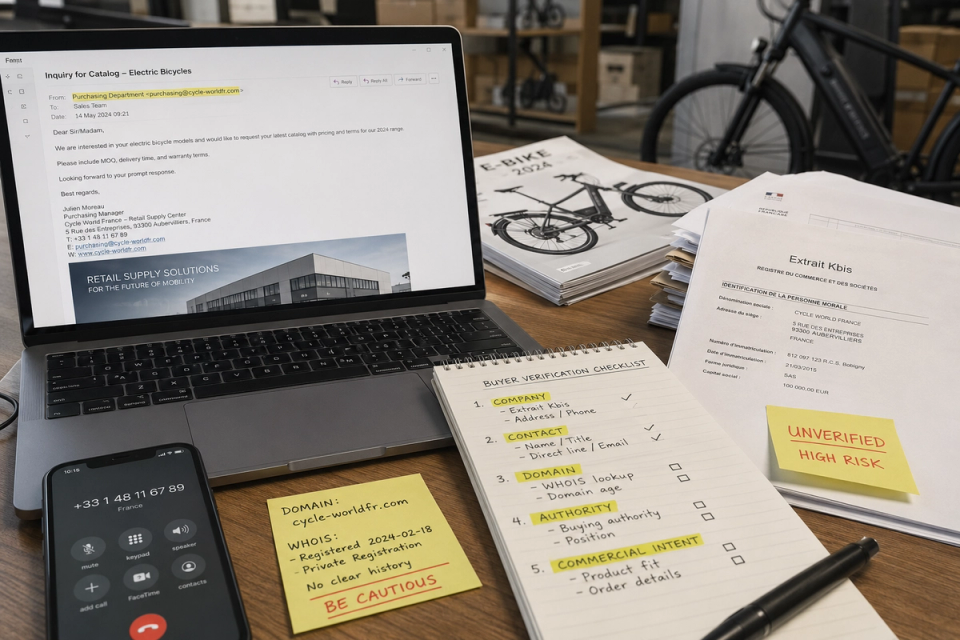
How We Verify B2B Buyers: A Case Study in Preventing Procurement Fraud & Impersonation
E-Bike Frame Sourcing for Brazil: Corrosion-Resistant 6061-T6 Aluminum for Tropical Fleets
Send your brief. We will field-note back.
Reply includes the feasibility view, sample cost, MOQ, and the next step for your project. We aim to respond within 48 hours.