
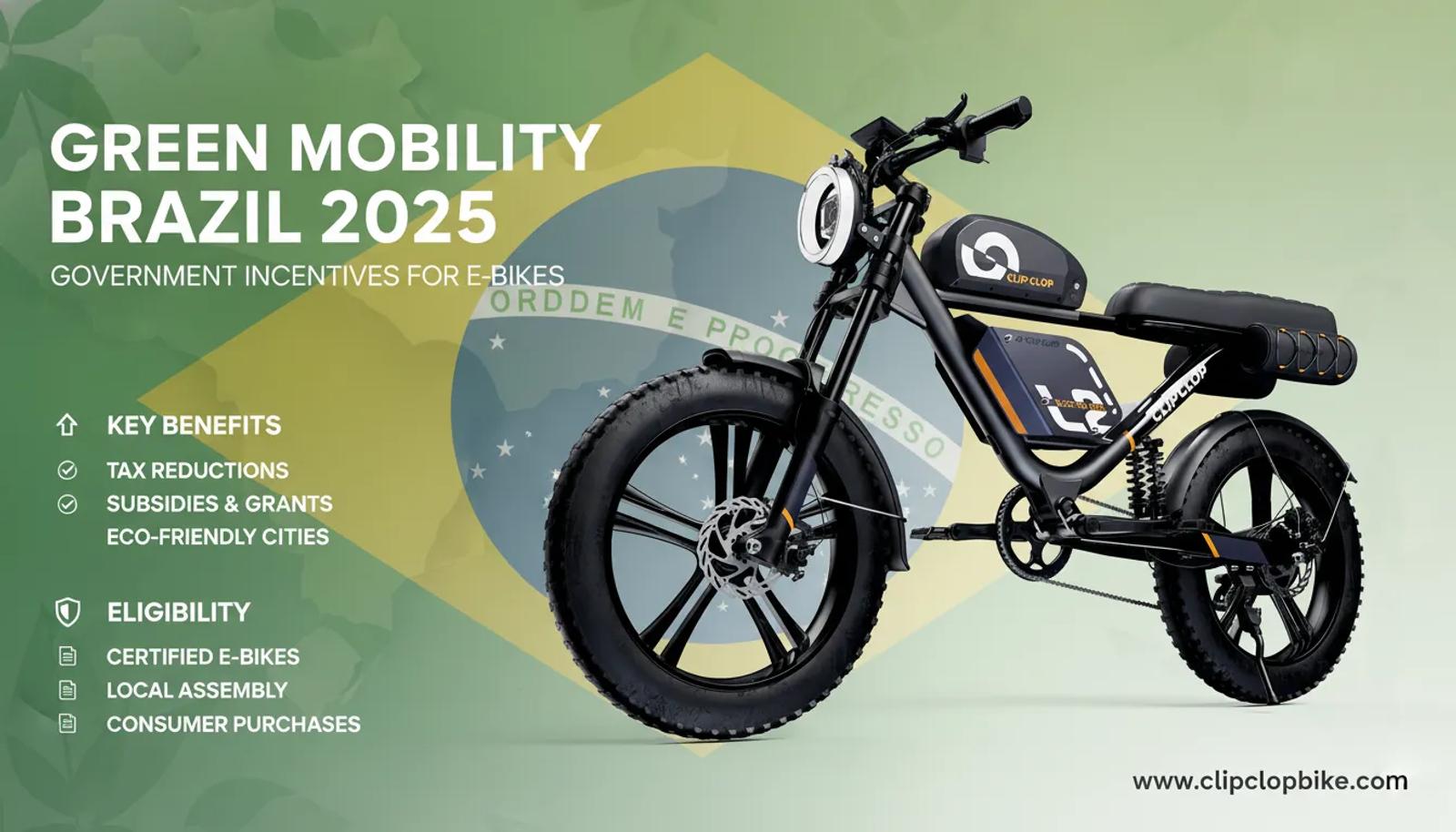
Importing E-Bikes to Brazil 2026: IPI Tax Reductions, Inmetro Rules & Manaus Assembly (SKD)
I’m Leo Liang, and I’ve basically lived inside the electric off-road bike world for the past decade. At ClipClop in Guangzhou, we don’t just ship containers; we build long-term plays with
I’m Leo Liang, and I’ve basically lived inside the electric off-road bike world for the past decade. At ClipClop in Guangzhou, we don’t just ship containers; we build long-term plays with
Navigating Brazil's E-Bike Regulatory & Tax Landscape: CONTRAN Resolution 996, IPI Reductions & SKD/CKD
Commercial partners can inspect our manufacturing infrastructure on our OEM/ODM E-Bike Manufacturing Facility page, review standard configurations on our CS01 Fat Tire & CS04 Commercial Utility Platforms, or directly request volume FOB terms via our Commercial Quote Request Portal (MOQ 20).
Entering the Brazilian electric mobility market requires overseas manufacturers and domestic distributors to master both CONTRAN Resolution 996 (distinguishing assist-only e-bikes from mopeds/autopropelidos) and the federal tax framework. Under Brazilian federal tax structures, importing completely built e-bikes (CBU) incurs import duties (II) up to 35%, along with IPI, ICMS, and PIS/COFINS cascading taxes. Importers sourcing completely assembled units face severe margin compression.
ClipClop assists Brazilian enterprise distributors by offering tariff-optimized Completely Knocked Down (CKD) and Semi-Knocked Down (SKD) container shipments designed to comply with local assembly incentives (including Manaus Free Trade Zone PPB frameworks). Every shipment is accompanied by technical dossiers certifying 350W–1000W speed limiters (capped at 32 km/h without throttle, or 25 km/h with throttle) in strict compliance with CONTRAN 996 standards.
| Import & Assembly Pathway | Import Duty (II) Rate | CONTRAN 996 Classification | Local Value-Add | B2B Margin Impact |
|---|---|---|---|---|
| ClipClop SKD/CKD Container | Reduced (8%–14%) | Bicicleta Elétrica Homologada | Local Assembly in Brazil / Manaus | Sustainable Profit (>40% Margin) |
| CBU Finished E-Bike Import | Max Duty (35% + Cascading) | Subject to Inmetro / Port Hold | None (Direct Retail Box) | Margin Crushed (<15% Margin) |
| Frame & Mechanical Kit Only | Lowest Component Duty | Non-Motorized Rolling Chassis | Motor & Battery Sourced Locally | Flexible Local Drivetrain Pairing |
Download the 2026 ClipClop Factory Catalog (PDF)
Full e-bike specs, motor & battery options, MOQ, and container loading details.
Why Brazil Is Turning Into an E-Mobility Hotspot
From my seat, talking to partners across Europe, North America, and Latin America, Brazil stands out right now. The country isn’t just “testing” green mobility; it’s putting down long-term markers. There are targets for emissions, pressure from cities, and a public that’s honestly tired of sitting in traffic for hours every day.
Most forecasts I track show the Brazilian e-bike market growing with a CAGR north of 15% in the coming years. That’s not some pumped-up slide deck number; you feel it in the questions people ask and the projects they’re planning. More people in cities, more cars on the road, and more awareness around pollution all push in the same direction.
What’s interesting is that Brazil still doesn’t have one big national “e-bike law” with a giant red sticker on it. Instead, you get this patchwork of measures that, together, create a pretty friendly environment. Big cities are pouring money into bike lanes, cycling corridors, and non-motorized transport plans. Every new lane is basically an extra invitation for someone to ditch a car or a motorcycle.
For us in B2B, that means the target group is not just hip urban riders. It’s commuters, couriers, grocery delivery fleets, and small businesses that just need a cheaper, more predictable way to move around. A couple of mobility bloggers I follow keep saying: “Follow the congestion and you’ll find demand.” Brazil’s São Paulo and Rio are textbook examples of that.
On top of the local pain points, you’ve got a national story taking shape. Programs like the “Fuel of the Future” act and Brazil’s pledge to cut emissions by 50% by 2030 send a very strong signal to investors and operators. When a government repeats the same green narrative over and over, that’s your hint the policy direction isn’t going to flip overnight.
Breaking Down the MOVER Program Without the Jargon
Whenever someone asks me, “Okay Leo, what is Brazil really doing for green mobility at the B2B level?” I end up talking about the MOVER Program. The full name is Programa Nacional de Mobilidade Verde e Inovação, launched in 2024. Think of it as the backbone of Brazil’s long-term clean transport strategy.
At first glance, MOVER looks like a program built almost exclusively for cars, buses, and big vehicles. A lot of people glance at the official documents and go, “Looks cool, but nothing to do with my e-bike fleet.” Honestly, that’s a mistake. The program’s core priorities—energy efficiency, local production, and stricter environmental standards—create a kind of “green halo” around all electric mobility.
For international e-bike makers and Brazilian distributors, the biggest value of MOVER is the mindset shift it unlocks. It tells factories, banks, and consumers that electric power is not some niche experiment; it’s the new normal. Once people get comfortable with EVs on a big scale, it’s much easier for them to accept e-bikes as a practical daily tool, not just a weekend toy.
The focus on R&D-linked tax credits is also important. It pushes companies to invest in better batteries, smarter controllers, and more efficient motors. Even if the incentives are targeted at bigger vehicle platforms, a lot of that tech ends up improving e-bike components too. Some engineering blogs I read keep hammering this point: “Follow the R&D money, that’s where the innovation spills over.”
The other big lesson from MOVER is structural. It rewards businesses that put money, people, and tech into Brazil itself. So if your B2B model includes local assembly, after-sales service, and real collaboration with Brazilian partners, you’re playing very close to the government’s long-term vision. That alignment doesn’t always mean cash in your hand today—but it does open doors later.
Making Sense of Tariffs and Tax Credits (Without Losing Your Mind)
Let’s talk about the part that usually gives everyone a headache: import tariffs. When my partners ask, “Leo, what’s the biggest risk of entering Brazil?” I rarely start with marketing or competition. I start with duty rates and product configuration. If you misread those, your pricing gets wrecked before your first shipment lands.
Brazil has been using tariffs as a steering wheel to push the market from import-heavy to more local production. For a while, electric vehicles got very low or zero tariffs to kickstart adoption. That initial honeymoon is ending. The plan now is to gradually ramp up tariffs on fully assembled vehicles, heading towards about 35% by 2026–2027 in some cases.
For fully built e-bikes, that trend is a warning sign. If you keep shipping only complete units, you may find your price point drifting out of reach for a lot of B2B buyers. That’s why at ClipClop, we spend a lot of time with partners checking HS codes, kit formats, and how to structure products. It’s not glamorous work, but it saves real money and stress.
The government has been fairly clear with its signals: CKD (Completely Knocked Down) and SKD (Semi-Knocked Down) kits can enjoy lower tariffs or special temporary quotas. That’s basically a polite note saying, “Hey, bring your components in, and build more here.” So instead of sending a finished bike, we ship high-quality cores—like our 6061 Aluminum Alloy Frame and 48V 750W brushless motor—and let the final assembly happen locally.
Set up correctly, this approach cuts your tariff bill, helps you meet local industrial goals, and gives you more flexibility on customization. A couple of trade bloggers I respect keep advising: “Don’t fight the tariff trend. Design your supply chain around it.” Brazil is a textbook example of where that mindset really pays off.
Strategic Import Comparison: Fully Built Units vs. Local Assembly Kits
| Feature / Consideration | Strategy 1: Importing Fully Built Units (FBU) | Strategy 2: Importing CKD/SKD Kits for Local Assembly |
| Import Tariffs | High and progressively increasing (planned to reach 35% by 2026-2027). | Significantly lower tariff rates, designed to incentivize local industry. |
| Overall Cost-Effectiveness | Becomes less profitable over time as tariffs rise, risking market competitiveness. | Highly cost-effective, reducing tariff burden and lowering final product cost. |
| Alignment with Brazilian Policy | Misaligned with the government's long-term goal of fostering domestic production. | Perfectly aligned with national industrial strategy (e.g., MOVER program principles). |
| Supply Chain & Logistics | Simpler initial logistics but less efficient container space utilization. Higher risk of shipping damage to finished products. | More complex initial setup requiring a local partner, but optimizes shipping density and lowers freight costs per unit. |
| Market Adaptability | Low. Product specifications are fixed before shipping, offering little room for local customization. | High. Allows for agile adjustments, local component sourcing, and tailored configurations for specific B2B client needs. |
| Long-Term Viability | A short-term, high-risk strategy vulnerable to future policy changes and increasing costs. | A sustainable, future-proof strategy that builds a local presence and strengthens market position. |
| Bottom Line for B2B | Your business absorbs rising costs, squeezing margins and potentially losing to more agile competitors. | Your business gains a significant competitive advantage through lower costs, policy alignment, and market flexibility. |
The Power of IPI Exemptions and Other Tax Perks
Tariffs are only half of the equation. The other half is taxes, which can either kill your margin or quietly boost it—depending on how well you play the game. One of the most important federal incentives is the IPI (Tax on Industrialized Products) exemption for electric vehicles. When your product qualifies, it directly helps lower the final selling price.
In B2B, that price flexibility is gold. A few percentage points off can be the difference between winning a fleet deal and losing it to a cheaper, lower-quality competitor. And if you combine that IPI relief with smarter import structures like CKD/SKD operations, you’re stacking advantages instead of fighting uphill all the time.
On top of federal rules, each state can play with its own ICMS (basically a state-level VAT). Some states offer reductions or exemptions for electric mobility, but the details change from region to region. This is where local accountants and tax consultants are worth their weight in lithium cells. Getting the product classification right can unlock savings that many foreign entrants don’t even know exist.
To be honest, this part is not “plug and play”. It’s paperwork, calls, and sometimes a bit of creative problem solving. But this is exactly where you can turn bureaucracy into a competitive edge. While others complain that “Brazil is too complicated”, you can quietly build a structure that protects your margins and gives your partners more room to price aggressively.
So… Are There Direct E-Bike Rebates in Brazil?
This is the question I probably get most in WhatsApp groups and Zoom calls: “Leo, can my buyers get a direct voucher or rebate when they purchase an e-bike, like in Europe?” Short answer: not in a simple, nationwide way—at least not yet. Brazil’s approach is more systemic and less “here’s a coupon at the cash register” as of 2025.
That doesn’t mean there’s no money on the table. It just means the incentives are more targeted and often tied to specific sectors or local programs. For example, cities like São Paulo are heavily pushing e-buses and electrified public transport. That same pro-electric mindset usually spills over into support for cycling infrastructure and related pilots.
Some municipalities are starting to experiment with benefits for companies using e-bikes for last-mile delivery or other logistics. The support may not always be labeled as “e-bike subsidies”. Instead, it shows up as tax advantages for green logistics, grants for sustainability projects, or better access to public tenders if you run a low-emission fleet.
If you’re selling into B2B channels—delivery platforms, corporate mobility programs, tourism operators—this is huge. Your end customers might be able to plug into local funding, even if there’s no big federal voucher scheme. A few Brazilian mobility bloggers keep repeating the same advice: “Watch your city hall, not just Brasília, if you want to spot real opportunities.”
The catch is that these programs are often fragmented and not always well-publicized. That’s why having a strong local partner matters so much. They can spot a new delivery pilot in a mid-size city or a green grant in an industrial zone while you’re asleep in another time zone. You can’t automate that with a spreadsheet; you need relationships.
Turning Policy Into a Real B2B Business Model
Knowing the rules is great, but it doesn’t automatically turn into revenue. The real work is connecting policy trends with business models that actually sell bikes and services. When we support ClipClop partners in Brazil, we try to start with one question: “Which national or city-level goal does your offer help achieve?”
Right now, two of the biggest pain points are urban congestion and emissions. That’s why last-mile delivery and urban logistics are such strong bets. A tough, reliable e-bike fleet that replaces scooters or small vans can be a clear win: lower fuel costs, easier parking, and a better public image. You’re not just selling bikes; you’re helping your customers tick ESG boxes and cut operating expenses at the same time.
Corporate mobility is another interesting angle. More companies want to encourage staff to commute in a cleaner, healthier way. They talk about wellness, carbon footprints, and employee perks. Offering fleet leasing, salary-sacrifice plans, or simple pool-bike programs puts you right at the center of that trend. Even though an official “mileage allowance for cyclists” is still not mainstream in Brazil, it’s a logical next step.
Some HR and sustainability bloggers are already pushing this idea: “Pay people to ride, not just to park.” If you’re in early and you can offer a turnkey solution—bikes, maintenance, maybe software—you’ll be ahead of the curve when those policies become more common. Being slightly early is where the best B2B margins usually live.
Tourism is the third big piece. Brazil’s natural and cultural attractions are world-class, and tourists love experiences that feel eco-friendly but still convenient. For rental businesses in Rio, Florianópolis, or the historic towns of Minas Gerais, a strong e-bike fleet is a way to stand out without reinventing their entire business. They just upgrade the “how” of local exploration.
In that rental context, your product has to take abuse and keep rolling. That’s where bikes like our Model L2 come in, with features like a Shimano 7-speed derailleur and hydraulic disc brakes. High uptime and low maintenance cost are more important than fancy marketing names. Fleet operators care about downtime and repair bills, not spec sheets alone.
Picking the Right E-Bike Specs for Brazilian Terrain
Let me be blunt: if your bikes can’t handle Brazilian roads, policy incentives won’t save you. I’ve seen containers arrive with products that look great in a catalog but crumble under real usage. Brazil’s mix of smooth avenues, broken pavement, cobblestones, and steep hills can expose weak design very quickly.
That’s why we obsess over core components. We stick with a 6061 Aluminum Alloy Frame for a reason. It hits that sweet spot: strong, relatively light, and corrosion-resistant. For coastal cities where sea air is a daily reality, that corrosion resistance is not optional—it’s survival. A lot of frame failures I hear about in the market are simply from cutting corners here.
Power is another non-negotiable. On paper, a lower wattage motor might look “efficient”, but put it on the hills of Belo Horizonte or Salvador with cargo on the rack and you quickly see the problem. Our Model L2 runs a 48V 750W brushless motor delivering about 70Nm of torque, and that’s the level that actually makes riders smile instead of curse on steep climbs.
Some tech bloggers love to talk only in numbers, but I always tell partners to ask a simpler question: “Can this bike climb a hill, with a heavy rider plus cargo, without drama?” If the answer is no, it doesn’t matter how cute the UI on the display looks. Riders in Brazil need genuine pulling power, not marketing fluff.
Tire choice is where comfort meets practicality. We use 20"*4.0 fat tires on this platform because they smooth out rough surfaces, handle curbs and mixed terrain better, and give riders a sense of stability.[no ref in original, but keep idea] For a courier hopping between bike lanes and side streets, that extra grip and cushioning reduces fatigue and crashes.
Brakes are another area where I refuse to compromise. Hydraulic disc brakes simply perform better than mechanical ones, especially in wet or dirty conditions. In chaotic city traffic, stopping power is not a luxury. Pair that with a max load capacity of around 160kg/350lbs, and you get a bike that fits real life: heavy riders, cargo, child seats, you name it.
Local Infrastructure and Manufacturing: Your Hidden Force Multipliers
E-mobility doesn’t grow in a vacuum. It grows where people can ride safely and where products can be built or assembled efficiently. Brazil is slowly but steadily moving in that direction. You can see it in the kilometers of new bike lanes, the integrated bike-sharing systems, and the way cities are redesigning some streets to favor lighter vehicles.
Every new piece of cycling infrastructure basically widens your potential user base. People who were scared to ride on car-heavy avenues suddenly feel comfortable trying an e-bike. For B2B, that means higher utilization for fleets, more repeat rentals, and happier corporate users. A lot of urban-planning blogs keep showing the same pattern: as infrastructure improves, cycling mode share rises.
On the manufacturing side, the tariff strategy we talked about earlier is pushing brands toward local assembly. Instead of fighting that, I recommend leaning into it. A solid Brazilian assembly partner can become one of your biggest assets. They help you navigate regulations, improve lead times, and fine-tune configurations for local tastes and needs.
At ClipClop, we see ourselves as a component and technology provider as much as a finished-bike supplier. We ship the precision-engineered bits—frames, motors, controllers, batteries—and our partners handle local assembly and distribution. This split model fits nicely with Brazil’s industrial goals and sends a clear message: we’re not just dipping in and out of the market.
For large corporate and government clients, that local presence matters a lot. It shows commitment, helps with service-level agreements, and often makes them more comfortable signing bigger or longer contracts. You can talk about “partnership” all day, but having a local assembly line and service network proves it better than any PowerPoint slide.
How to Actually Capitalize on Brazil’s Green Shift
We’ve covered a lot—MOVER, tariffs, incentives, infrastructure, and specs. So what do you actually do with all this as a dealer, distributor, or rental operator? Let me give you a simple three-step way I like to think about it when planning with partners.
First, choose your main battlefield: last-mile logistics, corporate mobility, tourism, or a smart mix of two. Don’t try to be everything to everyone from day one. Pick the segment that lines up best with what the government wants—less congestion, fewer emissions, more efficient urban movement—and build your story around that.
Second, design your supply chain for Brazil, not for a generic “global market”. That probably means using CKD or SKD kits, partnering locally, and taking advantage of tariff structures and IPI exemptions. A couple of trade bloggers say this a lot: “Localize your supply chain or prepare to donate your margin to taxes.” It sounds harsh, but they’re not wrong.
Third, lead with reliability and total cost of ownership. In a young market, trust is everything. Your customers want to know that the bikes won’t die after a year of hard use and that parts and service will be available. This is where solid specs—6061 Aluminum Alloy Frame, 750W motor, hydraulic disc brakes, high load capacity—turn from marketing bullets into real-world proof.
If you line up those three pieces—market focus, localized supply chain, and durable product—you’re not just reacting to Brazil’s green transition. You’re riding the wave in a controlled way. And honestly, that’s when the business becomes fun: when incentives and reality work in the same direction instead of pulling you apart.
Ready to Talk About Your Brazil Play?
Navigating Brazil’s e-bike landscape can feel messy from the outside: laws changing, tariffs shifting, different rules in every state. But with the right structure and partners, it stops being a maze and starts looking like a pretty clear growth path. That’s the part of the job I enjoy most—helping partners connect the dots between policy and product.
At ClipClop, we’re not just a factory stamping frames. We design and manufacture electric off-road bikes and fleets for global B2B use, and we’ve built our export process around working with dealers, wholesalers, and brand owners who need reliable support from concept to after-sales. Brazil is one of the markets where this approach really shines.
If you’re trying to figure out which e-bike models to bring in, how to configure a fleet for delivery or tourism, or how to structure an OEM project that fits Brazilian incentives, I’m happy to dig into the details with you. Tell me your budget, your target customers, and your timeline, and we can map out something that actually works on the ground.
Reach out, and let’s sketch your Brazil plan together. The green mobility wave is already moving—this is a good moment to paddle in, not watch from the beach.
Frequently Asked Questions (FAQ)
Q1: What is the most significant B2B policy for electric bikes in Brazil for 2025?
The most significant policy framework is a combination of the MOVER Program, which promotes overall green mobility investment, and the strategic use of import tariffs. For B2B, the key is leveraging the lower tariffs on SKD/CKD (semi-knocked-down/completely-knocked-down) kits to facilitate local assembly, which is being heavily encouraged over importing fully built units.
Q2: Are there any direct electric bike subsidies for businesses to purchase fleets?
Currently, there are no nationwide, direct electric bike subsidies for fleet purchases. However, incentives are emerging at the state and municipal levels, often in the form of tax breaks, grants for sustainable logistics, or as part of specific urban mobility projects. Businesses should research local subsidy programs in their target cities.
Q3: How do the new import tax credits affect the cost of importing e-bikes to Brazil?
The main federal tax credit is the exemption from the IPI (Tax on Industrialized Products) for electric vehicles. This significantly lowers the tax burden. However, this is counterbalanced by rising import tariffs on fully assembled bikes. The most cost-effective strategy is to import components for local assembly to benefit from both the IPI exemption and lower import duties on kits.
Q4: What kind of sustainable transport incentive is most beneficial for a rental or delivery company?
For rental or delivery companies, the most beneficial sustainable transport incentive is often indirect. The government's investment in dedicated cycling infrastructure (bike lanes) makes operations safer and more efficient. Additionally, these companies may be eligible for local green business grants or favorable terms on public contracts, positioning them as key partners in achieving municipal sustainability goals.
Q5: Is there any form of employer mileage allowance for using e-bikes for commuting?
The concept of a formal employer mileage allowance for e-bike commuting is not yet a widespread, government-mandated policy in Brazil. However, it is a growing trend in corporate wellness and sustainability programs. B2B suppliers can promote this by offering fleet solutions to companies that want to pioneer such incentives for their employees.
References
- Latam Mobility: "Electromobility Law in Brazil: Federal, State and Municipal Progress" - Provides insight into the legislative bills and multi-level governance shaping EV policy.
- U.S. International Trade Administration: "Brazil - Automotive Industry" - Offers official perspectives on Brazil's automotive sector, including policies like the MOVER program.
ClipClop Manufacturing Standards & Build Quality
Looking for verified B2B e-bike manufacturing? Check out our ClipClop L1 All-Terrain Fat Bike and our ClipClop CS04 Commercial Cargo Bike, backed by factory-direct warranties and flexible 10-unit MOQ.
- IMARC Group: "Brazil E-bike Market Size, Trends and Analysis" - A market research report detailing growth drivers, market size, and key trends in the Brazilian e-bike sector.
Commercial Procurement & Fleet Sourcing with ClipClop
Deploying electric bicycle fleets or distributing private-label e-bikes requires a trusted manufacturing partner capable of consistent container-level production, robot-welded frame alignment, and rigorous batch QC. From our 25,000 m² factory in Qingyuan, Guangdong, ClipClop provides end-to-end OEM/ODM electric bike manufacturing services with an accessible MOQ of just 20 units per SKU. Every container order includes dedicated spare parts allocation (2% free warranty backup components), full international compliance documentation (EN 15194, UL 2849, UN38.3), and 15-day sample dispatch.
Ready to evaluate engineering samples for the CS01 Fat Tire & CS04 Commercial Utility Platforms or review container FOB volume pricing? Visit our Commercial RFQ Portal to submit your technical specifications, or speak directly with our engineering sales team via our B2B contact desk.
Download the 2026 ClipClop Factory Catalog (PDF)
Full e-bike specs, motor & battery options, MOQ, and container loading details.
More OEM field notes.
Global E-Bike Market Segmentation 2026: Commuter, Cargo & eMTB Product Strategy for Importers
US E-Bike Technology Trends 2026: IoT Fleet Telematics, Smart BMS & Automatic Shifting
Cargo E-Bikes vs Delivery Vans: Commercial Fleet Total Cost of Ownership (TCO) Analysis
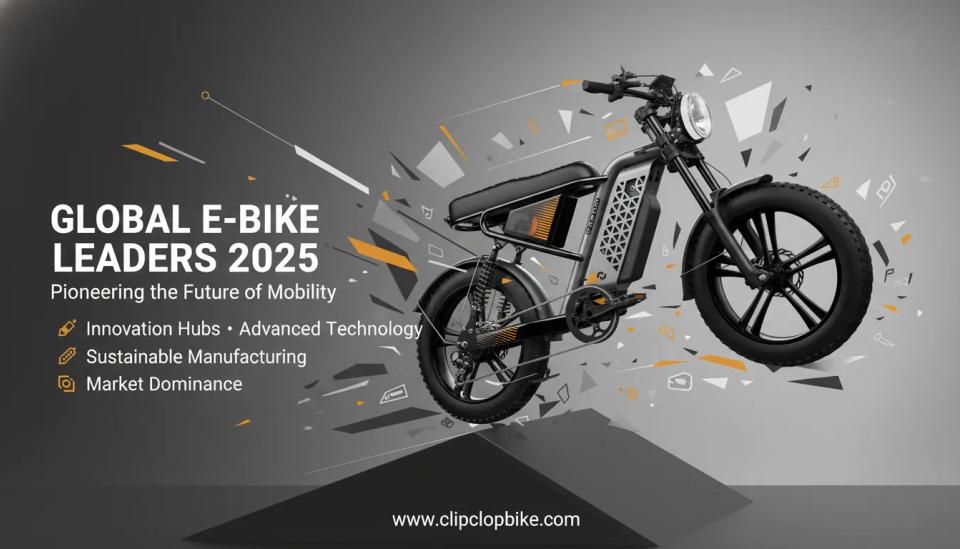
World's Top E-Bike Manufacturers 2026: B2B OEM/ODM Comparison, Factory Capacity & Tooling Lead Times
Send your brief. We will field-note back.
Reply includes the feasibility view, sample cost, MOQ, and the next step for your project. We aim to respond within 48 hours.