

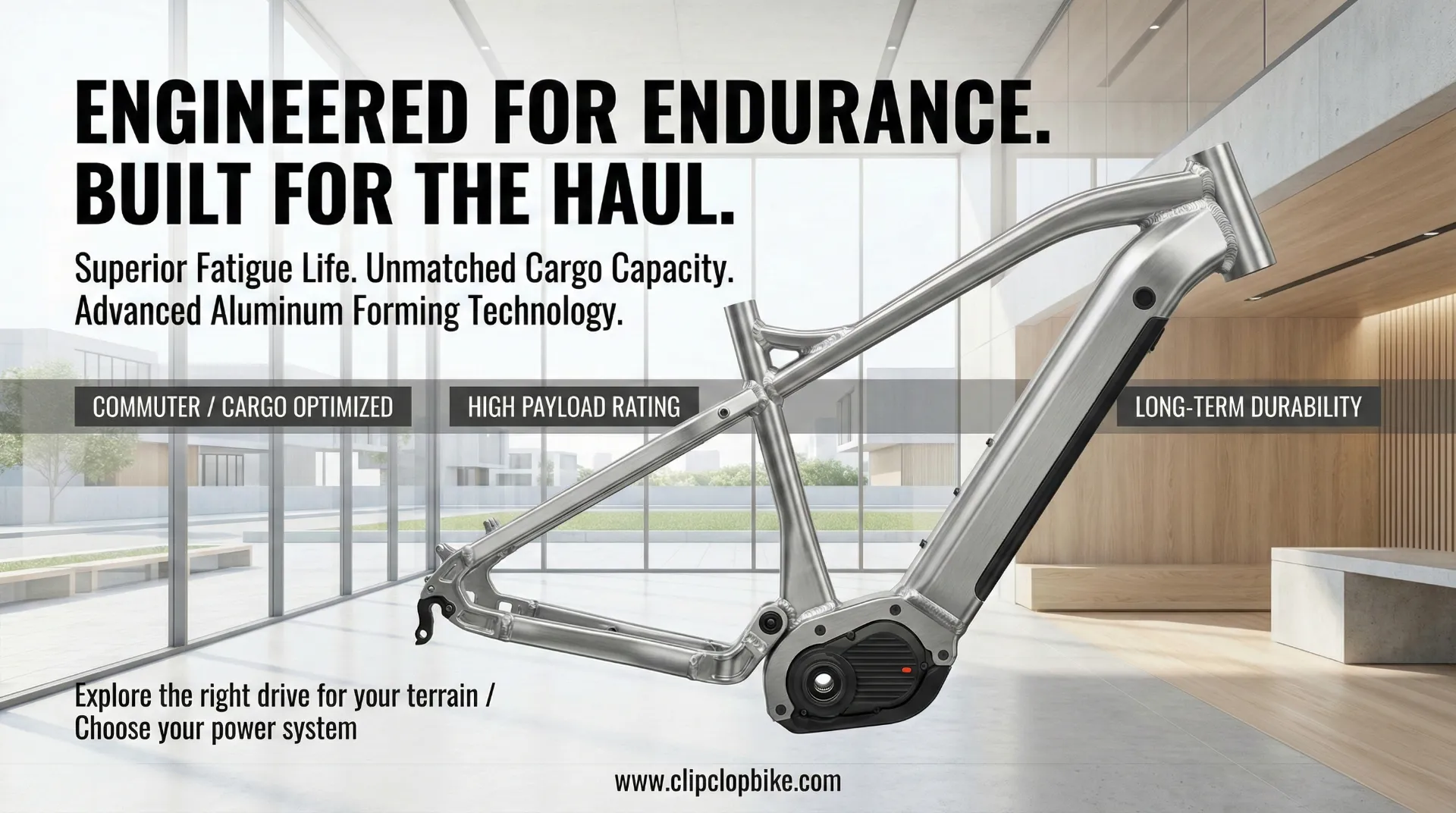
Micro-mobility is growing fast, but fleets pay a different price than weekend riders. For B2B buyers, the frame isn’t “just the skeleton”. It’s the thing that protects your reputation when bikes run all day. If a frame cracks, you’re not only paying for parts—you’re losing uptime and sometimes dealing with real liability in demanding markets (Latin America, Southeast Asia, coastal cities, etc.).
When I say fatigue life, I mean how many stress cycles a frame can take before tiny cracks become a failure. Aluminum (like 6061-T6) doesn’t have a true fatigue limit the way steel does, so every pothole, curb, vibration, and overloaded rack is spending that lifespan. That’s why I care about material science and structural design: tube shapes, weld zones, reinforcement, and how the load travels through the frame.
At ClipClop, our MODEL L2 uses a 20-inch 6061 aluminum frame and we design it around real abuse, not showroom photos. And I keep repeating one boring phrase because it saves fleets: system weight (rider + cargo + bike). A “150 kg rating” means nothing if it ignores the 25–30 kg bike plus daily impacts. Hydroforming helps because it lets us thicken metal only where stress is nasty (head tube, bottom bracket, rack mounts) instead of making the whole frame heavy.
What load rating is realistic in Latin American conditions?
In Latin America, road reality usually forces you to de-rate whatever the spec sheet says. I split load into rider weight, cargo weight, and total system weight, then I assume rough pavement, speed bumps, and potholes are normal. A simple rule that works in practice: cut the “static” rating by about 20% to cover dynamic impacts. So a bike marketed at 150 kg on smooth asphalt might behave like it’s safe closer to 120 kg system weight on rough routes.
Static vs dynamic is where cheap builds fail. Hit a deep pothole at 30–35 km/h and the instantaneous force at the dropout or seat cluster can jump to 2–3× the static load. That’s why I tell partners to ask for a stated Max Permissible Total Weight, and to check that the fork and 20×4.0 tires are rated to absorb shock. Add climate on top—humidity and salt spray can damage coatings, and once the finish is compromised, fatigue cracks start faster.
Buffer example: 80 kg rider + 30 kg cargo + 25–30 kg bike = around 135–140 kg system weight. For rough cities, I’d rather buy a frame tested around 170 kg static than gamble on a “150 kg” sticker.
Fatigue life: commuter frames vs cargo frames
Commuter frames usually see lots of small bumps (high frequency, low amplitude). Cargo/delivery frames see heavier loads, more start-stop torque, and more twisting from uneven cargo. One overloaded delivery run can create stress similar to days of normal commuting, especially at the welds. So no, a cargo bike is not “a commuter bike with a rack”.
On commuters, the head tube area often becomes the hotspot because braking and steering repeat constantly. Cargo bikes shift the pain to the bottom bracket/motor area and the rear triangle because of torque and load. For fleets, I watch duty cycle: how many full-load accelerations and hard brakes happen daily. If the motor cradle and BB zone aren’t reinforced, fatigue life collapses early, even if the bike passes basic lab tests.
Aluminum will eventually fail if you cycle it enough. The practical goal is to keep working stress well below yield strength and reduce peak stress at joints. Hydroformed tubes, integrated gussets, and high torsional stiffness help.
Alloys and heat treatments that last
Alloy choice matters, but heat treatment is what makes or breaks the frame. 6061-T6 is popular for a reason: it balances weldability, corrosion resistance, and strength. Some factories push 7005 or 6069 for higher numbers, but that comes with higher cost and tighter process control. For most fleet programs, a well-engineered 6061-T6 frame is still the value “sweet spot”.
The critical weak area is the HAZ (heat affected zone) around welds. Welding softens aluminum locally. If a factory skips proper post-weld heat treatment, frames fail at welds long before tubes wear out. So I tell buyers to verify the full process: solution treatment (often referred to as the T4 stage) and then aging back to T6. If a supplier can’t show documentation of ovens, quench control, and aging cycles, that’s a procurement red flag.
Also, don’t get hypnotized by tensile strength. Fatigue strength and toughness keep fleets rolling. Ultra-high strength alloys like 7075 are rarely used for welded frames because weldability and brittleness get ugly fast.
Motor torque and battery weight: the hidden fatigue multipliers
E-bikes add stress that classic bikes didn’t. High-output motors (750W–1000W) can put 80–100 Nm into the frame path, and that torque hits in sharper pulses than human pedaling. Over time, those pulses create cracks near motor mounts, bottom brackets, and dropouts if the structure isn’t built for it.
Battery weight is sneakier. A 48V pack can add about 4–5 kg, often high on the down tube, which increases inertia over bumps. The frame has to “catch” that mass every time the bike hits an obstacle. On L2 designs, we reinforce the battery cradle and the down tube/head tube junction for exactly this reason.
Motor placement changes where you should look for trouble. Mid-drives punish the BB shell. Hub motors punish rear dropouts and seatstay junctions. Without thick dropout plates, torque arms, and decent weld quality, a hub motor can slowly deform the dropout slots or start cracking. More power needs more structure—you can’t just swap motors and hope.
What test evidence should buyers demand?
Certificates help, but minimum standards don’t always match fleet reality. I prefer fatigue test reports that show forces (Newtons), cycle counts, and setups—especially vertical fatigue and horizontal fatigue. For cargo models, add asymmetric loading tests because cargo is rarely balanced in real life.
I also recommend verifying materials: ask for mill certificates for the alloy chemistry. For big orders, it’s reasonable to request random weld inspections (X-ray or ultrasound sampling) on high-risk joints like the head tube. And if you sell near the ocean, ask for salt spray results on coatings; corrosion pits are classic crack starters. If a supplier can share an FEA report from design, even better.
Common fatigue failure points on aluminum e-bike frames
In the field, the head tube/down tube junction is the classic crack zone because it eats front impacts and fork leverage. The seat tube/top tube area (especially step-through frames) is another frequent one because the seat tube acts like a lever. We brace it and we enforce minimum seatpost insertion depth so loads don’t concentrate at the top.
Then you’ve got rack mounts. Lots of “lifestyle” frames use tiny welded bosses that can tear out under vibrating cargo. For real cargo work, mounts should tie into forged eyelets or integrated structures near the dropout. Bottom bracket/motor areas and rear dropouts are next, especially with higher power—thickened dropouts plus torque washers are boring parts that save frames.
Quick tip from a frame-inspection blogger I follow: flip the bike and look at the welds you don’t see in marketing photos.
Design choices that extend fatigue life under heavy cargo
For fleets, I focus on reducing stress risers. Hydroforming creates variable cross-sections: wider near joints for weld area, optimized shapes in the spans for bending resistance. Integrated gussets formed into the tube are better than welded patch plates (patches add more weld lines, and every weld line is a future risk).
I also like forged or CNC-machined parts at stress points like dropouts and motor cradles. Forging aligns grain flow and usually handles fatigue better than cheap casting. And finishing matters: good powder coat or anodizing protects the surface, and surface damage is where cracks like to start.
That’s the whole message: treat frame durability as a system—geometry, metallurgy, welding, testing, and road assumptions—so your fleet earns money instead of living in the repair shop.
FAQ & Extended Knowledge
Q1: Is a 6061-T6 aluminum frame strong enough for a 150kg delivery rider? Yes, but only if the wall thickness and weld quality are optimized. For high-weight riders, we recommend a hydroformed ebike frame which allows for thicker “butted” ends at the joints. Our MODEL L2 is specifically tested for these loads.
Q2: How do I know if my supplier is using real 6061-T6? Always ask for a Material Spectrum Analysis and a Hardness Test Report (HRB/HB). A genuine T6 treated 6061 frame should have a specific hardness range. If it’s too soft, the fatigue life will be dangerously short.
Q3: Can a cracked aluminum frame be repaired? In a B2B or fleet context, no. While you can technically re-weld aluminum, it destroys the heat treatment (T6). The frame would need to be stripped and put back into an aging oven, which is not cost-effective. Replacement is the only safe option.
Q4: Does the 20*4.0 fat tire help with frame life? Absolutely. The high air volume of 20*4.0 tires acts as a primary suspension system, absorbing 30-40% of high-frequency road vibrations before they reach the aluminum alloy frame, significantly extending its fatigue life.
Q5: What is the benefit of a “Step-Through” frame for B2B? It improves rider safety and efficiency for last-mile delivery, but it requires a hydroforming bicycle frame with a “double-tube” or “reinforced down-tube” to compensate for the lack of a top tube and prevent “frame wag.”
References:



 English
  Spanish
  Portuguese
  Russian
  Arabic
  French
  Dutch
Dutch  German
  Danish
